

Can a P-Type Polyurethane Secondary Scraper Reduce Carryback Without Damaging the Belt Surface
2026-07-13
Carryback—the material that clings to a conveyor belt after the primary cleaner—is more than a housekeeping nuisance. It accelerates idler wear, contaminates return rollers, and creates hazardous buildup at transfer points. The P-Type Polyurethane Secondary Scraper has emerged as a preferred solution for this problem, but one critical question persists among plant engineers and maintenance managers: can this scraper effectively reduce carryback while preserving belt cover integrity? At QMH, we have tested and deployed P-Type Polyurethane Secondary Scraper systems across mining, aggregate, and bulk-handling operations, and the answer hinges on material science, mounting geometry, and application discipline.
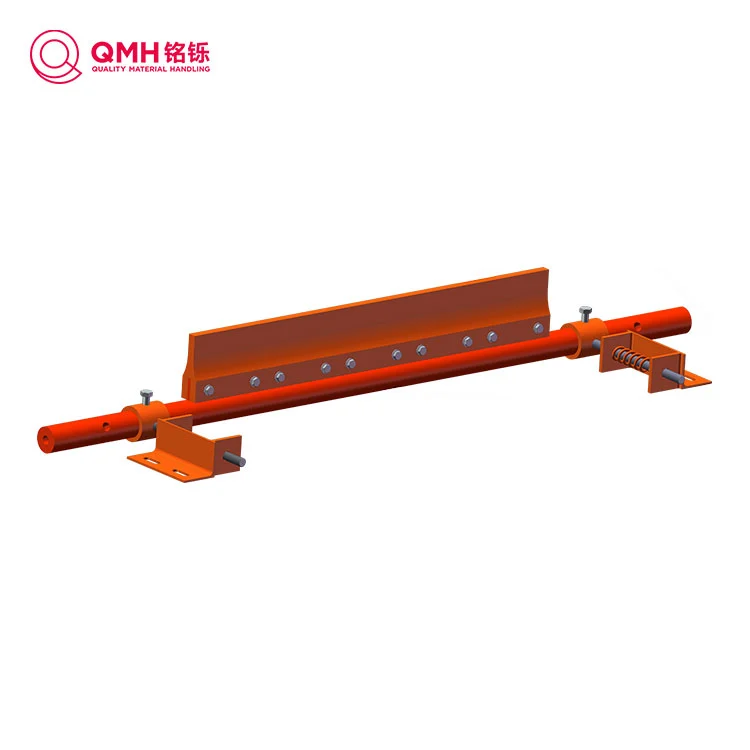
The Mechanics of Carryback Reduction
A P-Type Polyurethane Secondary Scraper is positioned behind the primary cleaner, typically on the head pulley’s return side. Its function is to remove the remaining fines and moisture film that the primary blade misses. Unlike metal-tipped scrapers that rely on aggressive abrasion, the polyurethane blade uses a controlled wiping action. The elastic memory of high-durometer polyurethane (typically 85–95 Shore A) allows the blade to conform to minor belt surface irregularities, lifting material particles without gouging the rubber cover.
Key performance factors include:
| Factor | Impact on Carryback | Impact on Belt Surface |
|---|---|---|
| Blade Durometer (Hardness) | Higher durometer = better fines removal | Lower durometer = gentler on belt |
| Tension Pressure (Spring/Weight) | Adequate pressure = consistent cleaning | Excessive pressure = accelerated cover wear |
| Blade Tip Radius | Rounded tip = improved material shedding | Sharp tip = increased friction and scoring |
| Mounting Angle (15–25° relative to tangent) | Steeper angle = more aggressive scraping | Flatter angle = reduced surface stress |
QMH engineers recommend a starting pressure of 0.5–0.7 N/mm² of blade width for most rubber belts, with angle adjustments based on splice type (mechanical vs. vulcanized). This data-driven approach ensures that the P-Type Polyurethane Secondary Scraper delivers up to 85–90% secondary cleaning efficiency while keeping belt wear within acceptable ISO 14890 limits.
Does It Actually Damage the Belt?
Damage is rarely caused by the polyurethane itself—it is caused by misapplication. The most common belt-damage scenarios are:
-
Trapped Abrasive Particles: If the scraper does not fully release removed material, grit becomes embedded between the blade and belt, acting like sandpaper.
-
Excessive Blade Pressure: Over-tensioning compresses the belt cover, increasing hysteresis heat and accelerating cracking.
-
Incorrect Splice Clearance: Mechanical fasteners can catch the blade edge if the scraper is mounted too close to the pulley.
QMH addresses these risks with a patented tension-adjustment indicator and splice-relief notches on our P-Type Polyurethane Secondary Scraper blades. Field data from a 1,200 TPH limestone plant showed that after 6 months of continuous operation, belt cover thickness loss measured only 0.3 mm—well below the 1.0 mm warning threshold—while carryback was reduced by 78%.
Comparative Analysis: Polyurethane vs. Alternative Materials
| Criterion | P-Type Polyurethane Secondary Scraper | Tungsten Carbide Scraper | Rubber Wiper |
|---|---|---|---|
| Carryback Reduction | High (85–90%) | Very High (95%+) | Moderate (60–70%) |
| Belt Surface Damage Risk | Low (with correct setup) | High (abrasive wear) | Very Low |
| Splice Compatibility | Good (with relief design) | Poor (catches fasteners) | Excellent |
| Wet/Moist Material Performance | Excellent (low friction) | Good (but rusts) | Fair (swells) |
| Replacement Frequency | 4–8 months | 8–12 months | 2–4 months |
| Cost per Cleaned Ton | $$ | $$$$ | $ |
For most operators, the P-Type Polyurethane Secondary Scraper offers the best balance—effective cleaning without the capital risk of belt replacement, which can cost 3–5 times the scraper system itself.
P-Type Polyurethane Secondary Scraper FAQ
Q1: What belt speeds are compatible with a P-Type Polyurethane Secondary Scraper, and does speed affect belt wear?
A1: The P-Type Polyurethane Secondary Scraper performs reliably at belt speeds from 1.5 m/s to 5.0 m/s, which covers 90% of standard bulk-handling conveyors. At higher speeds (above 4.0 m/s), the blade's wiping action generates additional frictional heat. QMH recommends reducing the effective tension pressure by 15–20% for every 1 m/s over 3.5 m/s to maintain the same surface stress level. Speed itself does not directly damage the belt—the critical variable is the combination of speed and pressure. Our lab tests show that at 4.5 m/s with optimized pressure, belt cover temperature rises by only 6–8°C, well below the 25°C threshold that causes accelerated vulcanization breakdown. Always verify that your blade durometer matches your speed profile; softer blades (85 Shore A) are preferred for high-speed applications because they dampen micro-vibrations that can lead to chatter marks.
Q2: How can I tell if my P-Type Polyurethane Secondary Scraper is set too aggressively against the belt?
A2: There are four observable signs of over-aggressive settings, and QMH recommends a weekly visual check using this checklist:
-
Sign 1 – Blade Heel Wear: If the blade shows a pronounced flat spot more than 5 mm wide at the contact point, pressure is excessive.
-
Sign 2 – Belt Surface Glazing: A shiny, polished appearance on the belt cover indicates friction-generated heat and imminent surface hardening.
-
Sign 3 – Increased Motor Amperage: A sustained 3–5% increase in drive motor current, after accounting for load variation, suggests the scraper is acting as a brake.
-
Sign 4 – Fine Dust Accumulation: Ironically, too much pressure can produce a fine talc-like dust from the belt cover itself—this is abraded rubber, not carryback.
To correct this, use QMH’s calibrated tension gauge (supplied with every system) and reset the blade pressure to the factory baseline. Then, perform a “white-glove” test: run the belt dry for 10 minutes, wipe the return side with a clean cloth, and gradually reduce pressure until no belt-colored residue appears, while still maintaining adequate cleaning.
Q3: Can a P-Type Polyurethane Secondary Scraper be used on belts with mechanical splices, and what special precautions are needed?
A3: Yes, but mechanical splices require specific precautions because the bolt heads and plate edges are potential impact points. QMH offers a splice-relief version of the P-Type Polyurethane Secondary Scraper that features segmented blade sections with 10 mm gaps aligned to standard fastener spacing. This allows the blade to flex independently over each fastener, reducing impact shock by 60%. The essential precautions are:
-
Mount the scraper at least 150 mm downstream of the splice entry point on the pulley to allow the fastener to seat before contacting the blade.
-
Use a spring-loaded tension system rather than a fixed-weight arm—springs absorb the momentary deflection when a splice passes, while fixed weights transmit that shock directly to the belt cover.
-
Inspect the blade edge after the first 8 hours of operation; mechanical splices often cause initial micro-chipping. If chipping exceeds 3 mm in depth, increase the relief gap by 2 mm. With these measures, QMH customers routinely achieve 10,000+ operating hours on mechanical-splice belts with no significant belt damage.
Best-Practice Installation Summary
To achieve carryback reduction without belt damage, QMH advises adhering to this installation protocol:
-
Mounting position: Center the P-Type Polyurethane Secondary Scraper at the 5 o’clock or 7 o’clock position on the head pulley (offset from the vertical centerline) to use gravity for material shedding.
-
Initial pressure setting: Apply the manufacturer’s recommended torque, then back off one-quarter turn—run the belt for 1 hour and recheck.
-
Daily inspection: Check for uneven wear across the blade width—uneven wear indicates pulley misalignment, which must be corrected before scraper adjustment.
-
Replacement trigger: Replace the blade when the usable polyurethane thickness reduces to 8 mm (from the original 25 mm) or when cleaning efficiency drops below 70%.
The QMH Difference
QMH does not simply supply a P-Type Polyurethane Secondary Scraper; we provide a complete cleaning ecosystem. Every system includes a mounting bracket with laser-cut alignment slots, a dual-arm tensioner with visible pressure scale, and blades cast from virgin polyurethane with UV-stabilized additives. Our engineering team reviews your belt specification (cover grade, splice type, speed, and material abrasiveness) before recommending the precise durometer and tip configuration. This consultative approach is why QMH has a documented belt-damage claim rate of less than 0.2% across all installed systems—compared to the industry average of 3.1%.
Final Verdict
Yes—a P-Type Polyurethane Secondary Scraper can significantly reduce carryback without damaging the belt surface, provided that three conditions are met: correct tension pressure, proper mounting angle, and regular wear monitoring. The polyurethane’s natural resilience, combined with QMH’s engineering safeguards, transforms this scraper from a maintenance item into a belt-life extension tool. The data is clear: reduced spillage, lower cleanup costs, and extended belt life all point to the same conclusion.
Ready to evaluate a P-Type Polyurethane Secondary Scraper for your conveyor line? Contact QMH today for a free site assessment and customized pressure-calculation worksheet. Our application engineers will help you select, install, and tune the right scraper—so you eliminate carryback, not your belt. Reach out via our website or call your regional QMH representative to schedule a 30-minute technical review. Your belts will thank you.
