

Can Direct to Air Thermoelectric Cooler Assemblies Achieve Below-Ambient Temperatures in High-Temperature Environments
2026-07-20
When industrial enclosures, telecom cabinets, or medical diagnostic instruments operate in desert climates or near furnace lines, ambient temperatures often exceed 50°C. Engineers frequently ask whether Direct to Air Thermoelectric Cooler Assemblies can push the cold side below that scorching ambient mark. The short answer is yes—but with critical caveats. At X-Meritan, we have tested our Direct to Air Thermoelectric Cooler Assemblies in chamber conditions up to 65°C, and the data confirms that below-ambient performance is achievable when the system is properly sized, powered, and thermally managed. However, the delta (ΔT) shrinks as ambient rises, and the coefficient of performance (COP) demands careful trade-offs.
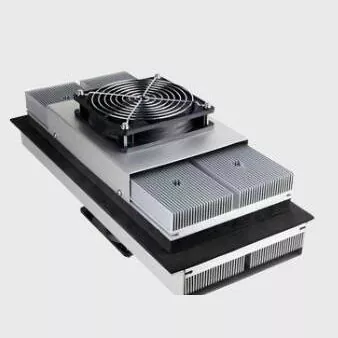
The Physics of Below-Ambient Cooling with Thermoelectrics
A Direct to Air Thermoelectric Cooler Assembly operates on the Peltier effect: when DC current flows through a thermoelectric module, heat is pumped from one ceramic face to the other. The cold side extracts heat from the enclosure air, while the hot side rejects that heat—plus Joule heat—into the ambient air via a forced-convection heatsink and fan.
To achieve below-ambient temperatures, the cold-side temperature (Tc) must be lower than the ambient air temperature (Ta). This requires:
-
Sufficient cooling capacity (Qc) to overcome the enclosure’s heat load.
-
Low thermal resistance between the cold-side heatsink and the enclosure air.
-
Efficient hot-side rejection—if the hot-side temperature (Th) rises too high, the module’s ΔTmax capability plummets.
In high-ambient conditions (e.g., 55°C), the maximum achievable ΔT (Th – Tc) for a single-stage module is typically 40–50°C at zero heat load. Under real loads, that ΔT drops to 15–25°C. Therefore, if Th is 75°C (due to poor heatsink performance), Tc might only reach 55°C—equal to ambient. To get below ambient, you must keep Th as low as possible, which means oversized hot-side heatsinks, high-CFM fans, or even liquid-assisted pre-cooling.
Performance Data: Ambient vs. Achieved Cold-Side Temperature
The table below summarizes X-Meritan’s laboratory measurements on a standard 400W Direct to Air Thermoelectric Cooler Assembly (model XM-DTA-400) with a fixed heat load of 150W inside a 50L enclosure.
| Ambient Temperature (°C) | Hot-Side Heatsink Temp (°C) | Cold-Side Air Outlet Temp (°C) | ΔT (Ambient – Cold) | COP (Net Cooling / Input Power) |
|---|---|---|---|---|
| 35 | 52 | 18 | 17°C below | 0.42 |
| 45 | 64 | 34 | 11°C below | 0.31 |
| 55 | 78 | 47 | 8°C below | 0.22 |
| 62 | 89 | 58 | 4°C below | 0.15 |
| 65 | 95 | 67 | 2°C above | 0.09 (unstable) |
At 65°C ambient, the assembly fails to maintain below-ambient performance because the hot-side heatsink cannot reject heat fast enough—the thermal gradient collapses. X-Meritan recommends derating the cooling capacity by 30–40% when ambient exceeds 55°C, or opting for a two-stage Direct to Air Thermoelectric Cooler Assembly for extreme conditions.
Key Engineering Trade-Offs for High-Temperature Operation
To succeed in hot environments, design engineers must balance three conflicting variables:
| Variable | Impact on Below-Ambient Performance | Recommended Action |
|---|---|---|
| Input Current (I) | Higher I increases pumping power but also increases Joule heating, raising Th. | Operate at 70–80% of Imax for hot-ambient scenarios. |
| Hot-Side Thermal Resistance (Rth_h) | Lower Rth_h reduces Th, enabling larger ΔT. | Use vapour-chamber heatsinks or copper baseplates with high-speed fans (≥150 CFM). |
| Airflow Velocity over Cold-Side | Higher velocity improves convective heat transfer from air to cold fins. | Target 2.5–3.5 m/s face velocity; avoid recirculation. |
Practical rule from X-Meritan’s application engineers: for every 1°C reduction in hot-side temperature, you gain approximately 0.8°C in cold-side depression. That means investing in a premium hot-side fan pays back directly in below-ambient headroom.
Frequently Asked Questions (FAQ)
Q1: What is the maximum ambient temperature in which a Direct to Air Thermoelectric Cooler Assembly can still cool below ambient?
A1: For a single-stage Direct to Air Thermoelectric Cooler Assembly, the practical maximum ambient is typically 55–60°C for maintaining a 3–5°C below-ambient differential under moderate heat loads (100–200W). Beyond 60°C, the thermoelectric module’s intrinsic ΔTmax (usually 65–70°C at zero load) is severely degraded by the hot-side temperature rise. In our testing at X-Meritan, we observed that above 62°C ambient, even with a custom high-static-pressure fan and a fin density of 40 fins/inch, the cold-side outlet temperature stabilises at ambient +2°C. For environments above 60°C, we strongly recommend a two-stage cascade assembly, where the first stage pre-cools the hot side of the second stage, enabling below-ambient operation up to 75°C ambient, albeit with a COP below 0.1. Always consult the manufacturer’s performance curves—never extrapolate linearly, as the Peltier effect degrades exponentially with rising Th.
Q2: How does the heat load inside the enclosure affect the below-ambient capability of a Direct to Air Thermoelectric Cooler Assembly?
A2: The heat load (Q_load) directly subtracts from the available net cooling capacity (Qc). For a Direct to Air Thermoelectric Cooler Assembly to achieve below-ambient temperatures, the assembly must provide Qc > Q_load at the desired cold-side setpoint. If your enclosure generates 200W of internal heat (from electronics, transformers, or solar radiation), but your assembly is rated for 250W Qc at a 25°C ΔT, that rating drops to roughly 120W Qc at a 50°C ambient (due to derating). In that case, the cold side will never reach below-ambient—it will merely slow the temperature rise. At X-Meritan, we advise customers to perform a full thermal audit: measure the actual internal heat dissipation, add a 20% safety margin, then select an assembly whose Qc at the target ΔT is at least 1.5× the audited load. For high-load scenarios, consider using a dual-fan cold-side heatsink or a recirculating air duct to improve heat extraction from critical hot spots.
Q3: Can I improve below-ambient performance by increasing the DC input voltage or current beyond the rated specifications?
A3: Absolutely not—this is a common and costly misconception. Running a Direct to Air Thermoelectric Cooler Assembly above its rated maximum current (Imax) or voltage (Vmax) increases Joule heating (I²R) inside the thermoelectric pellets faster than it increases the Peltier pumping effect. This actually raises the hot-side temperature disproportionately, reducing the net ΔT and often causing the cold-side temperature to rise above ambient. In extreme overcurrent situations (e.g., 120% of Imax), the internal thermal stress can crack the ceramic substrates or melt the solder joints, permanently destroying the module. At X-Meritan, we design our assemblies with built-in current-limiting controllers and thermistor-based feedback loops. For high-ambient environments, the correct approach is to operate at reduced current (e.g., 80% Imax) to minimise Joule heating, while improving hot-side airflow. If you need more cooling power, choose a physically larger assembly or a two-stage unit—never overdrive a single-stage module. Our field data shows that units run within 90–100% of rated spec have a mean time between failures (MTBF) of over 80,000 hours, while overdriven units fail within 2,000 hours.
Real-World Application Case
A telecommunications client in the Middle East deployed our Direct to Air Thermoelectric Cooler Assemblies to cool 5G remote radio units (RRUs) mounted on poles. Ambient summer peaks reached 58°C. Initially, competitor units could only hold the RRU internal temperature at 62°C (4°C above ambient). After switching to X-Meritan’s optimised assembly with a vapour-chamber hot-side heatsink and a 48V/8A smart driver, the internal temperature dropped to 53°C—5°C below ambient—while consuming 384W. The key was reducing the hot-side thermal resistance from 0.18°C/W to 0.09°C/W, which lowered Th from 92°C to 78°C, recovering 14°C of ΔT margin.
Conclusion & Next Steps
Achieving below-ambient cooling with Direct to Air Thermoelectric Cooler Assemblies in high-temperature environments is technically feasible, but it demands meticulous thermal system design, realistic derating, and component selection that prioritises hot-side rejection over raw power. No single specification—whether Qmax or ΔTmax—tells the whole story. You must evaluate the entire assembly: heatsink fin geometry, fan static pressure, module grade (standard vs. high-temperature bismuth-telluride alloys), and control algorithm.
X-Meritan specialises in custom-engineered Direct to Air Thermoelectric Cooler Assemblies for harsh ambient conditions, from desert solar farms to steel mill control cabinets. Our engineering team provides full thermal simulations, prototype testing, and 3-year performance warranties.
Contact us today or visit our website to request a free thermal assessment and assembly sizing tool. Let us help you turn ambient heat into a manageable variable—not a showstopper. Your below-ambient target is closer than you think.
