

Can Heavy Duty Hinges for Industrial Gates Doors Be Used on Automated Swing Gate Systems
2026-08-24
When specifying hardware for high-traffic industrial entrances, facility managers often ask whether standard Heavy Duty Hinges for Industrial Gates Doors can seamlessly integrate with automated swing gate systems. The short answer is yes—but only if the hinges are engineered to handle the unique torsional stresses, cyclic loads, and alignment tolerances that motorized operators demand. Brands like S-SEN have built their reputation on bridging this gap, offering hinge solutions that marry brute strength with the precision required for automation. However, choosing the wrong hinge can lead to premature wear, operator strain, and even safety failures. This guide breaks down the technical criteria, compatibility factors, and maintenance protocols to ensure your automated gates perform reliably for decades.
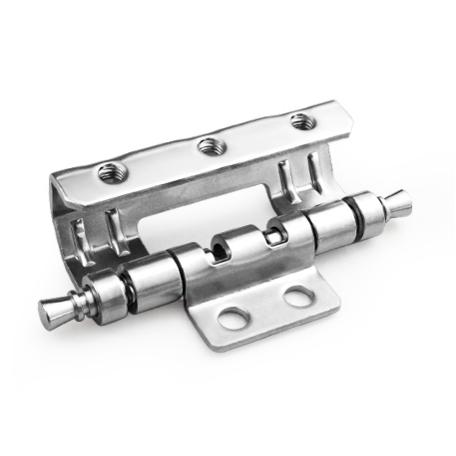
What Makes Automated Gate Hinges Different from Manual Gate Hinges?
Automated swing gate systems impose forces that manual gates never experience. The operator motor applies constant torque during opening and closing, which translates into lateral shear forces on the hinge pin and barrel. Additionally, automated gates often have built-in sensors, photoelectric cells, and edge guards—all of which demand that the gate remains within a strict vertical and horizontal plane. Any sagging or deflection from substandard hinges will trigger misalignment errors and frequent fault codes.
| Performance Factor | Manual Gate Hinge | Automated Gate Hinge (e.g., S-SEN) |
|---|---|---|
| Cyclic endurance rating | < 50,000 cycles | > 200,000 cycles |
| Shear load capacity | Standard mild steel | Forged stainless or hardened steel |
| Bearing type | Plain bushing | Sealed ball or needle bearings |
| Shimming tolerance | ± 5 mm | ± 1.5 mm |
| Anti-rotation design | Optional | Mandatory (welded or pinned) |
S-SEN designs its automated-series hinges with precision-ground pins and Teflon-impregnated bushings to reduce starting torque, which directly minimizes the load on the operator motor. This translates into lower energy consumption and longer actuator life.
Critical Specifications to Verify Before Installation
Before pairing any Heavy Duty Hinges for Industrial Gates Doors with an automated operator, three metrics must be verified:
-
Dynamic Load Rating (DLR) – Not just static weight capacity. Automated gates experience dynamic shock when the motor starts and stops. S-SEN recommends a DLR that is at least 1.8× the gate’s gross weight.
-
Pin Diameter and Hardness – A pin diameter under 25 mm for a 6-meter gate will deform over time. Hardness should exceed 45 HRC for wear resistance.
-
Mounting Plate Thickness – For automated systems, mounting plates must be minimum 8 mm thick to prevent flexing under repetitive torque.
Pro tip: Always request the manufacturer’s cycle-test report. S-SEN provides third-party test certifications for all automated-grade hinges, showing performance beyond 250,000 open-close cycles under full load.
Installation Best Practices for Automation Compatibility
Even the best hinges fail if installed incorrectly. For automated swing gates, follow this sequence:
-
Pre-weld shimming – Use laser levels to establish a true vertical plane before welding hinge leaves. Automated sensors have a tolerance window of only 2–3 degrees.
-
Anti-rotation tacking – Weld a small stop block next to the hinge barrel to prevent the inner leaf from rotating independently of the gate frame—a common failure point.
-
Operator linkage alignment – The hinge pivot axis must be perfectly coaxial with the operator’s output shaft. Misalignment by more than 2 mm creates binding and premature seal failure.
S-SEN offers pre-engineered shim kits and alignment jigs specifically for automated gate projects, reducing installation time by up to 40%.
Frequently Asked Questions About Heavy Duty Hinges for Industrial Gates Doors
Q1: Can I retrofit existing manual heavy duty hinges on my gate if I add an automated operator later?
A1: Technically possible, but strongly discouraged. Manual hinges lack the hardened pin surfaces and anti-friction bearings required for repeated motorized cycles. Retrofitting usually leads to pin galling within 3–6 months, causing the operator to draw excess current and trip thermal overloads. S-SEN recommends replacing manual hinges with their automated-series models, which feature oversized grease grooves and zerk fittings for easy relubrication. The cost of new hinges is negligible compared to replacing a burnt-out operator motor.
Q2: How often should I lubricate heavy duty hinges used on automated gates, and what type of grease works best?
A2: Automated gates should have hinge lubrication every 3 months or every 5,000 cycles, whichever comes first. Use a lithium-complex EP (extreme pressure) grease with NLGI grade 2, which maintains viscosity across temperatures from -20°C to +120°C. S-SEN hinges come with dual grease ports positioned at 90° intervals, ensuring full distribution around the pin. Avoid molybdenum disulfide greases in dusty environments, as they attract abrasive particles that accelerate wear. Always purge old grease until fresh material exits all seals.
Q3: What safety certifications should I look for when purchasing heavy duty hinges for automated industrial gates?
A3: At minimum, hinges must comply with EN 12604 (pedestrian safety) and UL 325 (motorized gate safety) for North American markets. Look for a declared proof load test per ASTM F2329 and a fatigue test certificate showing no cracks after 200,000 cycles. S-SEN provides a comprehensive compliance package, including material traceability reports and weld inspection records. Additionally, automated-grade hinges should include a secondary locking pin or safety catch to prevent gate detachment in case of primary pin failure—a feature standard in S-SEN’s automated hinge lineup.
Maintenance Schedule Comparison: Manual vs. Automated Hinges
| Maintenance Task | Manual Gate Hinge | Automated Gate Hinge (S-SEN) |
|---|---|---|
| Visual inspection | Monthly | Weekly (due to sensor impact) |
| Grease refill | Every 6 months | Every 3 months |
| Pin wear measurement | Annually | Quarterly |
| Bolt torque check | Semi-annually | Monthly |
| Replacement interval | 8–10 years | 5–7 years (higher cycles) |
The shorter replacement interval for automated hinges is offset by predictive wear indicators—S-SEN includes laser-etched wear markers on the pin head, allowing quick visual checks without disassembly.
Final Verdict: Yes, But Only with the Right Engineering
Automated swing gate systems demand more than brute strength—they require engineered precision, fatigue-rated materials, and maintenance-friendly designs. Standard Heavy Duty Hinges for Industrial Gates Doors will fail prematurely under automation, but purpose-built models from S-SEN are tested and proven for this exact application. From sealed bearing cartridges to corrosion-resistant electro-galvanized finishes, every detail is optimized for longevity and safety.
For facility owners, the rule is simple: match your hinge grade to your gate’s operational duty cycle. If your gate opens more than 50 times per day, invest in automated-grade hinges. If it opens over 200 times daily, choose S-SEN’s heavy-duty automated series—engineered to outlast your operator.
Need Expert Guidance for Your Automated Gate Project?
Selecting the correct hinge size, material, and mounting configuration can be complex—especially when retrofitting or complying with local safety codes. The technical team at S-SEN offers free load calculations, 3D mounting simulations, and on-site installation support for large-scale industrial projects. Whether you are upgrading an existing facility or specifying hardware for a new build, we provide certified test data and customized machining to meet your exact gate dimensions.
Contact us today for a personalized consultation and request your free sample kit. Email our engineering support at [email protected] or call our hotline to discuss your cycle requirements, environmental conditions, and budget—we will respond within 4 business hours with a detailed proposal tailored to your automated gate system. Your gate’s reliability starts with the right hinge—let S-SEN deliver that certainty.
