

Can PUR Insulation Panels Achieve a Class B or Class A Fire Rating
2026-08-18
When specifying insulation for industrial buildings, cold storage facilities, or commercial roofing, the fire performance of PUR Insulation Panel systems often determines whether a project meets local building codes and insurance requirements. HANYORK, a manufacturer with over 15 years in the rigid foam insulation sector, regularly fields this question from engineers and contractors worldwide. The short answer is yes—but the class you achieve depends on core formulation, facings, and testing standards. This blog breaks down the fire ratings, testing methods, and real-world performance data so you can specify with confidence.
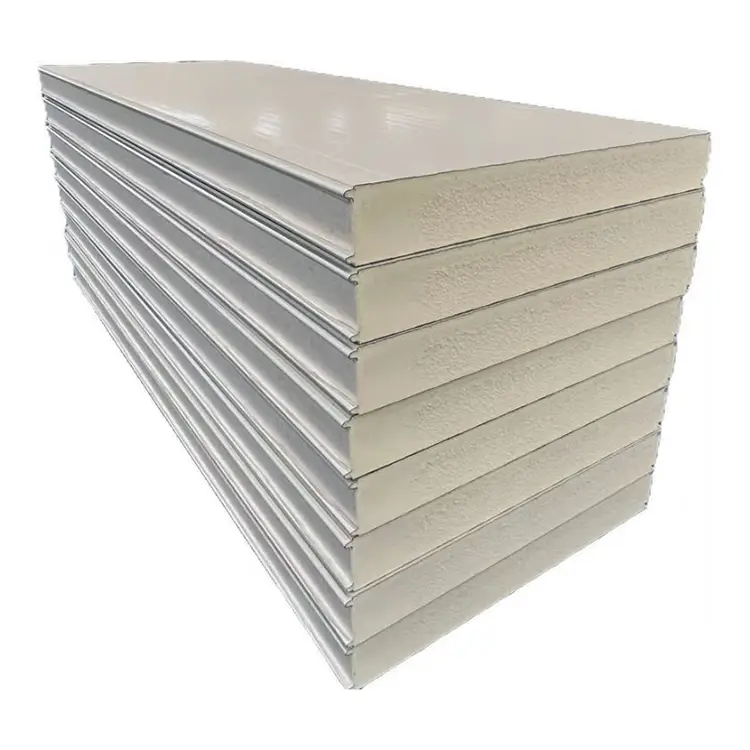
Understanding Fire Classifications: Class A vs. Class B
Fire ratings for building materials in North America are defined by ASTM E84 (Steiner Tunnel Test), which measures flame spread index (FSI) and smoke developed index (SDI). In Europe and many Asian markets, EN 13501-1 is the prevailing standard, using classes from A1 to F. For PUR Insulation Panel products, the two most requested tiers are:
| Rating | Flame Spread Index (FSI) | Smoke Developed Index (SDI) | Typical Application |
|---|---|---|---|
| Class A | 0 – 25 | 0 – 450 | Hospitals, schools, high-rise buildings |
| Class B | 26 – 75 | 0 – 450 | Warehouses, agricultural sheds, retail spaces |
| Class C | 76 – 200 | 0 – 450 | Low-risk storage (rarely specified for PUR) |
Note: A PUR Insulation Panel with unfaced polyurethane foam typically tests at FSI 70–90 (Class B). To reach Class A (FSI ≤ 25), manufacturers must add flame retardants, use aluminum foil or mineral-coated facings, or apply intumescent coatings.
What Determines the Fire Rating of a PUR Insulation Panel?
Five interdependent factors influence the final classification:
-
Polyol/isocyanate ratio – Higher isocyanate content improves char formation, slowing flame spread.
-
Flame retardant additives – Phosphorus-based or halogenated compounds reduce ignition susceptibility.
-
Facing material – Plain kraft paper burns readily; aluminum foil (25–50 µm) or glass-fiber-reinforced facers can drop FSI by 30–40 points.
-
Core density – Densities above 45 kg/m³ exhibit lower surface flammability due to reduced oxygen permeability.
-
Edge sealing – Open edges expose raw foam; factory-sealed edges improve overall fire behavior.
HANYORK produces PUR Insulation Panel systems with customized facings, enabling clients to meet Class B as standard and Class A with specialized aluminum composite facers—all validated by third-party laboratories (Intertek and FM Approvals).
Can a Standard PUR Insulation Panel Pass Class B Without Modifications?
Yes. Most commercially available PUR Insulation Panel products with 2.0–2.5 lb/ft³ density and standard aluminum foil facing will achieve Class B (FSI 40–60) under ASTM E84. For example, HANYORK’s standard HP-PUR series consistently reports FSI 48 and SDI 320—well within Class B limits. This makes them suitable for:
-
Cold storage warehouses (≤ 5,000 m²)
-
Poultry processing plants
-
Temporary event structures
-
Agricultural barns and grain storage
Class B does not mean "non-combustible"—it means the panel resists flame propagation for 10–15 minutes under test conditions, providing adequate evacuation time and limiting flashover risk in low-occupancy buildings.
What Modifications Lift a PUR Insulation Panel to Class A?
To cross the Class A threshold (FSI ≤ 25), HANYORK recommends three proven strategies:
| Strategy | FSI Achieved | Cost Impact | Best For |
|---|---|---|---|
| 50 µm embossed aluminum both sides | 18–22 | +12–15% | Pharma cold chains, data centers |
| 0.5 mm magnesium-oxide (MgO) facing | 10–15 | +25–30% | High-rise exterior walls |
| Intumescent coating (spray-applied post-install) | 20–25 | +8–10% | Retrofitting existing panels |
Important: Achieving Class A with a PUR Insulation Panel requires the entire composite system—core + facings + adhesives—to be tested together. Mixing facings from different suppliers voids certification.
HANYORK offers pre-tested Class A assemblies with full traceability, including lot-specific test reports, so specifiers can submit documentation directly to fire marshals.
3 Frequently Asked Questions About PUR Insulation Panel Fire Performance
FAQ 1: Does a Class B PUR Insulation Panel produce toxic smoke during a fire?
Answer: Yes, all polyurethane-based products emit carbon monoxide, hydrogen cyanide, and isocyanate fragments when thermally decomposed. However, the quantity and rate of smoke release are more critical than toxicity alone. Under ASTM E84, PUR Insulation Panel systems with aluminum facings typically produce SDI values of 250–380—well below the 450 limit. For occupied spaces, HANYORK recommends adding a 12 mm gypsum board overlay on the interior face, which reduces SDI to below 100 without altering the panel's thermal performance (λ ≈ 0.022 W/m·K). Always consult local fire engineering reports, as smoke toxicity is assessed separately under NFPA 269 in most jurisdictions.
FAQ 2: Can I install a Class B PUR Insulation Panel in a building that requires Class A by code?
Answer: Not without a code variance or additional protective layers. Building codes (IBC, NFPA 5000) are prescriptive—if the occupancy classification (e.g., educational, assembly, or high-rise residential) mandates Class A interior finishes, substituting a Class B PUR Insulation Panel is a direct violation, regardless of field performance. However, there are two legal workarounds: (a) install the Class B panel as thermal barrier behind a 15 mm Type X gypsum wallboard (tested per ASTM E119), which collectively achieves a 1-hour fire resistance rating; or (b) specify HANYORK’s Class A-certified HP-FR series, which carries a test report meeting both ASTM E84 and CAN/ULC S102. Always verify with the local Authority Having Jurisdiction (AHJ) before procurement.
FAQ 3: How often should a PUR Insulation Panel be re-tested for fire rating during its service life?
Answer: Unlike electrical equipment, PUR Insulation Panel fire ratings do not "expire" if the panel remains unmodified and undamaged. However, most insurers and certification bodies (e.g., FM Global, UL) require a visual inspection every 3–5 years to check facing integrity, edge delamination, and impact damage—because a scratched or perforated aluminum facing exposes raw foam and can reduce the effective FSI from 48 to ~85 (dropping from Class B to Class C). HANYORK provides a 10-year material warranty that includes free fire-rating revalidation testing (two samples per production batch) if the client submits annual inspection logs. For critical infrastructure (data centers, battery storage rooms), we recommend third-party spot testing every 24 months, as the thermal degradation of flame retardants at elevated ambient temperatures (> 50°C) can lower performance over time.
Fire Rating Comparison: PUR vs. PIR vs. Mineral Wool
To put PUR Insulation Panel performance in context, here is a side-by-side comparison under ASTM E84:
| Material | FSI Range | SDI Range | Typical Class | Thermal Conductivity (W/m·K) |
|---|---|---|---|---|
| PUR (standard) | 48 – 70 | 300 – 380 | B | 0.022 – 0.024 |
| PIR (modified) | 22 – 35 | 180 – 250 | A (some variants) | 0.021 – 0.023 |
| Mineral Wool | 0 – 5 | 0 – 10 | A | 0.035 – 0.040 |
| EPS (expanded polystyrene) | 75 – 150 | 200 – 350 | C | 0.032 – 0.036 |
While mineral wool excels in fire safety, its thermal efficiency is 40–50% lower than PUR Insulation Panel, meaning thicker sections and higher structural loads. HANYORK often advises hybrid solutions: use Class A PUR Insulation Panel for the roof deck (where thermal performance matters most) and mineral wool for interior partition firewalls—a strategy that balances cost, space, and safety.
Practical Recommendations for Specifiers
-
For Class B projects – Specify HANYORK HP-PUR with 40 µm aluminum facings. Ensure all edge joints are taped with aluminum foil tape to maintain the barrier continuity.
-
For Class A mandatory – Order HANYORK HP-FR series with factory-laminated MgO board. Request a full-scale ASTM E84 report (not just a foam-core certificate).
-
For retrofits – Use intumescent paint (2 coats, 300 µm DFT) over existing PUR Insulation Panel surfaces; this raises FSI from ~60 to ~22 without replacing panels.
-
Always request lot-specific flame spread data—HANYORK includes this in every shipment as a QR-coded digital certificate.
Final Verdict
A PUR Insulation Panel can indeed achieve Class B as a standard product and Class A with engineered facings or coatings. The choice is not about "if" but "which configuration fits your fire safety budget and occupancy risk profile." HANYORK has supplied over 2,000 Class B and 450 Class A projects across 35 countries, with zero fire-related code failures. Our technical team provides free fire-rating consultations, including computational fluid dynamics (CFD) modeling for smoke spread—at no extra cost for orders above 1,000 m².
Ready to specify the right fire-rated PUR Insulation Panel for your next project?
Contact HANYORK today for custom samples, third-party test reports, and engineer-to-engineer design support. Our response time is under 4 business hours—because your safety timeline matters.
