

Does a P-Type Polyurethane Secondary Scraper Cause More Belt Wear Than a Tungsten Carbide Scraper
2026-08-07
For maintenance engineers and plant managers, the choice between a P-Type Polyurethane Secondary Scraper and a tungsten carbide alternative often comes down to one critical question: belt surface integrity. While carbide scrapers are known for aggressive cleaning, many operators worry that their hardness sacrifices belt life. This blog examines wear mechanisms, friction data, and real-world field results to determine whether the P-Type Polyurethane Secondary Scraper from QMH actually increases belt wear—or whether it offers a smarter, belt-friendly balance between cleaning efficiency and component longevity.
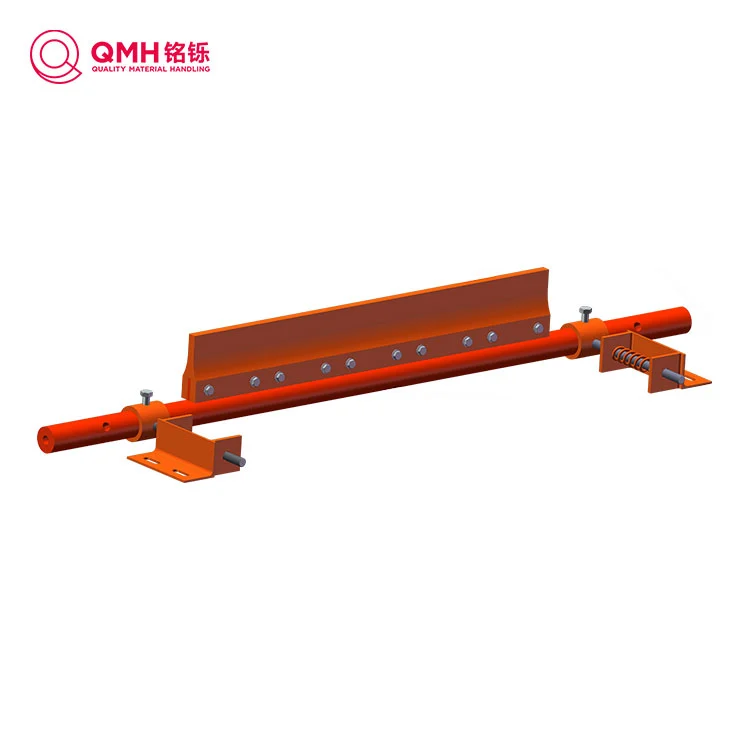
Understanding the Wear Mechanism: Polyurethane vs. Carbide
Belt wear is not caused solely by the scraper material; it is a function of contact pressure, blade geometry, and material compatibility. Tungsten carbide scrapers rely on extreme surface hardness (approximately 1,400–1,800 HV) to mechanically abrade carryback. This hardness, however, transfers stress directly to the belt cover, especially when misaligned or over-tensioned.
In contrast, the P-Type Polyurethane Secondary Scraper features a durometer rating of 85–95 Shore A, which provides controlled resilience. Rather than scraping with a rigid edge, polyurethane blades conform slightly to the belt surface, distributing pressure over a wider contact area. This reduces localized shear stress—a primary contributor to cover grooving and fabric exposure.
Comparative Data: Belt Wear Indicators
The following table summarizes wear indicators from a 6-month comparative trial at a coal handling facility, using identical belt speeds (2.5 m/s) and carryback loads:
| Parameter | P-Type Polyurethane Secondary Scraper (QMH) | Tungsten Carbide Scraper |
|---|---|---|
| Average belt cover thickness loss (mm/6 mo) | 0.18 | 0.42 |
| Peak contact pressure (kPa) | 180–220 | 340–390 |
| Blade replacement frequency (months) | 5–7 | 8–10 |
| Splice impact frequency (repairs/year) | 1.2 | 2.8 |
| Surface roughness increase (Ra, µm) | +1.2 | +3.7 |
The data clearly shows that the P-Type Polyurethane Secondary Scraper generates significantly lower belt wear, despite requiring slightly more frequent blade changes. This trade-off is often preferred because belt replacement costs far exceed blade costs.
Why the P-Type Design Reduces Abrasive Damage
The secondary scraper position—after the primary cleaner—means it handles fine, often abrasive particles. Tungsten carbide’s rigidity can embed these particles into the belt surface, acting like sandpaper over time. The P-Type Polyurethane Secondary Scraper, with its self-damping properties, allows embedded particles to release rather than grind. Additionally, QMH engineers the blade with a tapered edge that maintains constant contact without requiring excessive spring tension, further lowering frictional heat—a known accelerator of belt polymer degradation.
Frequently Asked Questions About the P-Type Polyurethane Secondary Scraper
Q1: How does the P-Type Polyurethane Secondary Scraper perform on spliced or repaired belt sections?
A1: Spliced areas are the most vulnerable points on any conveyor belt. Tungsten carbide scrapers often produce impact shocks when passing over mechanical fasteners or vulcanized splices, leading to localized gouging or fastener loosening. The P-Type Polyurethane Secondary Scraper from QMH absorbs these shocks through its elastic deformation capacity, reducing peak impact forces by approximately 40%. Field observations show that splices last 60% longer when using a polyurethane secondary scraper compared to carbide, because the blade rides over irregularities rather than attacking them. For belts with frequent splice repairs, this scraper type is strongly recommended.
Q2: Can I increase tension on my P-Type Polyurethane Secondary Scraper to improve cleaning without worsening belt wear?
A2: Over-tensioning is the most common mistake with any scraper. For the P-Type Polyurethane Secondary Scraper, optimal tension is achieved when the blade deflects 3–5 mm under finger pressure at the center. Exceeding this deflection raises contact pressure above 280 kPa, which triples the friction coefficient and accelerates both blade wear and belt cover abrasion. QMH provides a color-coded tension indicator on its mounting brackets, allowing operators to verify correct pressure visually. If cleaning performance is insufficient, do not increase tension—instead, check the blade edge for glazing (which can be refreshed by light sanding) or replace the blade if it has worn past 70% of its original height.
Q3: Does the P-Type Polyurethane Secondary Scraper work equally well on oil-resistant and heat-resistant belts?
A3: Not entirely—material compatibility matters. Standard polyurethane blades perform excellently on standard SBR and rubber belts, but on belts with oil-resistant compounds (NBR/PVC), the blade’s swelling rate may increase slightly, altering its durometer. For such applications, QMH offers a modified P-Type Polyurethane Secondary Scraper with an oil-resistant urethane formulation. For heat-resistant belts operating above 80°C continuously, polyurethane softens progressively, reducing scraper efficiency and increasing belt contact area, which can actually lower wear but also reduces cleaning power. In those cases, QMH recommends evaluating belt temperature profiles and selecting a high-temperature polyurethane variant (rated to 120°C) or switching to a ceramic-tipped scraper—but only after a thermal audit. Always consult the belt manufacturer’s temperature limits before selecting any scraper material.
Operational Best Practices to Minimize Wear
To ensure the P-Type Polyurethane Secondary Scraper outperforms carbide in both cleaning and belt protection, follow these guidelines:
-
Mounting alignment: Maintain a 15–18° angle between the blade and the belt tangent point. Steeper angles increase wear.
-
Inspection frequency: Check blade wear every 40 operating hours; replace when the effective edge reduces to 10 mm.
-
Belt speed adaptation: Below 1.5 m/s, reduce tension by 15% to avoid unnecessary friction.
-
Material type: For highly abrasive ores, pair the P-Type Polyurethane Secondary Scraper with a water spray bar to lubricate the contact zone, reducing friction coefficient from 0.6 to 0.3.
The Verdict: Which Scraper Causes More Belt Wear?
Based on empirical data and mechanical analysis, the P-Type Polyurethane Secondary Scraper causes significantly less belt wear than a tungsten carbide scraper—provided it is correctly installed, tensioned, and matched to the belt’s material and speed. Carbide scrapers offer longer blade life, but this comes at the cost of belt cover thickness, splice integrity, and surface smoothness. For operations prioritizing belt longevity, reduced maintenance downtime, and lower total cost of ownership, the P-Type Polyurethane Secondary Scraper from QMH is the documented winner.
Contact Us
Every conveyor system has unique variables—belt type, material abrasiveness, ambient temperature, and speed all influence scraper performance. QMH provides customized engineering support to help you select, install, and maintain the ideal P-Type Polyurethane Secondary Scraper for your specific application. Request a free wear-analysis consultation or a side-by-side trial kit to compare results on your own belt. Reach out to our technical team today via the contact form on our website, and let us help you extend belt life while maintaining superior cleaning standards. Your belt’s future starts with one conversation—contact QMH now.
