

How Automation in Concrete Block Molding Reduces Labor Expenses?
2026-02-26
In today’s competitive construction materials market, labor cost remains one of the most significant operating expenses for block producers across North America, Europe, and Southeast Asia. Rising minimum wages, strict OSHA compliance standards, union regulations in certain regions, and increasing worker turnover are forcing manufacturers to rethink traditional production models. Manual block production lines require multiple operators for feeding, vibration control, demolding, pallet transfer, curing supervision, and quality inspection. Each station introduces variability, downtime, and hidden payroll overhead.
Automation changes this equation completely. By integrating PLC-controlled systems, servo-driven vibration units, and automated pallet circulation, our production line reduces dependency on manual intervention. Instead of ten to twelve workers per shift, facilities can operate efficiently with three to five trained technicians. Our factory has observed that intelligent production systems not only reduce payroll expenses but also stabilize output per hour, improving ROI calculations and lowering cost per block.
At Quangong Machinery Co., Ltd., we design fully automated block lines tailored for high-volume operations. Our systems focus on minimizing human touchpoints while maximizing mechanical precision. Through automation, our clients reduce overtime, eliminate repetitive handling, and achieve consistent dimensional accuracy in every Mold for Concrete Block used on the line.
How Does Full Automation Replace Manual Workflows in Block Plants?
Traditional block yards rely heavily on manual batching, hand-adjusted vibration timing, and labor-intensive pallet stacking. In contrast, automated systems deploy computerized batching plants, synchronized vibration motors, hydraulic compression, and robotic stacking units. These technologies ensure repeatable cycles with minimal operator oversight.
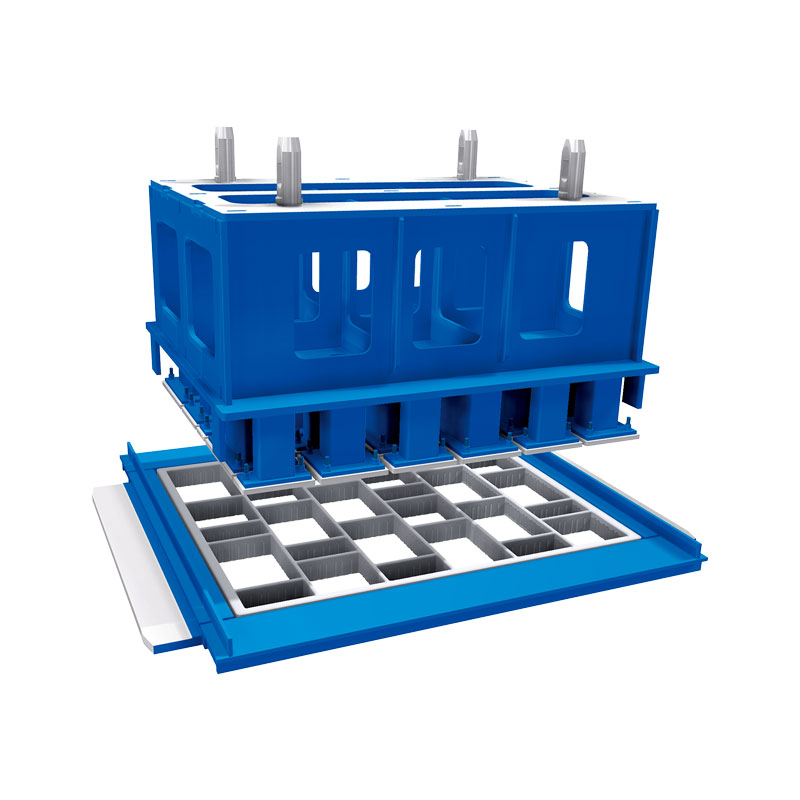
Our automated lines incorporate Siemens PLC control systems, touch-screen HMI panels, and frequency-controlled vibration modules. The system records cycle time, compaction pressure, and output metrics in real time. This digital monitoring eliminates guesswork and reduces operator fatigue. Our engineering team configures each Mold for Concrete Block with precise alignment tolerances to ensure seamless integration with automated demolding stations.
| Model | QGM QT10 Automatic Line |
| Cycle Time | 15 to 20 seconds |
| Vibration Frequency | Up to 4500 rpm |
| Hydraulic Pressure | 21 MPa |
| Daily Capacity | 18000 to 22000 blocks per 8 hours |
| Control System | Siemens PLC with touchscreen HMI |
With this configuration, one operator can supervise the main console while automated conveyors handle pallet feeding and block transfer. Our factory integrates servo-controlled stackers to reduce manual loading, cutting forklift movement and reducing workplace accidents. Quangong Machinery Co., Ltd. continuously upgrades automation modules to comply with CE standards and meet regional safety codes.
What Technical Specifications Support Labor Reduction in Automated Systems?
Labor reduction is not simply about replacing workers with machines. It depends on system stability, durability, and precision manufacturing. Poorly engineered equipment may require constant manual correction, offsetting automation benefits. Therefore, robust mechanical design is essential.
Our block machine frames are fabricated from high-strength Q345B steel with stress-relief treatment. Hydraulic components use proportional valves to ensure stable pressure distribution. The Mold for Concrete Block is manufactured with 20MnCr5 carburized steel, heat-treated to enhance wear resistance and dimensional stability under continuous vibration. This durability reduces maintenance downtime and limits the need for skilled repair labor.
| Mold Material | 20MnCr5 alloy steel |
| Surface Hardness | 58 to 62 HRC |
| Frame Structure | Heavy-duty welded steel frame |
| Automation Level | Fully automatic with pallet return system |
| Stacking System | Automatic servo stacking unit |
| Energy Consumption | Optimized inverter control system |
These specifications ensure that our equipment operates continuously with minimal supervision. Our clients report up to 40 percent reduction in total labor expenses within the first year of installation. In addition, fewer manual handling tasks lead to lower workers’ compensation claims and improved plant safety metrics.
How Does Automation Improve Productivity and Lower Cost Per Block?
Automation directly impacts output consistency. In manual systems, variation in vibration timing or compaction pressure can produce rejected blocks. Rework and scrap increase hidden labor costs. Automated control ensures uniform density, strength compliance, and accurate dimensions. Each Mold for Concrete Block operates within calibrated parameters, eliminating inconsistency caused by human error.
Furthermore, automated pallet return systems reduce idle time between cycles. Instead of waiting for workers to reposition pallets, the conveyor loop instantly feeds the next unit. This reduces cycle interruptions and maximizes hourly output. Our factory integrates smart curing chamber interfaces, allowing digital tracking of curing duration and humidity levels. These integrations minimize supervision requirements and maintain consistent quality control.
At Quangong Machinery Co., Ltd., we prioritize integration between batching, molding, stacking, and curing systems. By connecting all modules into one synchronized production line, our clients reduce dependency on shift-based labor planning. Automation enables predictable scheduling and supports lean manufacturing strategies widely adopted in the US and EU markets.
Why Is Investing in Automated Molding a Long-Term Strategic Advantage?
Beyond immediate payroll savings, automation provides scalability. As demand increases, production can expand without proportionally increasing workforce size. The modular structure of our production lines allows easy upgrades, including additional molds, expanded pallet circulation, and smart monitoring systems.
In regions where skilled labor shortages are common, automated equipment ensures operational continuity. Our Mold for Concrete Block configurations are designed for quick replacement and alignment, reducing downtime during changeovers. Our engineering support team provides remote diagnostics and on-site commissioning, ensuring smooth implementation.
Automation also enhances brand reputation. Consistent block dimensions and compressive strength improve contractor satisfaction and project reliability. Over time, improved product consistency translates into stronger market positioning and repeat orders.
Frequently Asked Questions
Q1: How Automation in Concrete Block Molding Reduces Labor Expenses?
Automation reduces labor expenses by replacing manual handling, vibration control, stacking, and quality monitoring with PLC-controlled systems and robotic modules. Fewer operators are required per shift, overtime is minimized, and workplace injuries decrease. In addition, consistent production reduces scrap and rework, further lowering hidden labor costs.
Q2: How long does it take to recover investment in an automated block line?
Return on investment typically ranges from 18 to 36 months depending on plant size and local wage structure. Facilities with high payroll burdens or multi-shift operations often achieve faster payback. Reduced downtime, stable cycle times, and lower maintenance labor significantly contribute to quicker capital recovery.
Q3: Is automated molding suitable for small and medium-sized producers?
Yes. Modular automation allows scalable implementation. Even semi-automatic upgrades such as automated stacking or pallet return systems can reduce workforce requirements. As production demand grows, additional automation modules can be integrated without replacing the entire system.
Automation in concrete block molding is no longer optional for competitive manufacturers. It is a strategic solution that lowers labor expenses, improves production stability, and enhances product quality. By investing in advanced molding systems, producers gain cost control, operational efficiency, and long-term scalability. If you are planning to upgrade your plant or reduce workforce dependency, contact our team today to discuss customized automation solutions and receive a detailed proposal tailored to your production goals.
