

Article Summary: Bundle Conductor Stringing Blocks are essential tools used in overhead transmission line construction to guide, support, and protect bundled conductors during stringing operations. Choosing the correct stringing block directly affects conductor protection, construction efficiency, worker safety, and project reliability. This article explains how Bundle Conductor Stringing Blocks work, what problems they solve, how to select suitable equipment, and how professional solutions from Lingkai can support modern power transmission projects.
Understanding Bundle Conductor Stringing Blocks
Modern power transmission projects require reliable equipment capable of handling increasingly complex conductor arrangements. Bundle conductors are widely used in high-voltage transmission systems because they can improve electrical performance and increase transmission capacity. However, installing multiple conductors together requires specialized equipment to prevent damage and maintain accurate alignment.
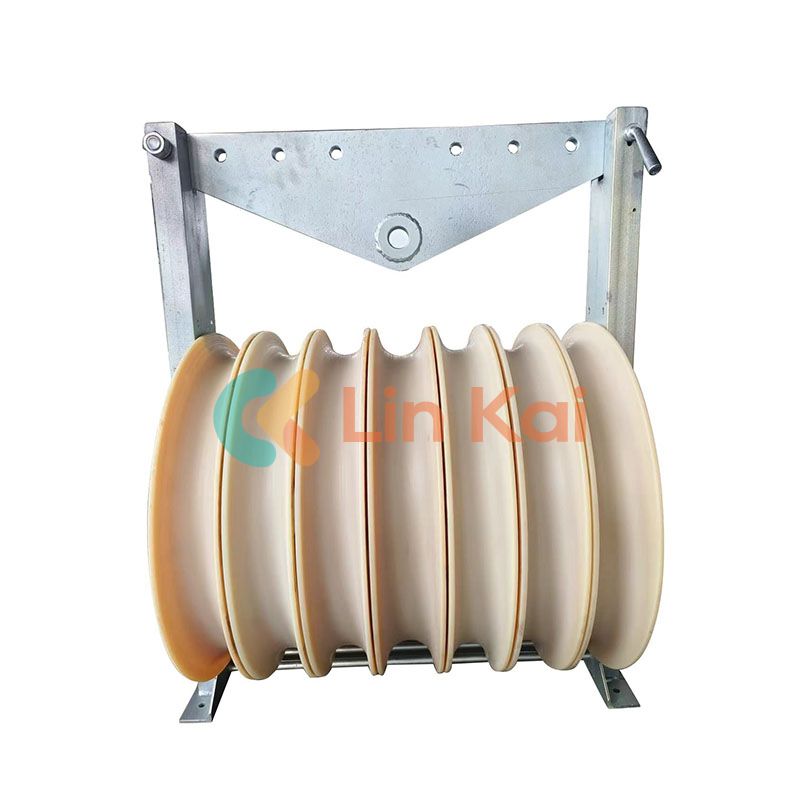
Bundle Conductor Stringing Blocks are designed to support bundled conductors while they are pulled through transmission towers during installation. They provide a controlled pathway that reduces friction, prevents unnecessary conductor wear, and helps construction teams maintain proper tension throughout the stringing process.
As a professional transmission line equipment manufacturer, Lingkai develops and supplies stringing equipment for overhead power line construction projects. Its product range includes conductor pulley stringing blocks, bundle conductor stringing blocks, and related transmission tools designed for different project requirements.
How Bundle Conductor Stringing Blocks Work
During overhead line construction, conductors must travel across multiple towers before reaching their final position. Direct contact between the conductor and tower structures can cause abrasion, deformation, or surface damage. Stringing blocks solve this challenge by creating a smooth supporting route.
Main working process
- Supporting conductors: The sheaves hold bundled conductors safely during pulling operations.
- Reducing friction: Bearings and suitable wheel materials help minimize resistance.
- Maintaining conductor shape: Proper grooves prevent excessive bending or deformation.
- Improving construction control: Workers can manage pulling tension more accurately.
For bundled conductors, the equipment must match the conductor quantity, diameter, weight, and installation method. Incorrect equipment selection may increase pulling resistance or create unnecessary mechanical stress.
Key Benefits During Transmission Construction
Selecting suitable Bundle Conductor Stringing Blocks helps solve several common challenges faced by transmission line contractors.
| Construction Challenge | How Stringing Blocks Help |
|---|---|
| Conductor surface damage | Provides smooth support and reduces direct contact with structures. |
| High pulling resistance | Rotating sheaves reduce friction during conductor movement. |
| Installation accuracy | Keeps bundled conductors positioned correctly during stringing. |
| Complex transmission projects | Supports different conductor arrangements and project conditions. |
| Maintenance requirements | Allows inspection and replacement of equipment components. |
Protecting valuable conductors
Transmission conductors represent a significant investment. Even minor surface damage during installation can affect long-term performance. Proper stringing blocks help protect conductor surfaces and reduce the possibility of costly repairs after installation.
Improving construction efficiency
Smooth conductor movement allows crews to complete installation tasks more efficiently. Reduced friction means less pulling force is required, helping improve productivity while reducing stress on pulling equipment.
How to Select the Right Bundle Conductor Stringing Blocks
Choosing suitable equipment requires more than selecting a product based only on appearance. Engineers should evaluate several technical factors before purchasing.
1. Check conductor specifications
The conductor diameter, weight, number of bundled conductors, and mechanical characteristics determine the required stringing block configuration.
2. Consider sheave quantity
Different projects may require different numbers of sheaves depending on conductor arrangement. Single, three, or multiple sheave designs can be selected according to installation needs.
3. Confirm load capacity
The rated load should meet or exceed the expected operational requirements. Choosing equipment with insufficient capacity may create safety risks and shorten service life.
4. Evaluate working environment
Outdoor transmission projects may involve dust, rain, temperature changes, and challenging terrain. Equipment should be suitable for the actual working conditions.
- Conductor diameter and type
- Number of bundled conductors
- Required working load
- Sheave material preference
- Installation environment
- Required certification and documentation
Materials and Structural Design
The performance of a stringing block depends heavily on material selection and manufacturing quality. Different projects may require different sheave materials depending on conductor characteristics and operating conditions.
| Component | Common Material Options | Purpose |
|---|---|---|
| Sheave | MC Nylon, Aluminum Alloy, Steel | Provides conductor support and smooth movement. |
| Frame | Galvanized Steel | Provides structural strength and durability. |
| Bearing System | High-quality bearings | Reduces friction and improves rotation efficiency. |
| Connection Components | Customized steel components | Ensures secure installation with transmission structures. |
Lingkai provides different configurations of stringing blocks with customized options to meet various overhead transmission requirements. Product details should always be confirmed according to specific project parameters.
Installation and Operation Practices
Proper operation is essential to achieve the expected performance of Bundle Conductor Stringing Blocks. Even high-quality equipment requires correct installation and inspection procedures.
Before installation
- Inspect the block structure and sheaves for visible damage.
- Confirm the equipment matches the conductor requirements.
- Check connection points and fastening components.
- Verify the installation location on the transmission tower.
During stringing operations
- Maintain suitable pulling speed and tension.
- Monitor conductor movement through each block.
- Avoid sudden pulling forces or excessive loading.
- Observe equipment condition throughout operation.
After operation
- Clean equipment after use.
- Inspect bearings and rotating parts.
- Store equipment in a dry and protected environment.
Common Problems and Solutions
Using unsuitable equipment size
A mismatch between conductor size and stringing block specifications may increase friction and reduce installation efficiency. Always verify technical parameters before ordering.
Ignoring maintenance
Regular inspection helps identify worn bearings, damaged sheaves, or structural issues before they affect construction.
Overlooking project conditions
Different environments require different equipment considerations. Mountain areas, long-span lines, and high-voltage projects may require specialized solutions.
Frequently Asked Questions
Q1: What are Bundle Conductor Stringing Blocks used for?
They are used to support and guide bundled conductors during overhead transmission line installation, helping reduce friction and protect conductor surfaces.
Q2: Why are stringing blocks important for transmission projects?
They improve installation control, reduce conductor damage risks, and help construction teams complete stringing operations more efficiently.
Q3: How do I choose the correct stringing block?
Selection should consider conductor size, bundle arrangement, load capacity, sheave design, working environment, and project requirements.
Q4: Can Bundle Conductor Stringing Blocks be customized?
Yes. Customized configurations may be available according to conductor parameters and construction requirements.
Q5: How can I improve the service life of stringing blocks?
Regular inspection, proper operation, correct storage, and timely maintenance of rotating components help extend equipment life.
Work with Lingkai for Reliable Transmission Equipment Solutions
Selecting the right Bundle Conductor Stringing Blocks is essential for safe, efficient, and reliable overhead transmission line construction. With professional manufacturing experience and a wide range of transmission line tools, Lingkai provides solutions designed to meet different project requirements.
If you need technical support, customized specifications, or detailed product information, visit Lingkai and contact us to discuss your transmission line equipment needs.
