

Article Summary: Logistics turnover boxes are expected to survive repeated handling, stacking, transportation, cleaning, and automated warehouse operations. Yet many supply-chain projects experience cracked corners, poor flatness, inconsistent dimensions, long molding cycles, or unstable production output because the mold is treated as an afterthought. This guide explains how to develop reliable logistics turnover boxes by connecting box design, HDPE/PP material selection, mold construction, cooling performance, injection molding control, quality inspection, and long-term production planning. It also shows what buyers should discuss with a mold manufacturer before approving a tooling project.
Why Logistics Turnover Boxes Matter in Modern Supply Chains
Logistics turnover boxes are more than reusable plastic containers. In manufacturing, warehousing, distribution, automotive supply chains, retail replenishment, and automated material handling, they become part of the physical infrastructure that moves products from one process to another.
A good turnover box must repeatedly tolerate loading and unloading without losing its shape. It may be stacked in a warehouse, transferred by conveyor, handled by forklifts or robotic systems, exposed to temperature changes, and cleaned many times during its service life. That means the quality of the finished box depends heavily on the mold used to produce it.
For high-volume applications, the mold should therefore be planned around the entire production cycle rather than only the initial tooling quotation.
Common Problems Buyers Encounter With Turnover Box Production
Procurement teams often focus on unit price and tooling cost. However, several less visible issues can have a much larger effect on total operating cost.
The solution is not simply to make the mold stronger. The entire product and manufacturing system must be designed together.
How Box Design Affects Mold Performance
The mold design begins with the plastic part. Before tooling starts, engineers should understand how the box will be loaded, stacked, transported, cleaned, and handled. These requirements determine where reinforcement ribs, handles, corners, stacking features, drainage areas, and locking structures should be positioned.
Balance strength with manufacturability
Adding material everywhere is rarely the best way to improve strength. Excessively thick sections can increase cooling time and create uneven shrinkage. A more practical approach is to use ribs and structural reinforcement in areas where loads are concentrated while keeping wall thickness as consistent as the application allows.
Consider stacking and nesting from the beginning
Many logistics boxes need to stack when full and nest or collapse when empty. The geometry must therefore provide enough clearance for reliable operation while maintaining dimensional stability. Even a small dimensional error can become significant when hundreds or thousands of boxes are used in an automated warehouse.
Design for cleaning and handling
Reusable logistics containers are frequently exposed to dust, oil, moisture, packaging debris, and industrial cleaning processes. Smooth surfaces, practical drainage features, and accessible geometry can make routine cleaning easier while reducing areas where contamination can accumulate.
How Material Selection Supports Repeated Use
HDPE and PP are commonly considered for reusable logistics containers because they offer useful combinations of toughness, chemical resistance, processability, and relatively low weight. The final material decision, however, should be based on the actual application rather than on material name alone.
| Requirement | What Buyers Should Consider | Why It Matters |
|---|---|---|
| Impact resistance | Handling conditions, drop risks, corner impacts, and operating temperature | Helps reduce cracking and premature failure during repeated circulation |
| Stiffness | Stacking height, payload, rib design, and wall structure | Supports stable stacking and reduces deformation |
| Chemical resistance | Oils, detergents, industrial chemicals, and cleaning agents | Important for automotive and industrial environments |
| Processing behavior | Flow characteristics, shrinkage, mold temperature, and injection conditions | Directly affects mold filling and dimensional consistency |
Recycled content may also be relevant for some applications, but it should be evaluated together with mechanical requirements, appearance expectations, traceability, and the customer's internal quality standards. A material change should never be treated as a simple cost substitution without reviewing its effect on the molding process.
How Mold Structure Determines Production Stability
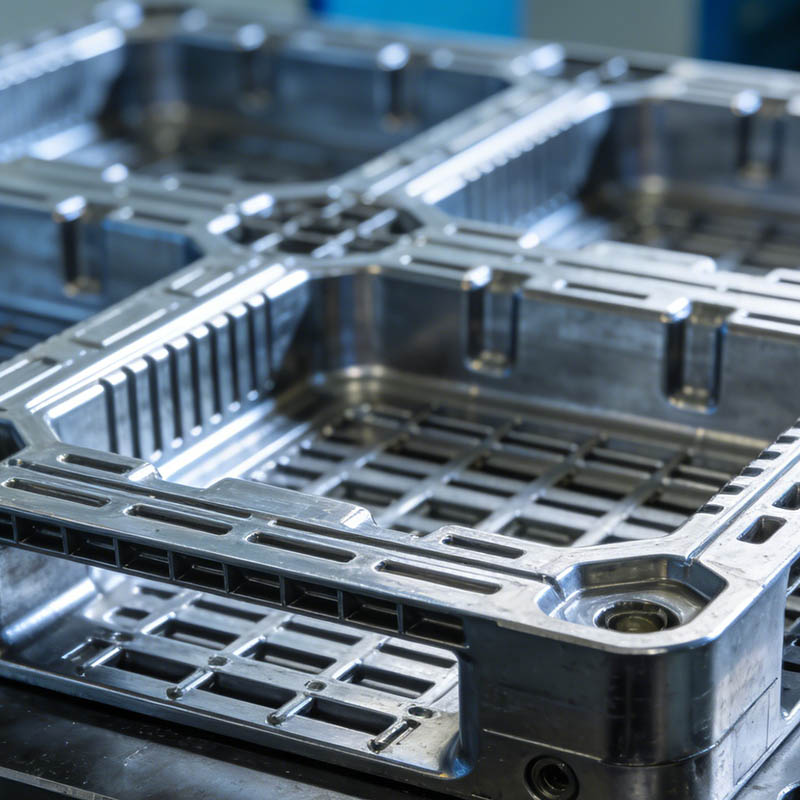
Large logistics turnover boxes require molds with sufficient structural rigidity and carefully engineered cavity and core systems. The mold must remain stable under injection pressure while also allowing the finished part to release cleanly.
Large mold bases require careful structural planning
Larger tooling introduces additional requirements for support, alignment, machining accuracy, and thermal management. Deflection or misalignment can eventually appear as dimensional inconsistencies or parting-line problems.
Pay attention to high-wear areas
Guide components, ejector systems, sliders, lifters, locking features, and other moving components should be selected with expected production volume and maintenance requirements in mind. The goal is not merely to make every component oversized; it is to place durability where repeated movement and mechanical stress actually occur.
Make maintenance part of the original design
A production mold should be serviceable. Cooling circuits, ejector components, inserts, and other maintenance-sensitive areas should be accessible enough to support inspection and repair. This is particularly important for customers planning long-term production programs.
Weishuo positions its logistics turnover box and pallet molds around high-strength structures, large mold bases, rapid-cycle cooling, and integration with automated production. The company also describes its broader manufacturing process as covering mold design, manufacturing, injection molding, inspection, and final production support.
How Cooling Design Reduces Cycle-Time Problems
Cooling is one of the most important considerations for large injection-molded logistics containers. The plastic must lose heat efficiently enough to achieve the required dimensional stability before ejection.
If one area cools much faster than another, differential shrinkage can contribute to warpage. If cooling is insufficient in thick sections, the cycle may need to be extended, reducing machine utilization and increasing the cost per part.
A practical cooling strategy considers:
- Distance between cooling channels and molded surfaces.
- Uniform coverage of thick and structurally critical sections.
- Water-flow efficiency and temperature control.
- Accessibility for cleaning and maintenance.
- Potential hot spots around ribs, corners, handles, and reinforced areas.
- Interaction between cooling layout and expected cycle time.
How Quality Control Protects Batch Consistency
A successful tooling project is not finished when the first sample looks good. Buyers should evaluate whether the mold can repeatedly produce parts within the agreed specification.
| Control Stage | Recommended Focus | Customer Benefit |
|---|---|---|
| Design review | Wall thickness, ribs, draft, shrinkage, ejection, and assembly features | Reduces avoidable tooling changes |
| Mold manufacturing | Steel quality, machining accuracy, cooling passages, and component fit | Builds a stable tooling foundation |
| Trial molding | Filling, cooling, ejection, warpage, and dimensional results | Identifies issues before mass production |
| First article inspection | Critical dimensions and functional characteristics | Confirms the product against agreed specifications |
| Mass production | Process stability, visual quality, dimensions, and sampling frequency | Protects consistency across large batches |
For precision manufacturing projects, measurement capability matters as much as visual inspection. Weishuo states that its quality process includes dimensional verification using coordinate measuring equipment and mold cycle stability testing, while its integrated manufacturing model covers mold development through injection production and assembly.
How to Evaluate a Logistics Turnover Box Mold Supplier
Choosing a mold supplier should involve more than comparing quotations. A technically cheaper tool may become more expensive if it requires repeated modifications, produces excessive scrap, or cannot maintain production stability.
Before placing an order, ask the supplier to explain:
- Which material grades are recommended and why.
- How the mold structure will handle the expected production volume.
- How cooling will be distributed across the box.
- How warpage and shrinkage risks will be evaluated.
- Which dimensions are considered critical.
- How first article inspection will be performed.
- What mold maintenance procedures are recommended.
- How replacement components will be supported.
- How trial production and approval will be documented.
- Whether the supplier can support both tooling and injection molding when required.
An integrated supplier can reduce communication gaps between product design, tooling, injection molding, and quality control. Weishuo describes itself as a manufacturer integrating mold design, R&D, mold manufacturing, injection molding, and sales, with a manufacturing facility of more than 7,600 square meters.
A Practical Mold-to-Mass-Production Process
A structured workflow can prevent many problems before they become expensive tooling changes. The following sequence is suitable for buyers developing a new logistics turnover box or upgrading an existing design.
-
Define the application.
Confirm payload, stacking conditions, handling methods, environmental exposure, cleaning requirements, and expected annual production volume. -
Review the product design.
Analyze wall thickness, ribs, corners, handles, nesting features, draft angles, ejection areas, and other critical geometry before mold construction. -
Select the material and molding strategy.
Match polymer characteristics with mechanical requirements and production conditions. Consider shrinkage and processing behavior during the tooling stage. -
Engineer the mold.
Develop the cavity, core, gating, ejection, cooling, guide systems, and structural support around the intended production volume. -
Run mold trials.
Verify filling, cooling, ejection, appearance, dimensions, and functional performance. Record process parameters rather than relying only on visual judgment. -
Complete first article approval.
Measure critical dimensions and confirm that the product meets the agreed technical requirements before moving to full production. -
Establish mass-production controls.
Define inspection points, process monitoring, mold maintenance intervals, and documentation requirements for ongoing production.
This approach shifts the focus from “getting a mold made” to building a repeatable manufacturing system. That distinction becomes increasingly important as order volumes increase.
Buyer Checklist Before Tooling Approval
Use the following checklist during technical discussions with a mold manufacturer:
- ☐ Final 3D product model and 2D drawings are available.
- ☐ Critical dimensions and allowable tolerances are identified.
- ☐ Expected box payload and stacking requirements are documented.
- ☐ Material grade and relevant additives are confirmed.
- ☐ Expected annual production quantity is estimated.
- ☐ Mold cycle-time target has been discussed.
- ☐ Cooling strategy has been reviewed.
- ☐ Ejection and demolding risks have been evaluated.
- ☐ Trial-molding and first-article procedures are agreed.
- ☐ Mold maintenance and spare-component support are defined.
- ☐ Mass-production quality standards are documented.
- ☐ Delivery milestones and approval responsibilities are clear.
Having these items confirmed before tooling begins can substantially reduce uncertainty during mold development. It also gives both the buyer and manufacturer a common technical reference for later quality discussions.
Frequently Asked Questions About Logistics Turnover Boxes
What are logistics turnover boxes used for?
Logistics turnover boxes are reusable containers designed to move, store, sort, and protect products through manufacturing and distribution processes. They are commonly used where repeated handling and standardized storage are required.
Which materials are commonly considered for logistics turnover boxes?
HDPE and PP are common choices for reusable industrial containers. The appropriate grade depends on impact requirements, stiffness, temperature, chemical exposure, processing conditions, and the expected service environment.
Why is cooling so important in a turnover box mold?
Large boxes often contain ribs and relatively thick structural sections. Effective and balanced cooling helps control cycle time, shrinkage, and warpage while supporting stable dimensional results.
How can buyers reduce the risk of mold problems?
Start with a detailed product and application review. Confirm material, tolerances, annual volume, cooling strategy, ejection design, trial procedures, and quality standards before approving the final mold design.
Can one supplier handle both mold manufacturing and injection molding?
Yes. Some vertically integrated manufacturers provide mold development together with injection molding and quality inspection. This arrangement can simplify communication because tooling engineers and production teams can work from the same technical requirements.
What should be checked during the first mold trial?
Buyers should review filling behavior, surface appearance, dimensions, warpage, ejection, cooling performance, cycle time, and functional features such as stacking, nesting, handles, or locking mechanisms.
How long can a logistics turnover box mold remain in production?
Mold life depends on steel selection, mold construction, production conditions, maintenance, material, and the required cycle volume. Instead of relying on a generic cycle-life number, buyers should request a tooling specification matched to their expected production quantity and maintenance plan.
Build a More Reliable Logistics Turnover Box Program
A logistics turnover box is only as reliable as the manufacturing system behind it. The right combination of product engineering, material selection, mold structure, cooling design, injection process, and quality control can help reduce production interruptions while supporting consistent box performance over repeated circulation.
Weishuo provides integrated mold and injection manufacturing capabilities for industrial applications, including logistics turnover boxes and pallet molds. Its public manufacturing information describes capabilities spanning mold development, injection molding, inspection, and customized production support.
If you are developing a new reusable container, replacing an existing mold, or planning high-volume production, prepare your box drawings, material requirements, annual volume, critical dimensions, and application conditions. Then contact us to discuss the tooling structure, cooling strategy, production requirements, and a practical customized solution for your project.
This article is intended as a practical manufacturing guide. Final material grades, mold structures, tolerances, cycle times, and production parameters should be confirmed through application-specific engineering analysis and trial validation.
