

How Can Spline Shafts Improve Power Transmission in Custom Marine Machinery?
2026-09-02
Spline Shafts are precision mechanical components designed to transmit torque between rotating parts while maintaining accurate alignment and, in some designs, allowing controlled axial movement. By using multiple engaging teeth rather than relying on a single key, they can distribute transmission loads across several contact surfaces, making them suitable for demanding power transmission systems. For marine equipment, however, choosing the right shaft is not simply a matter of selecting a standard size. Different vessels have different engine power, gearbox configurations, shaft-line dimensions, installation spaces, operating loads, and environmental conditions. Jinjiang Feida Machinery Co., Ltd. focuses on providing practical spline shaft solutions with a strong advantage in customization for different vessel types and marine machinery requirements.
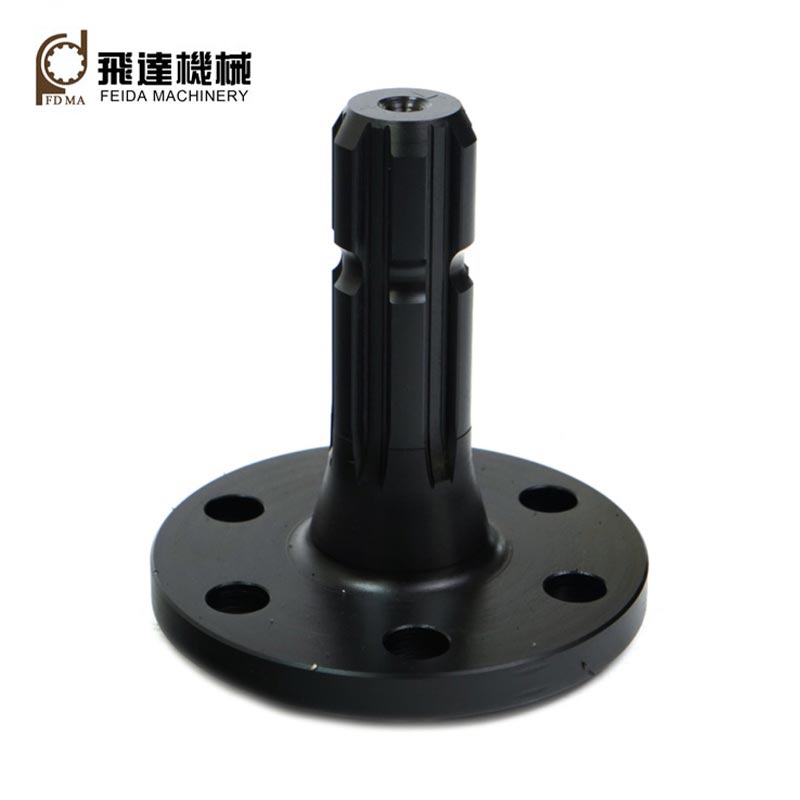
What Are Spline Shafts and How Do They Work?
Spline Shafts feature a series of precisely formed teeth or grooves along the shaft. These teeth engage with corresponding internal splines in a hub, coupling, gear, sleeve, or other mating component. During operation, rotational torque is transferred through multiple spline contact points.
Compared with a conventional keyed shaft, this structure can provide several important advantages:
- More distributed torque transmission
- Improved rotational positioning
- Better load distribution
- Reliable connection between shaft and hub
- Potential for axial sliding in suitable designs
- Easier assembly and disassembly in certain applications
The actual performance depends heavily on spline geometry, material, heat treatment, dimensional accuracy, mating components, lubrication, and operating conditions. Involute spline profiles, for example, can provide self-centering characteristics and favorable load transmission behavior when properly designed.
Why Are Spline Shafts Important in Power Transmission?
The shaft is often one of the key load-bearing components in a mechanical transmission system. If torque is not transferred efficiently, the entire machine can experience vibration, backlash, premature wear, or power loss.
Spline Shafts are important because they combine torque transmission and mechanical positioning within one compact connection.
1. Efficient Torque Transfer
Multiple teeth can participate in torque transmission simultaneously. Instead of concentrating the load at one key interface, the spline structure distributes the load across several contact surfaces.
This makes Spline Shafts particularly useful for machinery exposed to repeated rotation, variable loads, and demanding operating cycles.
2. Stable Mechanical Connection
The matching spline profile helps maintain the angular relationship between connected components. This is valuable in gearboxes, driveshaft assemblies, pumps, industrial machinery, and marine propulsion systems where accurate power transmission is essential.
3. Axial Movement Capability
Certain spline designs allow the mating component to move axially while continuing to transmit rotational torque. This characteristic can be useful in telescopic or adjustable transmission assemblies.
4. Better Adaptability for OEM Equipment
Not every machine can use an off-the-shelf shaft. Equipment manufacturers often require specific lengths, diameters, spline profiles, tooth counts, shoulders, threads, connection structures, or material specifications.
Custom Spline Shafts can therefore be engineered around the complete mechanical assembly instead of forcing the equipment design to fit a standard component.
How Do Spline Shafts Perform in Marine Applications?
Marine propulsion systems place demanding requirements on shafting because components may simultaneously experience torque, bending, thrust, vibration, and corrosive environmental exposure.
This is where customized Spline Shafts can provide particular value.
A marine shaft must work as part of a larger system that may include:
Engine → Gearbox → Coupling → Spline Shaft → Propeller Shaft → Propeller
The exact arrangement varies according to vessel design and propulsion configuration. A shaft designed for a compact recreational boat may be completely different from one required for a fishing vessel, workboat, tugboat, passenger vessel, or commercial marine application.
Vessel-Specific Customization
One of the major advantages of working with Jinjiang Feida Machinery Co., Ltd. is the ability to support custom Spline Shafts according to different vessel types and application requirements.
| Vessel Type | Typical Customization Considerations |
|---|---|
| Fishing Boats | Compact dimensions, durability, continuous operation |
| Workboats | High load capacity, rugged construction, reliability |
| Tugboats | High torque transmission and heavy-duty operation |
| Passenger Boats | Smooth transmission, vibration control, installation space |
| Speedboats | High rotational speed and lightweight design |
| Cargo Vessels | Long-term operation and heavy power transmission |
| Special-Purpose Vessels | Drawing-based and application-specific engineering |
Rather than applying one standard design to every vessel, customization can consider the vessel's propulsion power, gearbox output, installation dimensions, shaft-line arrangement, rotational speed, torque requirements, and connection method.
What Makes Custom Spline Shafts More Valuable?
For OEM buyers and marine equipment manufacturers, customization is more than changing the shaft length. A properly engineered custom shaft can be developed around the complete working environment.
Important parameters may include:
- Shaft overall length
- Outer diameter
- Spline tooth number
- Spline pitch
- Spline major and minor diameter
- Spline profile
- Connection dimensions
- Material specification
- Heat-treatment requirements
- Surface finish
- Tolerance requirements
- Keyways, threads, shoulders, or additional machining
- Installation and mating-part requirements
This approach helps reduce compatibility problems between the shaft and other transmission components.
Spline Shafts vs. Traditional Keyed Shafts
Both connection methods have their place, but their characteristics are different.
| Feature | Spline Shafts | Keyed Shafts |
|---|---|---|
| Torque Distribution | Multiple contact surfaces | Primarily key interface |
| Alignment | Good when properly designed | Dependent on shaft and hub fit |
| Axial Sliding | Possible in suitable designs | Usually limited |
| Compact Transmission | Excellent for many applications | Suitable for simpler systems |
| Customization | Highly adaptable | Generally straightforward |
| Heavy-Duty Applications | Well suited when correctly engineered | Depends strongly on key and shaft design |
For simple machinery, a keyed shaft may remain an economical solution. However, when an application requires higher torque transmission, precise engagement, repeated operation, or controlled axial movement, Spline Shafts can offer significant engineering advantages.
What Are the Practical Effects of Using High-Quality Spline Shafts?
The quality of a Spline Shaft directly affects the performance of the connected transmission system.
A well-designed and accurately manufactured spline connection can help achieve:
Stable torque transmission
Multiple teeth share the load, supporting consistent power transfer.
Reduced connection problems
Accurate spline geometry helps improve mating between the shaft and hub.
Improved operating reliability
Suitable material selection, heat treatment, and dimensional control can contribute to longer service life.
Better maintenance flexibility
Spline connections can facilitate repeated assembly and disassembly in appropriate applications.
Improved equipment integration
Custom dimensions allow the shaft to match the customer's existing mechanical structure.
For marine machinery, these effects become particularly important because unexpected shaft or connection problems can affect propulsion availability and maintenance schedules.
How Does Jinjiang Feida Machinery Support Custom Marine Spline Shafts?
Jinjiang Feida Machinery Co., Ltd. understands that marine customers may have very different shaft requirements. Instead of treating Spline Shafts as a single standardized product, the company can focus on application-specific solutions based on customer drawings, dimensions, samples, and technical requirements.
The customization process can be organized around several key stages:
- Requirement Confirmation – Review vessel type, application, dimensions, torque, speed, and connection requirements.
- Technical Evaluation – Analyze spline geometry and compatibility with mating components.
- Material Selection – Select an appropriate material according to load and operating conditions.
- Precision Manufacturing – Produce the shaft according to the agreed specifications.
- Dimensional Inspection – Check critical dimensions and spline-related parameters.
- Application Matching – Confirm that the finished shaft is suitable for the intended equipment assembly.
This drawing-based approach is particularly valuable for OEM customers developing specialized marine equipment or replacing existing propulsion components.
Why Choose Customized Spline Shafts for Different Vessel Designs?
Every vessel has its own combination of power, speed, weight, propulsion arrangement, operating environment, and available installation space. Marine propulsion shafting must also account for dynamic behavior and different loading conditions.
Therefore, a one-size-fits-all Spline Shaft may not always be the best engineering solution.
With custom manufacturing, customers can specify a shaft around their actual application instead of adapting the vessel to an unsuitable standard product. This is especially useful for:
- New vessel development
- Marine equipment OEM projects
- Propulsion system upgrades
- Replacement shafts
- Special-purpose vessels
- Customized gearbox assemblies
- Low-volume engineering projects
- Different vessel models requiring different shaft dimensions
The ability to customize according to vessel type is therefore a significant advantage for marine buyers seeking reliable transmission components.
What Should Buyers Consider Before Ordering Spline Shafts?
Before placing an order, customers should prepare as much technical information as possible. This helps the manufacturer understand the application and reduce unnecessary design revisions.
A useful specification checklist includes:
- Application and vessel type
- Engine or motor power
- Rated and maximum torque
- Rotational speed
- Shaft length and diameter
- Spline specifications
- Mating component information
- Material requirements
- Heat treatment requirements
- Installation conditions
- Quantity
- Drawing or sample, if available
The more complete the technical information, the easier it is to develop a suitable customized solution.
Final Thoughts
Spline Shafts are more than simple rotating components. They are critical transmission elements that help transfer torque, maintain mechanical alignment, and, where required, accommodate axial movement. Their multi-tooth engagement makes them suitable for demanding industrial and marine applications.
For marine customers, the most important consideration is often not simply finding a Spline Shaft, but finding a shaft customized to the vessel, propulsion system, and operating requirements. With application-focused manufacturing and customization capabilities, Jinjiang Feida Machinery Co., Ltd. can support customers looking for Spline Shafts tailored to different vessel types and mechanical configurations.
If you are developing a marine transmission system, replacing an existing shaft, or need a custom Spline Shaft designed for a specific vessel, contact us with your drawings, dimensions, samples, or technical requirements. Jinjiang Feida Machinery Co., Ltd. can help you explore a suitable customized shaft solution for your application.
