

How Can Telescopic Hydraulic Cylinders Meet the Lifting Requirements of Heavy Equipment?
2026-10-19
A design engineer is specifying the lift system for a 40-ton dump truck. The body must be raised to 8 meters for full discharge. The available space between the chassis frame and the body floor is only 1.5 meters when the body is down. A single-stage cylinder with a 1.5-meter closed length cannot achieve an 8-meter stroke. The engineer specifies a Telescopic Hydraulic Cylinders with five stages. The closed length is 1.4 meters, and the extended length is 8.2 meters. The multi-stage design solves the geometric problem. But it also introduces a new set of engineering considerations: the thrust decreases as the stages extend, the stability decreases as the stages become slender, and the hydraulic system must supply higher pressure to compensate. This guide explains how telescopic cylinders meet the lifting requirements of heavy equipment.
1. How Does Stage Configuration Solve the Stroke-to-Length Problem?
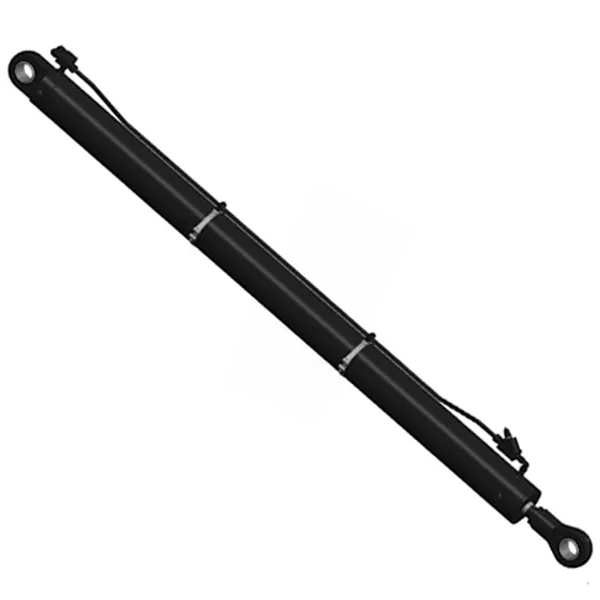
A Telescopic Hydraulic Cylinders consists of multiple nested tubes, called stages or sleeves. The largest stage is the outermost, and the smallest stage is the innermost. When the cylinder is pressurized, the stages extend in sequence from the largest to the smallest. The closed length is determined by the length of the largest stage. The extended length is the sum of the stroke of each stage. The ratio of extended length to closed length can be 3:1 to 6:1, depending on the number of stages. The table below shows the relationship between the number of stages and the length ratio.
| Number of stages | Typical closed length (m) | Typical extended length (m) | Length ratio | Typical application |
| 2 | 1.5 | 3.0 | 2:1 | Small dump trailers |
| 3 | 1.5 | 4.5 | 3:1 | Medium dump trucks |
| 4 | 1.4 | 6.0 | 4.3:1 | Heavy dump trucks |
| 5 | 1.4 | 8.0 | 5.7:1 | Large dump trucks, tippers |
| 6 | 1.3 | 9.5 | 7.3:1 | Specialty heavy equipment |
In our factory, we manufacture Telescopic Hydraulic Cylinders with 2 to 6 stages. The stage configuration is determined by the required stroke and the available closed length. We also consider the thrust requirement at each stage. Raydafon Technology Group Co.,Limited has been manufacturing telescopic cylinders for over 20 years and provides stage configuration calculations for each application.
2. Why Does Thrust Decrease as the Stages Extend?
The thrust of a hydraulic cylinder is the product of the pressure and the effective area. In a Telescopic Hydraulic Cylinders, the effective area decreases as the stages extend because the smaller stages have a smaller diameter. The first stage (largest) provides the highest thrust. The last stage (smallest) provides the lowest thrust. This is the opposite of what is needed in many lifting applications, where the load is highest at the beginning of the lift. The table below shows the thrust at each stage for a five-stage cylinder with a 200 bar supply pressure.
| Stage | Bore diameter (mm) | Effective area (cm²) | Thrust at 200 bar (kN) | Thrust relative to stage 1 |
| 1 (largest) | 200 | 314 | 628 | 100% |
| 2 | 170 | 227 | 454 | 72% |
| 3 | 140 | 154 | 308 | 49% |
| 4 | 110 | 95 | 190 | 30% |
| 5 (smallest) | 80 | 50 | 100 | 16% |
The thrust at the last stage is only 16 percent of the thrust at the first stage. This means that the cylinder can lift the load at the beginning of the stroke, but it may not be able to hold or lift the load at the end of the stroke if the load is constant. In a dump truck, the load decreases as the material slides out, which compensates for the thrust reduction. In a crane, the load is constant, so the cylinder must be sized for the worst-case condition at the last stage. In our factory, we work with the customer to define the load profile and to select the stage diameters that provide adequate thrust throughout the stroke.
3. How Does Stability Affect the Design of a Telescopic Cylinder?
The stability of a Telescopic Hydraulic Cylinders decreases as the stages extend. The extended stages are slender, and they are subjected to bending moments from side loads and from the weight of the load. The critical buckling load is determined by the diameter and the unsupported length of the smallest stage. If the load exceeds the critical buckling load, the cylinder will buckle and fail. The table below shows the critical buckling load for different stage diameters and unsupported lengths.
| Stage diameter (mm) | Unsupported length (m) | Critical buckling load (kN) | Recommended maximum load (kN) |
| 80 | 1.5 | 180 | 90 |
| 80 | 2.0 | 100 | 50 |
| 110 | 2.0 | 260 | 130 |
| 140 | 2.5 | 480 | 240 |
| 170 | 3.0 | 720 | 360 |
Design engineer's note: The stability calculation must consider the worst-case condition, which is usually when the cylinder is fully extended and the load is at its maximum. In a dump truck, the worst case is when the body is fully raised and the load is stuck. In this condition, the cylinder must be able to hold the load without buckling. In our factory, we use a safety factor of 2.0 on the critical buckling load. We also recommend using a guide system or a trunnion mount to reduce the side load on the cylinder.
4. What Hydraulic System Requirements Do Telescopic Cylinders Impose?
A Telescopic Hydraulic Cylinders requires a hydraulic system that can supply the required flow and pressure at each stage. The flow requirement is highest when the first stage is extending, because the first stage has the largest volume. The pressure requirement is highest when the last stage is extending, because the last stage has the smallest area and requires the highest pressure to lift the load. The table below shows the flow and pressure requirements for a five-stage cylinder lifting a 20-ton load.
| Stage | Flow required (L/min) | Pressure required (bar) | Pump power (kW) |
| 1 (largest) | 120 | 65 | 13 |
| 2 | 85 | 90 | 12.8 |
| 3 | 58 | 130 | 12.6 |
| 4 | 35 | 210 | 12.3 |
| 5 (smallest) | 18 | 400 | 12.0 |
The pump power is approximately constant across the stages because the flow decreases as the pressure increases. The hydraulic system must be designed to handle the maximum pressure, which occurs at the last stage. In our factory, we provide the flow and pressure requirements for each telescopic cylinder model. We also recommend using a load-sensing pump or a proportional valve to match the flow and pressure to the stage requirements. Raydafon provides complete hydraulic system design support for telescopic cylinder applications.
Frequently Asked Questions About Telescopic Hydraulic Cylinders for Heavy Equipment
Summary for Design Engineers
Telescopic Hydraulic Cylinders meet the lifting requirements of heavy equipment by providing a long stroke from a short closed length. The multi-stage design solves the geometric constraint, but it introduces thrust reduction, stability concerns, and hydraulic system requirements that must be addressed in the design. The number of stages, the stage diameters, and the mounting arrangement must be selected based on the load profile and the available space. The hydraulic system must supply the required flow and pressure at each stage. By understanding these factors, design engineers can specify a telescopic cylinder that delivers reliable performance in the most demanding heavy equipment applications. Raydafon Technology Group Co.,Limited has been manufacturing Telescopic Hydraulic Cylinders for over 20 years and provides full engineering support for our customers.
Raydafon Technology Group Co.,Limited manufactures Telescopic Hydraulic Cylinders with 2 to 6 stages, single-acting and double-acting configurations, and custom mounting arrangements. We provide stage configuration calculations, thrust and stability data, and hydraulic system requirements for all of our products.
