

How do Belt Pulleys support reliable operation in general industrial equipment?
2026-10-15
Belt Pulleys play an important role in general industrial equipment by transferring rotational power between shafts while helping maintain stable operating speeds and predictable mechanical performance. They are widely used in conveyors, ventilation systems, pumps, compressors, agricultural machinery, and production-line equipment. Their reliability depends on more than the pulley itself. Material strength, groove geometry, shaft fit, belt compatibility, alignment, and operating load all influence the performance of the complete drive system. At Zhejiang Hawen Electromechanical Co., Ltd., we consider these factors when evaluating pulley requirements for industrial applications. A properly specified pulley helps reduce unnecessary belt wear, limit vibration, and support consistent equipment operation under normal working conditions.
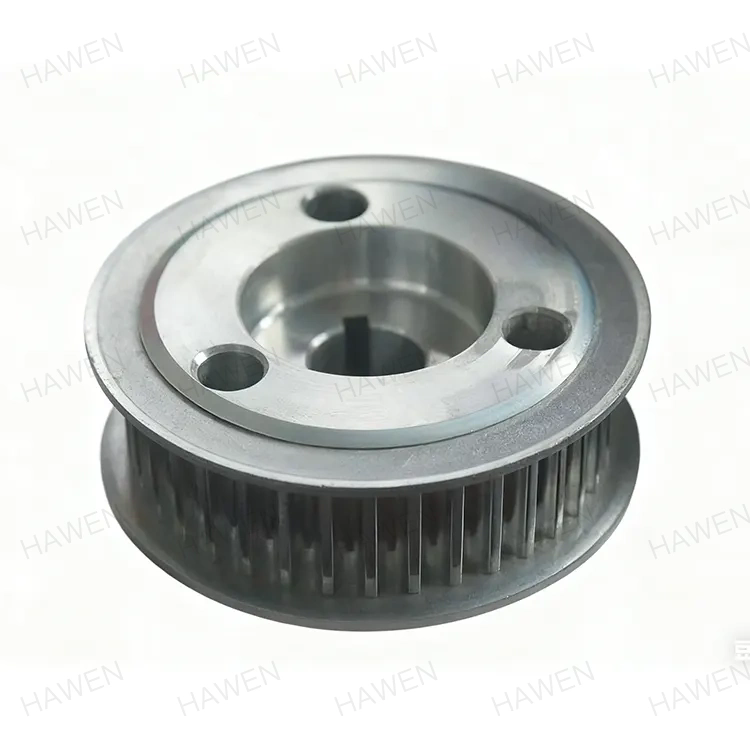
Why Are Pulleys Important to Industrial Power Transmission?
A belt drive transfers mechanical power through the interaction between a driving pulley, a driven pulley, and a compatible belt. As the motor rotates the driving pulley, friction or positive engagement moves the belt and transmits torque to the driven shaft. This arrangement allows machinery designers to position components flexibly, adjust speed ratios, and isolate some motor vibration from the driven equipment.
In a conventional belt drive, the pulley diameter ratio influences the speed relationship between the shafts. For a simple drive without significant slip, the driven speed can be estimated by dividing the driving pulley pitch diameter by the driven pulley pitch diameter and multiplying the result by the driving speed. The pitch diameter, rather than the outside diameter, is the relevant reference for many belt-drive calculations.
For example, a driving pulley with a pitch diameter of 100 mm operating at 1,500 rpm and a driven pulley with a pitch diameter of 200 mm will produce an ideal driven speed of approximately 750 rpm. Actual performance can differ because of belt slip, elastic deformation, loading, and other operating conditions. This calculation provides a starting point for drive design, not a guarantee of the final machine speed.
| Drive parameter | Engineering significance | What buyers should confirm |
| Pitch diameter | Determines the effective belt contact diameter and influences speed ratio | Required speed relationship and belt profile |
| Groove profile | Controls belt seating and force transmission in grooved belt systems | Compatibility with the specified belt section |
| Bore diameter | Determines the fit between the pulley and shaft or mounting system | Shaft dimensions and required fit tolerance |
| Number of grooves | Influences belt arrangement and available power transmission capacity | Required belt count and manufacturer load ratings |
| Operating speed | Affects centrifugal forces, vibration sensitivity, and service conditions | Normal speed, peak speed, and duty cycle |
| Material and construction | Influence strength, mass, corrosion behaviour, and dimensional stability | Load, environment, temperature, and maintenance requirements |
Our approach to drive selection begins with the machine's actual operating requirements. A conveyor operating for extended shifts may place different demands on its drive components than a ventilation fan with a relatively steady load. Understanding the duty cycle, required torque, and expected service conditions helps prevent the common mistake of selecting a pulley by diameter alone.
Which Design and Material Factors Influence Service Life?
Reliable performance starts with a pulley that matches the belt, shaft, and transmission load. V-belt pulleys rely on correctly formed grooves to maintain belt contact and transmit force. Timing pulleys use toothed profiles that engage with a matching synchronous belt. Flat-belt systems require suitable surface geometry and belt tracking arrangements. These designs are not interchangeable, and selecting the wrong profile can lead to poor engagement, slipping, excessive wear, or premature drive failure.
Material selection is equally important. Cast iron is commonly used in general-purpose industrial drives because it provides useful rigidity and wear performance for many conventional applications. Steel pulleys may be appropriate where higher mechanical strength, impact resistance, or a particular manufacturing configuration is required. Aluminium can reduce rotating mass in suitable light-duty systems, while corrosion-resistant materials or protective finishes may be considered for demanding environmental conditions.
Each material involves trade-offs. A heavier pulley increases rotating inertia and may affect acceleration requirements. A lighter pulley can reduce the load associated with starting and stopping, but its suitability still depends on strength, geometry, and operating speed. Corrosion protection also needs to match the exposure conditions, especially in humid facilities, washdown areas, and environments containing corrosive contaminants.
| Product specification | Common engineering considerations | Application relevance |
| Material grade | Mechanical strength, machinability, mass, and corrosion behaviour | Must suit the operating load and environment |
| Outside and pitch diameters | Speed ratio, belt path, and available installation space | Need to match the drive design |
| Groove dimensions | Profile angle, depth, spacing, and dimensional consistency | Must match the selected belt specification |
| Bore and mounting style | Plain bore, keyed bore, taper-lock bushing, or other specified mounting arrangement | Must suit the shaft and torque transmission requirements |
| Balance and runout | Rotational stability and vibration behaviour | Especially important for higher-speed or vibration-sensitive equipment |
| Surface protection | Coating, finish, and resistance to the operating environment | Selected according to moisture, contamination, and corrosion exposure |
Exact product parameters should be confirmed against the approved drawing and applicable manufacturing specification. There is no single bore tolerance, groove dimension, hardness value, or maximum speed that applies to every pulley design. The permitted values depend on the pulley type, diameter, material, mounting method, and intended service conditions.
At Zhejiang Hawen Electromechanical Co., Ltd., our factory considers the relationship between design geometry and the intended installation when reviewing product requirements. Buyers should provide the shaft drawing, belt designation, target speed, transmitted power, and mounting details whenever possible. This information allows the supplier to assess compatibility instead of relying on a general product description that may not reflect the actual machine.
How Do Correct Installation and Alignment Prevent Common Failures?
Even a well-manufactured pulley can contribute to unreliable operation when it is installed incorrectly. Angular misalignment, parallel offset, an unsuitable shaft fit, and uneven mounting pressure can create abnormal belt tracking and loading. The consequences may include edge wear, excessive noise, vibration, bearing stress, and repeated belt replacement.
Before installation, technicians should inspect the shaft, keyway, mounting hardware, and pulley contact surfaces for damage or contamination. The mounting method should follow the manufacturer's instructions. A keyed connection or taper-lock bushing must be installed and secured correctly, while excessive force should not be applied in a way that damages the bore, shaft, or bearings.
Alignment should be checked using an appropriate straightedge, laser alignment tool, or other suitable method. The permissible alignment error depends on the drive design and manufacturer's guidance. Belt tension should also be adjusted to the specified range. Excessive tension increases radial load on shafts and bearings, while insufficient tension can cause slip, heat generation, and unstable power transmission.
For multi-belt drives, all belts should be compatible with the pulley grooves and selected as a suitable matched set when required by the drive manufacturer. Mixing belts with significantly different lengths or wear conditions can cause uneven load sharing. During commissioning, operators should observe belt tracking, temperature, vibration, and unusual noise, then recheck tension according to the equipment maintenance procedure.
Our maintenance recommendations focus on identifying developing problems before they cause unplanned downtime. Regular inspections should look for cracked or damaged pulley sections, worn grooves, loose fasteners, corrosion, belt glazing, and abnormal bearing temperatures. Any damaged rotating component should be assessed before the equipment returns to service.
What Maintenance Practices Keep Industrial Drives Reliable?
Preventive maintenance helps preserve drive efficiency and makes wear patterns easier to identify. The inspection interval should reflect operating speed, load variation, dust exposure, temperature, and the consequences of a drive failure. Equipment operating continuously in a dusty production area may require more frequent inspection than a lightly loaded machine used intermittently.
- Inspect belt condition: Look for cracking, fraying, glazing, deformation, and signs of contamination. Replace belts according to the manufacturer's criteria.
- Check alignment: Confirm that the driving and driven shafts remain aligned within the permitted limits.
- Verify belt tension: Use the specified tension measurement method rather than relying only on visual appearance.
- Monitor vibration and noise: Changes from the normal operating pattern can indicate imbalance, misalignment, bearing problems, or belt deterioration.
- Examine mounting hardware: Check for looseness, fretting, damaged keyways, or movement between the pulley and shaft.
- Keep the drive clean: Remove accumulated debris safely and prevent oil or other incompatible substances from contaminating the belt.
- Record inspection results: Tracking tension, vibration, temperature, and replacement history helps identify recurring problems.
Lubrication practices require particular care. Most conventional belt surfaces should not be lubricated unless the specific drive manufacturer expressly requires it, because oil or grease can reduce traction and damage belt materials. Bearings and other lubricated machine components should follow their own maintenance schedules, independently of the belt drive.
Replacement decisions should consider the condition of the entire drive. Installing a new belt on a severely worn pulley may not restore proper contact or transmission efficiency. Likewise, replacing a pulley without correcting the underlying misalignment or excessive tension can lead to another early failure. Addressing the root cause is usually more effective than repeatedly replacing individual parts.
Where production continuity is important, our factory recommends defining acceptance criteria before ordering replacement components. These can include material identification, dimensional checks, bore and groove measurements, runout limits, visual inspection, and any required balance verification. Agreed inspection records also help maintenance teams confirm that replacement parts are consistent with the original equipment specification.
Frequently Asked Questions About Industrial Pulley Reliability
How do Belt Pulleys support reliable operation in general industrial equipment?
They transmit rotational power between shafts and help establish the required speed relationship in a belt-driven system. Reliability depends on matching the pulley profile, pitch diameter, material, bore, and mounting method to the belt and operating load. Correct alignment, suitable belt tension, and routine inspection further reduce the risk of slipping, vibration, uneven wear, and unplanned downtime.
How can buyers determine the correct pulley specifications for a replacement part?
Buyers should identify the existing pulley type, belt designation, pitch and outside diameters, groove profile, bore size, mounting arrangement, operating speed, and transmitted power. Shaft drawings and the original equipment manufacturer's documentation provide useful reference points. The replacement should also meet the required material, tolerance, runout, balance, and environmental specifications. Matching the nominal diameter alone is not sufficient to confirm compatibility.
What are the most common causes of premature pulley and belt drive failure?
Common causes include incorrect belt tension, shaft misalignment, incompatible groove geometry, excessive load, contamination, worn grooves, loose mounting hardware, and vibration caused by damaged or poorly balanced components. Preventive maintenance should examine both the pulley and the belt system because the visible damage may be a symptom of a problem elsewhere in the drive. Correcting the underlying cause helps reduce repeated failures and maintenance costs.
How Can the Right Pulley Specification Improve Equipment Reliability?
Reliable belt-driven equipment depends on a coordinated combination of pulley design, material selection, dimensional accuracy, installation quality, and preventive maintenance. The correct specification supports stable power transmission, reduces unnecessary wear, and helps maintenance teams manage operating costs over the equipment's service life. Zhejiang Hawen Electromechanical Co., Ltd. works with industrial requirements to evaluate pulley configurations according to application conditions and technical specifications. Contact our team with your belt type, shaft dimensions, required speed ratio, operating load, and installation drawing to discuss a suitable pulley solution for your equipment.
