

How Do Nitrogen and Oxygen Generators Separate Air into Pure Gases?
2026-09-29
Air is a mixture of gases. By volume, it contains approximately 78 percent nitrogen, 21 percent oxygen, and 1 percent argon and other trace gases. The challenge for any industrial gas user is to separate these components into streams that are pure enough for the intended process. A Nitrogen and Oxygen Generators system does this on site, eliminating the need for delivered liquid gas or cylinder supply. The separation is based on the difference in molecular size, boiling point, or adsorption characteristics of the gases. The choice of technology depends on the required purity, flow rate, and operating cost. This guide explains the two most common separation methods and how to match them to your application.
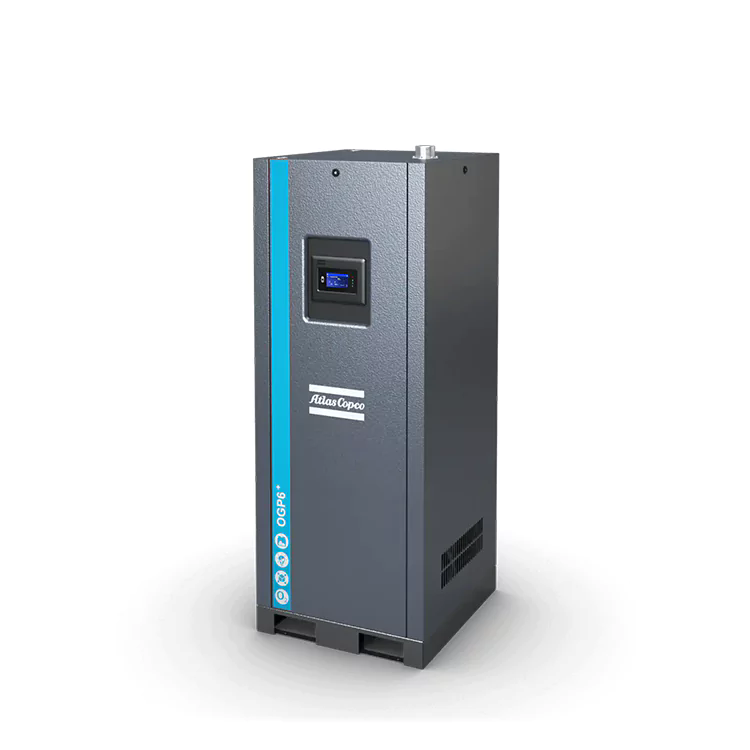
1. What Is the Principle Behind Pressure Swing Adsorption for Nitrogen and Oxygen Generators?
Pressure swing adsorption, or PSA, uses a carbon molecular sieve to separate nitrogen from oxygen. The sieve is a porous material with pores that are sized to allow oxygen molecules to enter while excluding nitrogen molecules. When compressed air is passed through a bed of carbon molecular sieve, the oxygen is adsorbed into the pores, and the nitrogen passes through as product gas. After a short period, the bed becomes saturated with oxygen and must be regenerated. The regeneration is done by reducing the pressure, which releases the oxygen and allows the bed to be reused. Two beds are used in alternating cycles, so that one bed is producing nitrogen while the other is regenerating. The table below shows the typical performance of a PSA nitrogen generator.
| Parameter | Typical range | Notes |
| Nitrogen purity | 95% – 99.9995% | Higher purity requires lower flow |
| Nitrogen flow rate | 1 – 5,000 Nm³/h | Multiple units can be paralleled |
| Oxygen content | 5% – 0.0005% | Depends on purity setting |
| Dew point | -40°C to -70°C | Requires dryer upstream |
| Air to nitrogen ratio | 2:1 to 5:1 | Higher purity increases ratio |
In our factory, we manufacture PSA Nitrogen and Oxygen Generators with capacities from 1 to 5,000 Nm³/h. The carbon molecular sieve is sourced from high-quality suppliers and is tested for adsorption capacity and crush strength. The PSA cycle is controlled by PLC, with automatic switching valves and purity monitoring. The purity can be set from 95 percent to 99.9995 percent depending on the application.
2. How Does Membrane Separation Work for Nitrogen Production?
Membrane separation uses hollow fiber membranes made from polymeric materials. The membranes are bundled together in a pressure vessel. When compressed air is fed into the vessel, the gases permeate through the membrane at different rates. Oxygen, carbon dioxide, and water vapor permeate faster than nitrogen. The nitrogen-rich gas that does not permeate is collected as product. The membrane separation process is simpler than PSA because it has no moving parts and no regeneration cycle. However, it is less efficient for high-purity nitrogen. The typical purity for a membrane nitrogen generator is 95 to 99.5 percent. The table below compares membrane and PSA technologies.
| Parameter | PSA | Membrane |
| Nitrogen purity range | 95% – 99.9995% | 95% – 99.5% |
| Flow rate range | 1 – 5,000 Nm³/h | 1 – 500 Nm³/h |
| Moving parts | Valves and controls | None (except compressor) |
| Maintenance requirement | Moderate (valve replacement) | Low (membrane replacement every 5-8 years) |
| Response to purity change | Fast (within minutes) | Slow (requires stabilization) |
| Air to nitrogen ratio | 2:1 to 5:1 | 3:1 to 6:1 |
Shanghai GDK International Trade Co., Ltd. supplies both PSA and membrane Nitrogen and Oxygen Generators. The choice between the two depends on the required purity, the flow rate, and the available space. For high-purity applications such as electronics or pharmaceutical manufacturing, PSA is the better choice. For low-purity applications such as tire inflation or food packaging, membrane is often more economical.
3. How Is Oxygen Produced On Site?
Oxygen can also be produced on site using PSA or vacuum swing adsorption (VSA). In the PSA oxygen process, a zeolite molecular sieve is used. The zeolite adsorbs nitrogen preferentially, allowing oxygen to pass through as product. The oxygen purity from a PSA oxygen generator is typically 90 to 95 percent. For higher purity, a second stage or a different technology such as cryogenic distillation is required. The table below shows the typical performance of a PSA oxygen generator.
| Parameter | Typical range | Notes |
| Oxygen purity | 90% – 95% | Higher purity requires additional stages |
| Oxygen flow rate | 1 – 500 Nm³/h | Multiple units can be paralleled |
| Nitrogen content | 5% – 10% | Depends on purity setting |
| Dew point | -40°C to -60°C | Requires dryer upstream |
| Air to oxygen ratio | 3:1 to 6:1 | Higher purity increases ratio |
In our factory, we supply PSA oxygen generators for applications such as wastewater treatment, fish farming, and medical oxygen supply. The zeolite sieve is selected for high adsorption capacity and long life. The generators are equipped with oxygen analyzers and automatic purity control. For medical applications, we provide additional filtration and monitoring to meet pharmacopoeia standards.
4. How Do You Select the Right Nitrogen and Oxygen Generators for Your Application?
The selection process follows four steps. First, determine the required purity. This is the most important parameter because it affects the technology choice and the operating cost. Second, determine the required flow rate. This determines the size of the generator and the compressor. Third, determine the operating conditions, including the ambient temperature, the altitude, and the available utilities. Fourth, determine the budget and the payback period. The table below provides a selection guide for common applications.
| Application | Recommended technology | Typical purity | Typical flow rate |
| Food packaging (MAP) | PSA or membrane | 99.5% – 99.9% N₂ | 10 – 200 Nm³/h |
| Electronics soldering | PSA | 99.999% N₂ | 5 – 100 Nm³/h |
| Pharmaceutical blanketing | PSA | 99.9% – 99.999% N₂ | 10 – 500 Nm³/h |
| Tire inflation | Membrane | 95% – 98% N₂ | 1 – 50 Nm³/h |
| Wastewater treatment | PSA | 90% – 93% O₂ | 5 – 200 Nm³/h |
| Fish farming | PSA | 90% – 95% O₂ | 2 – 100 Nm³/h |
Selection tip: The operating cost of a Nitrogen and Oxygen Generators system is primarily the electricity to run the air compressor. For every 1 Nm³/h of nitrogen at 99.9 percent purity, the compressor requires approximately 0.5 to 0.8 kW. For oxygen at 93 percent purity, the requirement is 0.6 to 1.0 kW per Nm³/h. The payback period compared to delivered gas is typically 12 to 24 months.
Frequently Asked Questions About Nitrogen and Oxygen Generators
Summary for Gas System Engineers
Nitrogen and Oxygen Generators separate air into pure gases using either pressure swing adsorption or membrane separation. PSA is suitable for high-purity applications and can produce nitrogen up to 99.9995 percent and oxygen up to 95 percent. Membrane separation is simpler and more economical for low-purity nitrogen applications. The selection of the right technology depends on the required purity, flow rate, and operating conditions. On-site generation eliminates the cost and logistics of delivered gas and provides a reliable supply. Shanghai GDK International Trade Co., Ltd. supplies a full range of Nitrogen and Oxygen Generators and provides technical support for selection and installation.
Shanghai GDK International Trade Co., Ltd. supplies PSA and membrane Nitrogen and Oxygen Generators in capacities from 1 to 5,000 Nm³/h. We provide complete air treatment packages, installation supervision, and operator training.
