

How Do You Properly Size a ZK2 Vacuum Ejector for High-Speed Pick-and-Place Applications
2026-08-20
Selecting the correct vacuum generation system directly impacts throughput, energy costs, and downtime in automated assembly lines. For high-speed pick-and-place operations, the ZK2 Vacuum Ejector series from Gaxis offers a compact, energy-efficient solution—but only if sized correctly. Undersizing leads to dropped components and cycle interruptions, while oversizing wastes compressed air and increases operational expenses. This guide walks through the engineering methodology for sizing a ZK2 Vacuum Ejector, integrating real-world application data, and addresses the most frequent questions engineers ask during system design.
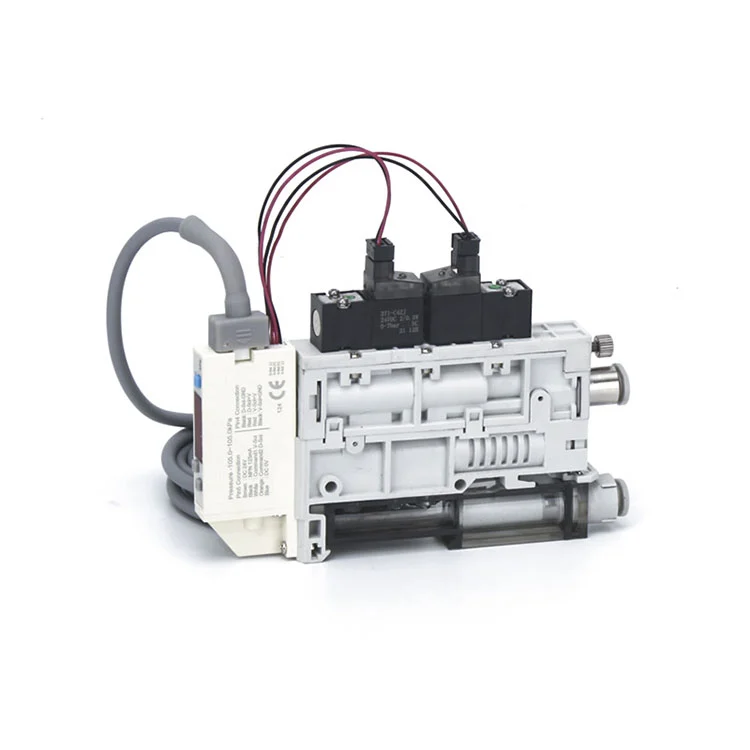
Core Sizing Parameters for ZK2 Vacuum Ejectors
Proper sizing rests on four interdependent variables. The table below outlines each parameter with its typical measurement unit and impact on ejector selection.
| Parameter | Unit | Measurement Method | Impact on Sizing |
|---|---|---|---|
| Required vacuum level | kPa / -bar | Gauge at suction cup | Determines ejector stage count |
| Effective suction flow rate | L/min (ANR) | Flow meter at cup | Drives nozzle diameter choice |
| System response time | milliseconds | Cycle time analysis | Influences blow-off function requirement |
| Total leak rate | L/min | Pressure decay test | Adds safety margin (15–30%) |
Step-by-Step Sizing Procedure for High-Speed Lines
Step 1: Define the Pick-and-Place Cycle Profile
Map out the complete motion sequence: approach, contact, vacuum build-up, acceleration, transport, deceleration, blow-off, and release. For a high-speed application (typically >120 cycles/min), the vacuum build-up phase must not exceed 50 ms. The ZK2 Vacuum Ejector achieves this with its large-diameter solenoid valve and optimized internal flow paths.
Step 2: Calculate the Required Vacuum Flow (Q_eff)
Use the formula:
Q_eff = (V_cup × N) / t_build + Q_leak
Where:
-
V_cup = internal volume of each suction cup (L)
-
N = number of active cups
-
t_build = target vacuum build time (seconds)
-
Q_leak = measured or estimated leakage from porous parts (add 20% safety factor)
For a typical electronics pick-and-place handling 0805 components with 4 cups (each 0.5 mL volume), t_build = 0.05 s, and Q_leak = 2 L/min, the required Q_eff equals approximately 14.5 L/min. This falls within the optimal range for the ZK2 Vacuum Ejector with a 0.7 mm nozzle.
Step 3: Match Nozzle Size to Flow Demand
The ZK2 Vacuum Ejector offers interchangeable nozzles from 0.5 mm to 1.2 mm. Reference the performance curve below (representative data for supply pressure at 5.5 bar):
| Nozzle Diameter (mm) | Max Vacuum (-kPa) | Flow at 60% Vacuum (L/min) | Recommended Application |
|---|---|---|---|
| 0.5 | 92 | 8 | Light, non-porous (chips, LEDs) |
| 0.7 (Gaxis default) | 88 | 16 | General SMT components |
| 1.0 | 82 | 32 | Heavy or porous (metal housings) |
| 1.2 | 72 | 52 | Large-area panels, high-leak parts |
For high-speed lines, Gaxis recommends starting with the 0.7 mm nozzle and only upsizing if the build time exceeds 60 ms at 80% of max vacuum.
Step 4: Verify Blow-Off Capability
In high-speed pick-and-place, release time is as critical as pick-up time. The integrated blow-off function in the ZK2 Vacuum Ejector uses a separate pilot valve to reverse flow, reducing release time to under 30 ms. Verify that your selected model includes the quick-release option—standard on all Gaxis ZK2 units ordered with suffix “-QB”.
Common Pitfalls and Corrections
-
Overlooking dynamic pressure drop – Supply line losses at peak flow can reduce inlet pressure from 6 bar to 4.5 bar, dropping ejector performance by 35%. Install a pressure gauge at the ejector inlet, not at the compressor outlet.
-
Ignoring temperature effects – Warm compressed air (above 40°C) reduces density and therefore mass flow. Derate the ZK2 Vacuum Ejector flow by 2% per °C above 25°C.
-
Mismatched cup compliance – Soft cups deform under high vacuum, increasing internal volume and extending build time. Use rigid cups with integrated springs for high-speed motions.
Frequently Asked Questions about ZK2 Vacuum Ejectors
Q1: Can the ZK2 Vacuum Ejector maintain stable vacuum during rapid acceleration of the robot arm?
A: Yes, but only if the ejector is sized with an adequate buffer volume (recommended 50–100 mL) between the ejector outlet and the cup. During acceleration, inertial forces create transient pressure spikes. The internal non-return valve of the ZK2 Vacuum Ejector prevents backflow, but the buffer volume ensures the vacuum level stays within ±5 kPa during 3G accelerations. For applications exceeding 5G, Gaxis offers an optional external vacuum reservoir kit that increases stability without enlarging the ejector itself.
Q2: How do I decide between single-stage and multi-stage operation for a ZK2 Vacuum Ejector in high-speed lines?
A: The ZK2 Vacuum Ejector is a multi-stage ejector by design (three series-connected nozzles). This configuration delivers higher vacuum (up to -92 kPa) at lower air consumption compared to single-stage types. For high-speed lines where cycle time is paramount, always choose the multi-stage version. However, if your parts are highly porous (e.g., sintered metals or unsealed paper boards), the single-stage variant provides higher flow at lower vacuum levels. Gaxis application engineers can run a porosity test on your sample parts to confirm the optimal stage count—this service is complementary for qualified projects.
Q3: What is the recommended supply pressure range for the ZK2 Vacuum Ejector, and how does pressure fluctuation affect sizing?
A: The nominal supply pressure is 4.5 to 6.5 bar, with the optimum at 5.5 bar. Below 4.0 bar, the ejector loses approximately 25% of its rated flow, and the vacuum build time doubles. Above 7.0 bar, the internal check valve may chatter, reducing service life. When sizing, always use the minimum expected supply pressure (not the plant average) in your flow calculation. For plants with pressure variation > ±0.5 bar, Gaxis recommends installing a precision pressure regulator upstream of each ZK2 Vacuum Ejector and adding a 10% extra flow margin to compensate for low-pressure periods.
Final Sizing Checklist from Gaxis
-
□
Cycle time analysis complete (including acceleration/deceleration profiles)
-
□
Cup volume and number confirmed with 20% leak margin
-
□
Nozzle diameter selected from performance table
-
□
Supply pressure measured at the ejector inlet under peak flow
-
□
Blow-off response time validated with a pressure transducer
-
□
Buffer volume added for high-G motions
Optimize Your Line with the Right ZK2 Vacuum Ejector
Incorrect sizing remains the number one cause of productivity loss in automated pick-and-place systems. The ZK2 Vacuum Ejector from Gaxis combines energy-efficient multi-stage technology with rapid blow-off and robust construction—but its full potential is unlocked only when matched precisely to your application parameters.
Contact us today to schedule a free application review. Our technical team will analyze your cycle data, cup configuration, and supply conditions, then deliver a recommended ZK2 Vacuum Ejector configuration with guaranteed build and release times. Reach out via the Gaxis website or email our support engineers directly—we respond to all sizing inquiries within 4 business hours. Let us help you achieve faster cycles, lower air consumption, and zero missed picks.
