

How Does a 20A Long Handle Transfer Cam Switch Improve Manual Circuit Control?
2026-09-28
In industrial electrical systems, reliable manual circuit switching is essential for equipment operation, power transfer, maintenance, and load management. A 20A Long Handle Transfer Cam Switch provides a practical way to control and transfer electrical circuits through a clearly defined rotary mechanism. Unlike simple on/off switches, cam switches can manage multiple contact configurations through different positions, making them suitable for motor control, source selection, equipment testing, and other industrial applications. Rotary cam switches are commonly used for circuit changeover and motor-control functions because one mechanical operation can control several contacts in a predetermined sequence.
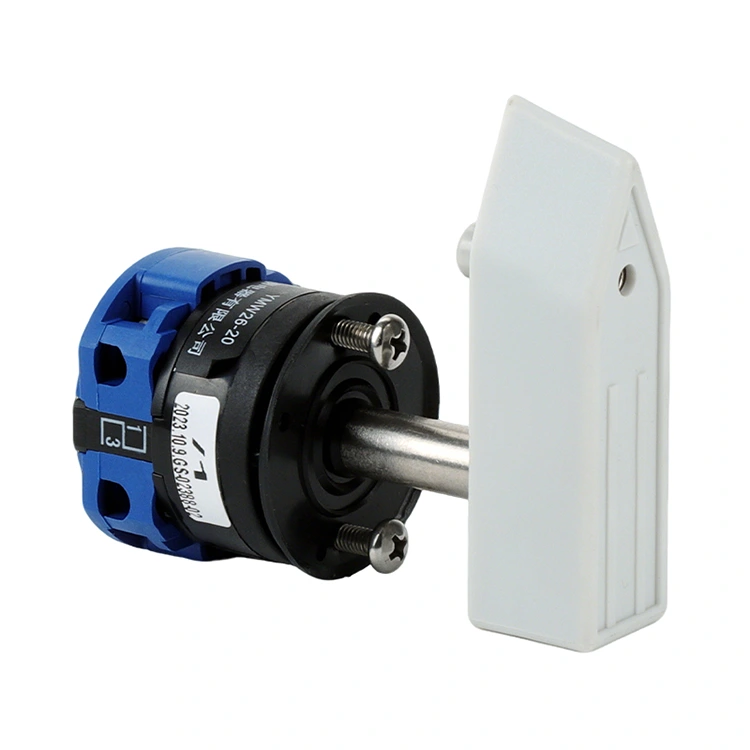
What Is a 20A Long Handle Transfer Cam Switch?
A 20A Long Handle Transfer Cam Switch is a manually operated rotary switch designed to transfer or select electrical circuits according to predefined contact positions. The 20A rating identifies its nominal current capacity, while the long handle provides a more visible and convenient operating interface.
When the operator rotates the handle, the internal cam mechanism changes the contact configuration. This makes it possible to select different circuit states with one controlled movement rather than operating several independent switches.
Depending on the configuration, transfer cam switches can be used for:
-
Power source selection
-
Manual circuit transfer
-
Motor forward/reverse control
-
Equipment testing and maintenance
-
Control-circuit switching
-
Machine operating-mode selection
-
Distribution and load-selection applications
Commercially available 20A transfer cam switches are offered in different pole numbers, positions, mounting formats, and voltage configurations, so the exact electrical specifications should always be matched to the intended installation.
Why Is the Long Handle Important?
The handle is more than an operating accessory. In industrial environments, operators may need to switch equipment while wearing gloves or while standing in front of a control panel. A longer handle can provide improved grip and make the selected position easier to identify.
Its practical benefits include:
| Feature | Practical Effect |
|---|---|
| Long operating handle | Easier manual operation |
| Rotary mechanism | Clear position-based switching |
| 20A current rating | Suitable for specified medium-current applications |
| Multiple contact configurations | Supports different transfer functions |
| Panel mounting | Convenient integration into control cabinets |
| Mechanical operation | Direct manual control without relying on electronic control signals |
The appropriate handle length, mounting method, contact arrangement, and electrical rating should be selected according to the actual equipment design.
How Does the Transfer Mechanism Work?
The operating principle is based on a rotating shaft and cam profiles. As the handle moves between defined positions, the cams mechanically actuate the internal contacts. This creates a repeatable switching sequence.
For example, a basic transfer arrangement may provide:
Source A → OFF → Source B
A more complex machine-control configuration may provide several operating positions for different functions.
This mechanical approach is particularly useful when operators need an obvious physical indication of the selected state. Unlike a simple push button, the rotary position itself can communicate which operating mode or circuit has been selected.
Where Can It Be Used?
The versatility of a 20A Long Handle Transfer Cam Switch makes it suitable for various electrical and industrial environments.
1. Power Transfer
It can be incorporated into systems where an operator needs to manually select between two electrical sources, provided the switch's voltage, current, pole configuration, and switching category are suitable.
2. Motor Control
Cam switches are widely used for manual motor-control functions, including direction selection and other predefined operating modes.
3. Industrial Machinery
Manufacturing equipment often requires clear manual selection between operating states. A rotary transfer switch can simplify the operator interface while maintaining a defined switching sequence.
4. Control Panels
Its panel-mounted format makes it suitable for electrical cabinets, machine-control panels, distribution equipment, and testing systems.
5. Maintenance and Testing
A manually operated switch can help technicians select specific circuit states during inspection, troubleshooting, or equipment maintenance, subject to the system's safety design.
What Effects Can It Deliver in Practical Applications?
The main value of a 20A Long Handle Transfer Cam Switch is not simply its current rating. Its value comes from combining manual control, defined switching positions, and a relatively straightforward mechanical structure.
Key practical effects include:
-
Improved operating convenience: The long handle gives operators a clear and accessible control point.
-
Clear switching status: Defined rotary positions make the selected circuit state easier to recognize.
-
Simplified circuit management: Multiple contacts can be controlled through one operating mechanism.
-
Flexible application: Different contact arrangements can support different machine-control requirements.
-
Reduced control complexity: Manual switching can perform certain functions without requiring a separate electronic control sequence.
-
Consistent operation: The cam mechanism determines the contact sequence according to its designed configuration.
Why Does Specification Matching Matter?
Not every 20A cam switch is suitable for every 20A application. The current rating is only one part of the selection process.
Before installation, buyers and engineers should consider:
-
Rated voltage – Confirm that the switch is appropriate for the system voltage.
-
Rated current – Check the actual continuous and application-specific load.
-
Number of poles – Make sure the switch can control the required circuits.
-
Number of positions – Match the switch positions to the required operating sequence.
-
Switching category – Motor and power-transfer applications can impose different electrical demands.
-
Mounting dimensions – Confirm compatibility with the control panel.
-
Environmental conditions – Consider dust, moisture, temperature, vibration, and enclosure requirements.
-
Contact configuration – Verify the required open/closed sequence before ordering.
For motor and power applications, engineers should pay particular attention to the applicable utilization category rather than selecting a product based only on the headline "20A" specification.
20A Long Handle Transfer Cam Switch vs. Conventional Toggle Switch
A conventional toggle switch may be sufficient for simple single-function control, but a transfer cam switch provides a different operating concept.
| Comparison | 20A Long Handle Transfer Cam Switch | Conventional Toggle Switch |
|---|---|---|
| Operating method | Rotary | Toggle |
| Multiple positions | Commonly available | Usually more limited |
| Multi-contact control | Suitable configurations available | More limited |
| Transfer functions | Well suited | Depends on configuration |
| Position indication | Clear rotary positions | Basic |
| Industrial machine control | Widely applicable | Suitable for simpler functions |
| Manual source selection | Suitable configurations available | Application dependent |
The choice should therefore be based on the electrical circuit and operating requirements rather than simply comparing the physical appearance of the two switch types.
Choosing the Right Supplier
For industrial buyers, product quality is only one consideration. Consistent specifications, suitable configurations, manufacturing capability, technical communication, and responsive support can also influence procurement efficiency.
Qingdao Uet Machinery Co., Ltd. can provide professional support for buyers looking for industrial switching components and related machinery solutions. For projects requiring a 20A Long Handle Transfer Cam Switch, the product should be evaluated according to the actual circuit design, installation environment, switching requirements, and equipment application.
A reliable selection process starts with the application rather than the product name. By confirming current, voltage, poles, positions, mounting dimensions, and switching requirements in advance, buyers can reduce specification mismatches and select a cam switch that fits the intended equipment.
Final Considerations
A 20A Long Handle Transfer Cam Switch combines straightforward mechanical operation with flexible circuit-transfer capabilities. Its long handle can improve manual accessibility, while the rotary cam mechanism enables predefined contact sequences for applications such as power transfer, motor control, machinery operation, and control-panel switching.
For OEMs, machinery manufacturers, electrical equipment integrators, and industrial buyers, choosing the correct configuration is essential to achieving reliable performance. Qingdao Uet Machinery Co., Ltd. is ready to discuss application requirements and product specifications for different industrial projects. If you need assistance selecting a suitable transfer cam switch for your equipment, contact us to discuss your requirements and find an appropriate solution.
