Abstract
The ratchet socket wrench has become an essential tool in automotive repair, industrial maintenance, and general mechanical work due to its ability to significantly reduce working time while increasing torque efficiency and operational comfort.
This article explores how the tool works, why it solves common user pain points such as slippage, fatigue, and inefficiency, and how professionals and DIY users can choose and maintain the right model for long-term performance.
Introduction
In mechanical fastening tasks, efficiency and precision determine productivity. Traditional wrenches require repeated repositioning, which slows down work and increases operator fatigue.
The ratchet socket wrench eliminates this limitation by allowing continuous rotation without removing the tool from the fastener.
This design innovation has transformed workflows in automotive garages, construction sites, and home repair environments.
Common User Pain Points
Before the widespread adoption of ratcheting tools, users often faced several challenges:
-
Time inefficiency: Constant repositioning of standard wrenches slows down repetitive fastening tasks.
-
Hand fatigue: Continuous grip adjustment increases strain during prolonged use.
-
Limited access: Tight or confined spaces make traditional tools difficult to operate.
-
Slippage risk: Improper grip or angle leads to rounded bolts or tool slipping.
These issues created a demand for a more adaptive and ergonomic solution, leading to the evolution of the ratchet socket wrench system.
What Is a Ratchet Socket Wrench?
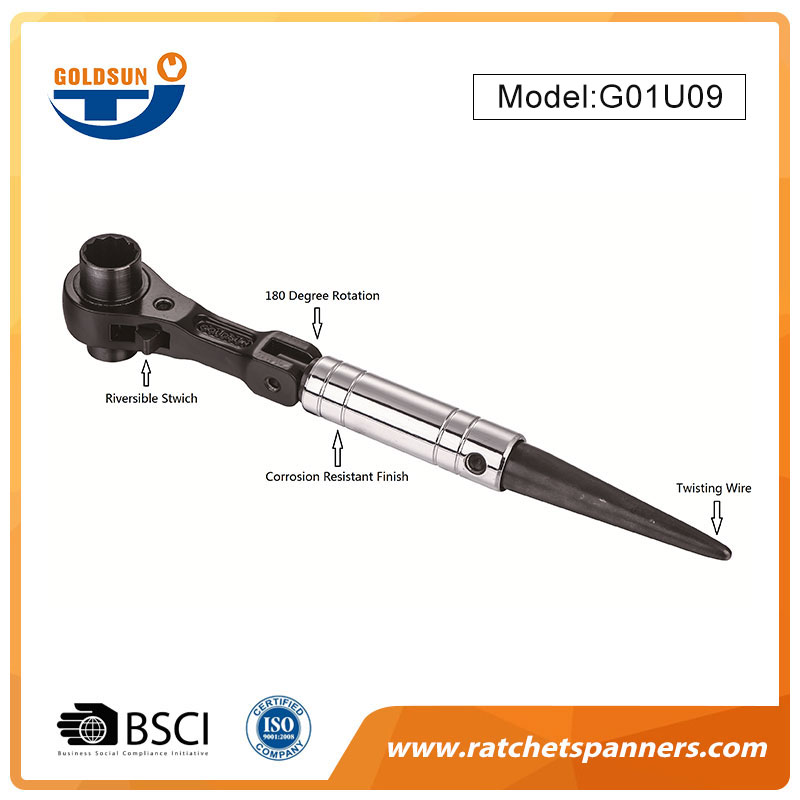
A ratchet socket wrench is a mechanical hand tool that uses a ratcheting mechanism to turn fasteners in one direction while allowing free movement in the opposite direction.
It works in combination with interchangeable sockets that fit various bolt and nut sizes.
The internal gear mechanism allows users to apply torque repeatedly without removing the tool from the fastener, dramatically improving workflow efficiency.
Key Benefits and Working Principle
The efficiency of this tool lies in its mechanical simplicity and functional design. The ratchet mechanism uses a pawl-and-gear system that locks motion in one direction while enabling free reverse motion.
-
Continuous operation: No need to reposition after every turn.
-
Higher torque control: Enables controlled tightening and loosening.
-
Ergonomic design: Reduces wrist strain and improves handling comfort.
-
Versatility: Compatible with multiple socket sizes and extensions.
Compared to conventional tools, this mechanism improves productivity by reducing unnecessary motion cycles.
How to Use It Correctly
Proper usage ensures safety and maximizes tool lifespan. Follow these steps:
-
Step 1: Select the correct socket size for the fastener.
-
Step 2: Attach the socket securely to the ratchet head.
-
Step 3: Set the direction switch (tightening or loosening).
-
Step 4: Apply steady force while maintaining alignment with the bolt.
-
Step 5: Continue ratcheting motion without removing the tool.
Avoid applying excessive force at incorrect angles, as this may damage both the fastener and the tool mechanism.
How to Choose the Right Model
Selecting the right ratchet socket wrench depends on application requirements and usage frequency. Consider the following factors:
-
Drive size: Common sizes include 1/4", 3/8", and 1/2". Smaller drives are ideal for precision work, while larger drives handle heavy-duty torque.
-
Material quality: Chrome vanadium steel offers high durability and corrosion resistance.
-
Tooth count: Higher tooth counts allow smoother and finer movement in tight spaces.
-
Grip design: Ergonomic handles reduce fatigue during extended use.
Industrial users often prefer reinforced models designed for continuous high-load operation.
Maintenance and Longevity Tips
Proper maintenance ensures long-term performance and reliability:
-
Clean the tool after each use to remove dust and grease.
-
Apply light machine oil periodically to the ratchet mechanism.
-
Store in a dry environment to prevent corrosion.
-
Avoid using the wrench beyond its torque capacity.
Regular maintenance not only extends tool life but also ensures consistent mechanical performance under load.
FAQ
What makes a ratchet socket wrench better than a regular wrench?
It allows continuous rotation without repositioning, significantly improving speed and reducing physical effort.
Can it be used in tight spaces?
Yes. The ratcheting mechanism is specifically designed for confined areas where full rotation is not possible.
Is it suitable for professional automotive repair?
Absolutely. It is widely used in automotive workshops due to its torque control and efficiency benefits.
How often should it be maintained?
For frequent users, light cleaning and lubrication after each major use cycle is recommended.
Conclusion & Contact
The ratchet socket wrench is a critical advancement in mechanical tooling, offering unmatched efficiency, reduced fatigue, and improved precision across a wide range of applications.
Whether in industrial maintenance or home repair, its design directly addresses common workflow challenges and enhances productivity.
Gold Sun Tools Ltd. provides high-quality ratchet socket wrench solutions engineered for durability and professional-grade performance, supporting users across global markets.
For product inquiries, specifications, or bulk purchasing options, please contact us today and our team will be ready to assist you with tailored solutions that fit your operational needs.