

How Does a Stainless Steel Plate Heat Exchanger Improve Industrial Heat Transfer Efficiency?
2025-12-15
In modern industrial systems, efficient heat transfer is critical for saving energy, reducing operating costs, and ensuring stable production. A Stainless Steel Plate Heat Exchanger is widely used in HVAC, food processing, chemical engineering, and energy industries because of its compact structure and high thermal efficiency. By using corrugated stainless steel plates to create turbulent flow, this equipment allows heat to be transferred rapidly between fluids without direct contact, making it both hygienic and reliable for long-term operation.
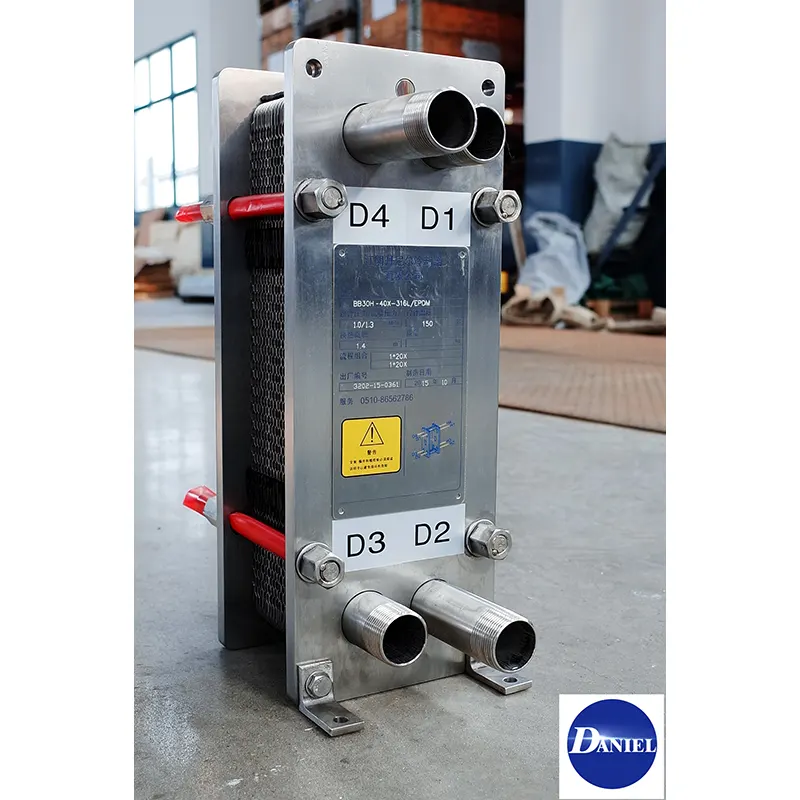
What Is a Stainless Steel Plate Heat Exchanger and How Does It Work?
A Stainless Steel Plate Heat Exchanger consists of multiple thin plates pressed with special patterns. These plates form channels where hot and cold fluids flow alternately, transferring heat efficiently through the plate surface.
Core Working Principle
-
Large heat transfer area in a compact space
-
Turbulent flow improves thermal efficiency
-
Counter-current design maximizes temperature difference
From an engineering perspective, we design such systems to balance pressure drop and heat transfer efficiency.
Why Is It Important in Industrial Applications?
Heat exchangers play a key role in energy management. A well-designed Stainless Steel Plate Heat Exchanger can significantly reduce energy loss while maintaining stable process temperatures. At Jiangyin Daniel Cooler Co., Ltd., we focus on matching exchanger specifications with real operating conditions to ensure long-term reliability.
Key Functions and Effects
-
Rapid heating and cooling
-
Reduced energy consumption
-
Improved system stability
-
Easy maintenance and cleaning
Stainless Steel Plate Heat Exchanger vs. Traditional Shell-and-Tube
Compared with conventional shell-and-tube units, plate heat exchangers offer clear advantages.
| Comparison Item | Plate Heat Exchanger | Shell-and-Tube |
|---|---|---|
| Heat Efficiency | High | Medium |
| Footprint | Compact | Large |
| Maintenance | Easy | Complex |
| Operating Cost | Lower | Higher |
This comparison shows why we often recommend plate-type designs for modern facilities.
Three Practical Q&A Based on Real Use
Q1: What makes a Stainless Steel Plate Heat Exchanger suitable for hygienic industries?
A: The smooth stainless steel surface prevents contamination and allows thorough cleaning, making it ideal for food and beverage applications.
Q2: How does plate design affect performance?
A: Corrugated plates increase turbulence, improving heat transfer efficiency while keeping equipment size small.
Q3: Which operating conditions are most suitable?
A: Systems requiring precise temperature control and energy efficiency benefit most from plate heat exchangers.
Which Industries Benefit the Most?
-
HVAC and district heating
-
Food and beverage processing
-
Chemical and pharmaceutical plants
-
Marine and power generation
As a manufacturer, we integrate engineering experience with quality materials to deliver dependable solutions.
Final Thoughts
Choosing the right heat exchanger is not only a technical decision but also a long-term investment. With professional design, proven materials, and application-focused solutions from Jiangyin Daniel Cooler Co., Ltd., a Stainless Steel Plate Heat Exchanger can significantly enhance system efficiency and reliability. For tailored solutions and expert support, please contact us to discuss your project requirements today.
