

How Does a Worm Gearbox Improve CNC Machine Accuracy?
2026-09-22
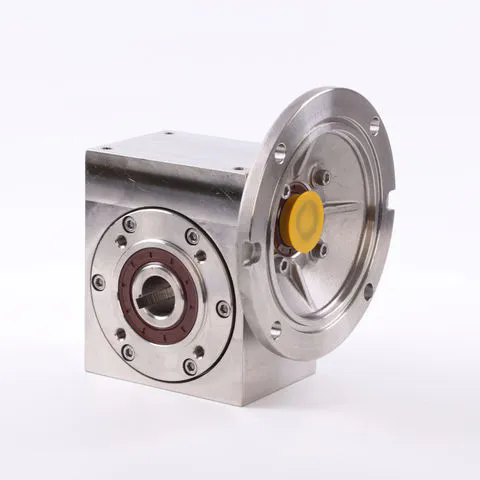
A Worm Gearbox is not a generic speed reducer. In a CNC machine, it is a precision positioning device that determines the accuracy of every rotary axis motion. The gearbox must transmit torque with minimal backlash, maintain its accuracy across a wide temperature range, and resist wear over millions of cycles. The difference between a standard industrial worm gearbox and a precision CNC worm gearbox is measured in arc minutes and microns. This guide explains the design parameters that make a Worm Gearbox suitable for CNC accuracy applications, and how to evaluate those parameters when selecting a gearbox.
1. What Accuracy Grade Should a CNC Worm Gearbox Meet?
The accuracy of a Worm Gearbox is defined by three parameters: backlash, transmission error, and lost motion. Backlash is the clearance between the worm thread and the wheel tooth. Transmission error is the periodic variation in output rotation as the worm rotates through one revolution. Lost motion is the total angular error when the direction of rotation is reversed. For CNC applications, these parameters must be controlled within very tight limits. The table below shows the accuracy grades for our precision Worm Gearbox units.
| Accuracy grade | Backlash (arc min) | Transmission error (arc sec) | Lost motion (arc min) | Typical CNC application |
| Standard industrial | 10 – 15 | 120 – 180 | 15 – 20 | General positioning |
| Precision (P1) | 3 – 5 | 60 – 90 | 5 – 8 | 3-axis milling |
| High precision (P2) | 1 – 2 | 30 – 45 | 2 – 3 | 4-axis and 5-axis machining |
| Ultra precision (P3) | < 1 | < 30 | < 1.5 | Gear cutting, optical machining |
Saifu Vietnam Company Limited manufactures Worm Gearbox units in all four accuracy grades. Our factory tests every gearbox for backlash and transmission error on a rotary table with a Heidenhain encoder. The test report is provided with each unit. For CNC machine builders, we recommend the P2 grade for most 5-axis applications and the P3 grade for gear cutting and precision grinding.
2. How Does the Worm and Wheel Design Affect Gearbox Accuracy?
The accuracy of a Worm Gearbox begins with the accuracy of the worm and the wheel. The worm is a threaded shaft that must be ground to a high lead accuracy. The lead error determines the transmission error. The wheel is a gear that must be hobbed or generated with a precise cutter. The tooth profile and pitch accuracy determine the backlash and the contact pattern. The table below shows the manufacturing tolerances for our precision worm and wheel sets.
| Component | Parameter | Standard grade | Precision grade (P2) | Ultra precision (P3) |
| Worm | Lead error (μm/100mm) | 12 | 6 | 3 |
| Worm | Surface roughness Ra (μm) | 0.4 | 0.2 | 0.1 |
| Wheel | Tooth profile error (μm) | 15 | 8 | 4 |
| Wheel | Pitch error (μm) | 18 | 10 | 5 |
| Assembly | Center distance tolerance (μm) | ±20 | ±10 | ±5 |
In our factory, we use a Klingelnberg gear measuring machine to verify the lead accuracy of every worm. The wheel is inspected on a Zeiss coordinate measuring machine. The assembly is performed in a temperature-controlled room at 20°C ± 1°C. The center distance is set using a gauge block and a dial indicator. This level of control is what allows our precision Worm Gearbox units to achieve the accuracy grades shown in the table.
3. What Role Does the Housing Material Play in Thermal Accuracy?
The housing of a Worm Gearbox determines how the center distance changes as the gearbox warms up during operation. The worm gearbox generates heat from the sliding friction between the worm and the wheel. As the temperature rises, the housing expands. If the housing is made of aluminum, the expansion is high, and the center distance decreases, which reduces the backlash. If the backlash is reduced to zero, the gearbox can bind and the servo motor will draw excessive current. The table below compares the thermal expansion of common housing materials and their effect on backlash.
| Housing material | Thermal expansion coefficient (10⁻⁶/°C) | Center distance change over 20°C rise (100 mm center) | Backlash change |
| Aluminum | 23 | 0.046 mm | Reduced by 50% |
| Cast iron | 11 | 0.022 mm | Reduced by 25% |
| Steel | 12 | 0.024 mm | Reduced by 27% |
| Cast iron with thermal compensation | 11 (plus bi-metallic shim) | 0.005 mm | Reduced by 6% |
For precision CNC applications, we recommend a cast iron housing. Saifu Vietnam Company Limited manufactures Worm Gearbox units with cast iron housings as standard for the P2 and P3 grades. For applications with high thermal cycles, we offer a bi-metallic thermal compensation shim that maintains the center distance within 0.005 mm over a 20°C rise. This feature is particularly important for gear cutting machines and jig borers that operate continuously for long periods.
4. How Is Backlash Adjusted and Maintained in a Precision Worm Gearbox?
Backlash adjustment is a critical feature of a precision Worm Gearbox. The adjustment allows the user to compensate for wear and to set the backlash for the specific application. There are three common adjustment mechanisms. The first is a eccentric worm housing. The worm is mounted in an eccentric sleeve that can be rotated to move the worm closer to or farther from the wheel. The second is a shim pack under the worm housing. Shims are added or removed to change the center distance. The third is a spring-loaded worm that maintains constant contact with the wheel. The table below compares these mechanisms.
| Adjustment mechanism | Adjustment range | Resolution | Maintenance requirement |
| Eccentric housing | 0.1 – 0.5 mm | 0.01 mm | Periodic adjustment |
| Shim pack | 0.05 – 0.3 mm | 0.02 mm | Disassembly required |
| Spring-loaded worm | Self-adjusting | Continuous | None |
Saifu Vietnam Company Limited manufactures Worm Gearbox units with all three adjustment mechanisms. For most CNC applications, we recommend the eccentric housing because it allows precise adjustment without disassembly. The spring-loaded design is used in applications where the gearbox is difficult to access for maintenance. We provide a backlash adjustment procedure and a feeler gauge with every gearbox.
Frequently Asked Questions About Worm Gearbox Accuracy in CNC Machines
Summary for CNC Machine Builders and Precision Engineers
A precision Worm Gearbox improves CNC machine accuracy through tight control of backlash, transmission error, and thermal stability. The accuracy grade is determined by the manufacturing tolerances of the worm and wheel, the assembly precision, and the housing material. For 5-axis machining, a P2 grade gearbox with a cast iron housing and eccentric backlash adjustment is recommended. For gear cutting and optical machining, a P3 grade is required. Saifu Vietnam Company Limited has been manufacturing precision Worm Gearbox units for over 15 years and provides full test data for every gearbox.
Saifu Vietnam Company Limited manufactures Worm Gearbox units in accuracy grades P1, P2, and P3, with cast iron housings, eccentric backlash adjustment, and thermal compensation options. We provide backlash and transmission error test reports for all of our products.
