

How Does Block Machine Mould Design Affect Finished Product Quality?
2026-01-28
In concrete block production, mould geometry is directly responsible for whether finished units meet local dimensional tolerances such as ASTM C90 or EN 771 requirements. Precise cavity alignment, uniform wall thickness, and controlled draft angles determine how evenly concrete is compacted and released. When mould geometry is inconsistent, common defects include chipped edges, uneven faces, and size deviation that causes problems during on site installation.
At Quangong Machinery Co., Ltd., our engineering team focuses on cavity symmetry and optimized draft angles to ensure smooth demoulding without surface tearing. Our design philosophy is based on long term field data from municipal infrastructure and commercial construction projects, allowing our factory to refine cavity transitions and corner radii. By maintaining stable geometry throughout the mould structure, finished blocks achieve consistent density and clean edges, even under high cycle production conditions.
How Does Material Selection Determine Wear Resistance and Service Life?
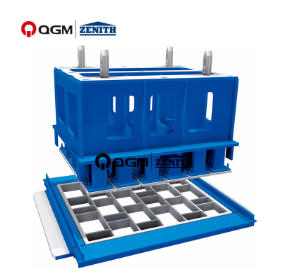
Mould material plays a decisive role in long term product quality, especially in high volume plants operating multiple shifts. High carbon alloy steel with controlled heat treatment provides superior abrasion resistance against aggregate rich concrete mixes. Inferior steel grades often lead to premature cavity wear, which results in dimensional drift and rough block surfaces.
Our factory uses precision machined alloy steel that balances hardness and toughness to prevent cracking under vibration stress. Each Block Machine Mould is engineered to withstand continuous compaction pressure while maintaining cavity integrity. Our material selection process also considers local raw material characteristics, such as sand particle size and cement ratio, to ensure stable performance across different regions.
| Mould Material Grade | Heat Treatment Method | Typical Service Life |
| High Carbon Alloy Steel | Vacuum Quenching and Tempering | 120000 to 150000 cycles |
| Standard Tool Steel | Conventional Quenching | 60000 to 80000 cycles |
How Do Machining Precision and Tolerances Affect Block Consistency?
Machining precision defines how accurately mould cavities replicate the intended block profile. Tight tolerances reduce variation between units and ensure better stacking stability during palletizing and transportation. In many regional markets, buyers increasingly demand uniform appearance for commercial and residential developments, making precision machining a competitive requirement.
Our production workflow integrates CNC machining and multi stage inspection to control tolerance within narrow limits. By applying consistent machining standards, each Block Machine Mould maintains uniform cavity depth and edge definition. This approach improves overall line efficiency by reducing rejected blocks and minimizing downstream handling issues.
| Machining Parameter | Standard Control Range | Impact on Finished Blocks |
| Cavity Dimensional Tolerance | Within 0.3 mm | Stable block size and alignment |
| Surface Roughness | Ra 1.6 to 3.2 | Smoother block faces |
How Does Structural Reinforcement Improve Stability Under Vibration?
During vibration and compaction, mould structures are exposed to repeated dynamic loads. Without adequate reinforcement, deformation may occur, leading to inconsistent block height and internal density variation. Structural rigidity is therefore essential for maintaining consistent quality over long production runs.
Our design integrates reinforced sidewalls and optimized load distribution zones to minimize deflection. Each Block Machine Mould is tested under simulated production conditions to verify structural stability. This reinforcement strategy allows our factory to support high frequency vibration systems commonly used in modern automated block plants.
How Does Compatibility With Block Machines Affect Production Efficiency?
Mould design must be fully compatible with the block machine frame, vibration system, and pallet size. Poor compatibility can cause misalignment, uneven compaction, and excessive mechanical wear. In contrast, well matched designs support smoother operation and consistent output quality.
Zenith develops moulds based on detailed machine interface data, ensuring seamless integration with different production lines. Our experience across multiple global markets enables our factory to adapt designs for local equipment standards. A properly matched Block Machine Mould reduces setup time, improves output stability, and supports long term operational reliability.
How Does Block Machine Mould Design Affect Finished Product Quality? FAQ
Q1: How Does Block Machine Mould Design Affect Finished Product Quality in high output plants?
High output plants rely on stable mould geometry, wear resistant materials, and reinforced structures to maintain consistent block dimensions and surface quality throughout extended production cycles.
Q2: How Does Block Machine Mould Design Affect Finished Product Quality when using different raw materials?
Design parameters such as cavity finish and steel hardness must be adapted to local aggregate characteristics to prevent excessive wear and ensure uniform compaction across varying concrete mixes.
Q3: How Does Block Machine Mould Design Affect Finished Product Quality over long term operation?
Long term quality depends on maintaining tight tolerances and structural rigidity, which prevents dimensional drift and surface degradation as production cycles accumulate.
How Can Proper Mould Design Support Long Term Business Value?
Investing in optimized mould design delivers more than consistent block quality. It reduces maintenance costs, minimizes downtime, and enhances brand reputation for finished products in competitive construction markets. By focusing on geometry, material selection, machining accuracy, and structural stability, manufacturers can achieve reliable output and higher customer satisfaction.
Quangong Machinery Co., Ltd. combines engineering expertise with practical production experience to deliver solutions that meet demands. If you are looking to improve finished block quality and production efficiency, our team is ready to provide technical guidance and customized solutions tailored to your project requirements. Contact us today to discuss your application and request detailed specifications.
