

How Does Cavity and Core Completed Machining Reduce Manual Polishing Time in Injection Molds
2026-08-12
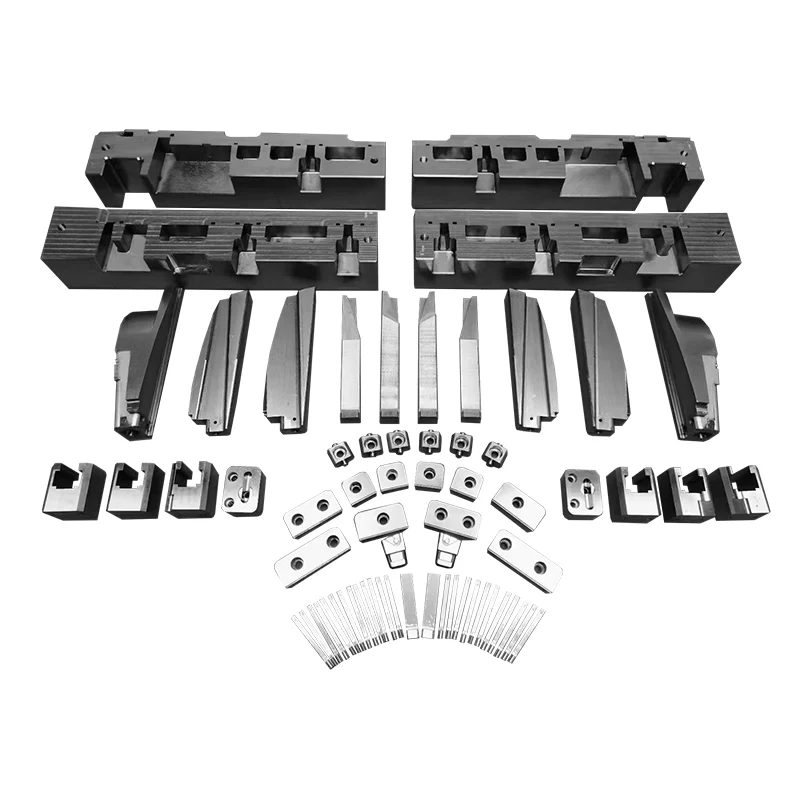
For injection mold makers, manual polishing remains one of the most labor-intensive, skill-dependent, and unpredictable stages of production. While a flawless surface finish is non-negotiable for plastic part quality, the hours spent on bench work directly erode profit margins and extend delivery timelines. This is where Cavity And Core Completed Machining—when executed with precision equipment and process discipline—transforms the entire finishing workflow. At Mudebao, we have documented average manual polishing time reductions of 40–55% across hundreds of mold projects by rethinking how cavity and core surfaces are machined before they ever reach the polishing bench.
The Direct Link Between Machining Quality and Polishing Workload
Every micro-scratch, tool mark, or step-over ridge left by previous operations must be removed by abrasive stones, papers, or diamond pastes. The deeper the roughness (Ra), the more material must be removed during polishing, and the more heat and pressure are applied—risking dimensional distortion. Cavity And Core Completed Machining addresses this at the source by delivering a near-final surface finish directly from the CNC machine or hard-milling center.
| Machining Parameter | Conventional Finish | Completed Machining Finish | Polishing Time Saved |
|---|---|---|---|
| Surface Roughness (Ra) | 0.8 – 1.2 µm | 0.2 – 0.4 µm | ~50% |
| Step-over distance | 0.15 – 0.25 mm | 0.04 – 0.08 mm | ~45% |
| Tool runout (TIR) | > 15 µm | < 5 µm | ~40% |
| Need for pre-polishing grinding | Always required | Often skipped | 1–2 hours per cavity |
Five Mechanisms That Eliminate Bench Time
1. High-speed hard milling with polished carbide tools – Using ball-nose end mills with wiper geometries, Cavity And Core Completed Machining produces scallop heights below 2 µm, allowing polishers to start with #800 grit instead of #180 grit.
2. Adaptive step-over algorithms – Modern CAM toolpaths maintain constant chip load on curved surfaces, avoiding sudden ridge buildups that traditionally require aggressive stoning.
3. Thermal stability control – By maintaining spindle and workpiece temperatures within ±2°C, Mudebao prevents thermal expansion that creates mismatched surface peaks across core and cavity splits.
4. Optimized lead-in/lead-out strategies – Tangential entries eliminate dwell marks at corners—a primary source of orange-peel defects during polishing.
5. On-machine measurement and compensation – Automated probes detect and correct residual stock deviations before the tool path ends, ensuring that the final pass is truly the final pass.
Real-World Time Savings Breakdown
| Mold Component | Conventional Polishing (hours) | After Completed Machining (hours) | Net Reduction |
|---|---|---|---|
| Cavity insert (200×150×80 mm) | 6.5 | 3.0 | 54% |
| Core insert with deep ribs | 8.0 | 4.5 | 44% |
| Sliding core (complex curvature) | 5.0 | 2.5 | 50% |
| Average across 50 mold sets | 6.2 | 3.3 | 47% |
Data compiled from Mudebao production records, 2024–2026.
Practical Implementation Checklist
-
□
Specify Cavity And Core Completed Machining at the quoting stage—not as an afterthought.
-
□
Use tool holders with < 3 µm runout (hydraulic or shrink-fit).
-
□
Program finish allowance ≤ 0.03 mm per side.
-
□
Apply minimum quantity lubrication (MQL) to avoid built-up edge.
-
□
Validate surface roughness with a portable profilometer after every third part.
-
□
Schedule polishing start within 4 hours of machining to avoid oxide film formation.
Frequently Asked Questions About Cavity And Core Completed Machining
Q1: What is the maximum hardness of steel that can benefit from Cavity And Core Completed Machining for polishing reduction?
A1: Cavity And Core Completed Machining delivers significant polishing reductions on steels up to 58–60 HRC, provided that the machine tool has sufficient spindle power (≥ 25 kW) and rigidity (damping ratio > 0.05). Above 60 HRC, tool wear accelerates and surface integrity may degrade; however, with cubic boron nitride (CBN) tools and rigid workholding, Mudebao has successfully applied this approach to 62 HRC stainless mold steels, achieving Ra 0.25 µm and cutting polishing time by 35%. Below 48 HRC, the benefits are even more pronounced, with some users skipping intermediate polishing entirely.
Q2: Does Cavity And Core Completed Machining require a different CAM strategy compared to standard roughing and finishing?
A2: Yes, fundamentally. Standard CAM focuses on material removal efficiency, whereas Cavity And Core Completed Machining prioritizes surface quality as the primary constraint. This means using constant scallop-height toolpaths (not constant step-over), implementing trochoidal milling for corners to maintain consistent tool engagement, and applying separate finish passes for walls, floors, and fillets—each with tailored feed rates. At Mudebao, we also employ a "finish-to-finish" verification simulation that predicts surface texture before cutting, allowing programmers to adjust tilt angles and step-over values virtually. Without this CAM adaptation, even the best machine tools cannot deliver the polishing-time savings promised by completed machining.
Q3: How do you verify that Cavity And Core Completed Machining has actually reduced polishing effort before the polisher starts working?
A3: Mudebao uses a three-stage verification protocol. First, a non-contact white-light interferometer measures surface roughness across 12 predefined points on the cavity and core—values must be within 15% of the programmed target. Second, a visual inspection under 10× magnification checks for directional tool marks; if any are visible, the final finish pass is repeated. Third, and most critically, we conduct a "wetting test"—applying a thin oil film to the machined surface and observing reflection distortion. If the reflection is clear and uninterrupted, the polisher can begin with #1000 grit or finer. This verification adds only 8–12 minutes per mold but consistently eliminates 1.5–2 hours of unnecessary rough polishing.
The Financial Impact
Reducing manual polishing from 6 hours to 3 hours per mold, across 200 molds annually, saves 600 labor hours. At an average shop rate of $75/hour (including overhead), that is **$45,000 in direct cost recovery**—before accounting for faster delivery, fewer rework cycles, and improved first-pass yield. Mudebao has helped over 70 injection mold shops achieve these numbers by integrating Cavity And Core Completed Machining into their standard process documentation, not as an upgrade, but as a baseline requirement.
Why Process Integration Matters
Isolated improvements—such as a better tool or a finer step-over—rarely deliver consistent results. True polishing reduction requires a closed-loop system: machine calibration → tool selection → CAM parameters → in-process measurement → feedback to programming. Mudebao provides this as a turnkey package, including post-processor customization and on-site operator training, so that every cavity and core leaves the machining center with a surface ready for final high-gloss buffing, not heavy stock removal.
Ready to Cut Your Polishing Time by Half?
Every day spent on excessive manual polishing is a day lost from new mold builds or engineering improvements. Mudebao offers a free process audit for your existing cavity and core production—we will measure your current surface roughness, identify the top three sources of polishing waste, and simulate the time savings achievable with Cavity And Core Completed Machining.
Contact us today at [[email protected]] or through our website’s live chat to schedule your audit. Include a sample drawing of your most challenging mold insert, and we will return a detailed comparison report within 48 hours—no obligation, just data. Your polishing bench should be for final aesthetics, not for fixing machining errors. Let Mudebao make that your reality.
