

How does material selection impact Belt Pulleys durability and performance?
2026-10-27
Two plants order the same size Belt Pulleys for their conveyor drives. The first plant runs a mineral conveying line with heavy shock loads and abrasive dust. The pulley rim wears through in about 18 months, and the keyway loosens on the shaft. The second plant runs a packaging line with steady load and a clean environment. The same pulley design is still in service after six years. The dimensions are identical. The difference is the material. The first plant received a standard grey cast iron pulley, and the second plant received a spheroidal graphite cast iron pulley with a hardened keyway. Material selection is not a purchasing detail. It decides whether the pulley survives the load and the environment. This guide explains how material selection affects the durability and performance of belt pulleys.
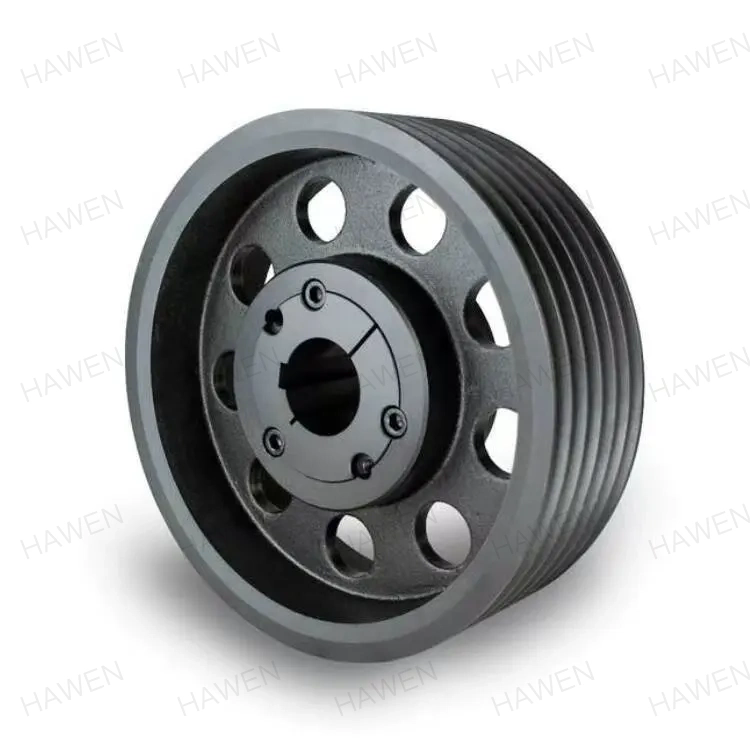
1. Why Does the Same Pulley Design Fail in One Plant and Last for Years in Another?
A Belt Pulleys fails in one of three modes: wear at the groove or the rim, fatigue at the keyway or the hub, or corrosion at the exposed surfaces. Each mode is governed by a different material property. Wear is governed by hardness and microstructure. Fatigue is governed by tensile strength and toughness. Corrosion is governed by alloy content and surface treatment. A pulley that is selected only by dimension may have the right geometry but the wrong property balance for the application. In our factory, we review the load profile and the environment before recommending a material grade. Zhejiang Hawen Electromechanical Co., Ltd. has been manufacturing belt pulleys for over 12 years.
The first plant in the example needed a material with higher hardness at the groove and higher toughness at the keyway. The second plant needed only a general-purpose material because the load was steady and the environment was clean. Selecting the same grade for both plants would either over-specify the packaging line or under-specify the mineral line.
2. How Do Cast Iron, Steel, and Aluminum Differ Under Real Load Conditions?
Three materials are commonly used for Belt Pulleys: grey cast iron, spheroidal graphite cast iron, and steel. Aluminum is used for light-duty and high-speed applications. The table below compares the key properties that affect durability and performance.
| Property | Grey cast iron | Spheroidal graphite iron | Steel (S355) | Aluminum 6061 |
| Tensile strength (MPa) | 200 – 300 | 400 – 600 | 470 – 630 | 260 – 310 |
| Hardness (HB) | 170 – 230 | 200 – 280 | 150 – 200 | 95 – 110 |
| Damping capacity | Excellent | Good | Moderate | Low |
| Weight (relative) | 1.0 | 1.0 | 1.0 | 0.35 |
| Typical application | General drives, low shock | Heavy shock, abrasive dust | High torque, welded hubs | High speed, light load |
Grey cast iron has excellent damping capacity, which reduces vibration and noise in general drives. Its tensile strength and toughness are moderate, so it is not suitable for heavy shock loads. Spheroidal graphite iron has higher strength and toughness because the graphite is in nodular form rather than flake form. It is the preferred material for pulleys that must resist shock and abrasion. Steel has the highest strength and can be welded, which is useful for large fabricated pulleys. Aluminum is the lightest and is used where inertia and weight are critical, but its low hardness limits its wear resistance. In our factory, we machine all four materials and provide the property data for each grade.
3. What Happens at the Hub and Keyway When the Material Is Too Soft or Too Brittle?
The hub and the keyway are the most highly stressed regions of a Belt Pulleys. The keyway transmits the torque from the shaft to the pulley, and the hub carries the resulting bearing stress. If the material is too soft, the keyway deforms under the torque, the fit between the pulley and the shaft loosens, and the pulley begins to wobble. If the material is too brittle, the hub can crack under a shock load or during installation if the fit is too tight. The table below shows the relationship between material hardness and keyway performance.
| Material hardness (HB) | Keyway bearing capacity | Shock resistance | Typical failure mode |
| 150 – 180 | Low | High | Keyway deformation, shaft slip |
| 180 – 220 | Moderate | Moderate | Gradual wear of keyway |
| 220 – 260 | High | Moderate to high | Long life if key is fitted correctly |
| 260 – 300 | Very high | Lower (risk of cracking) | Hub cracking under shock |
Drive engineer's note: The keyway is often the first feature to fail when the material is under-specified. Increasing the hardness improves the bearing capacity but reduces the toughness. The optimal hardness for a shock-loaded pulley is in the range of 220 to 260 HB, which provides a balance between keyway strength and crack resistance. In our factory, we verify the hardness of every pulley at the hub and at the rim. Zhejiang Hawen Electromechanical Co., Ltd. provides a hardness test report with each batch.
4. Why Does Surface Treatment and Material Grade Matter More Than Generic Material Name?
Two pulleys may both be described as cast iron, but their performance can differ significantly depending on the grade and the heat treatment. A grey cast iron pulley with a fine pearlitic matrix has higher strength and wear resistance than one with a coarse ferritic matrix. A spheroidal graphite iron pulley that has been normalized has a different property balance from one that has been as-cast. The surface treatment also matters. A black oxide coating provides mild corrosion resistance. A zinc coating provides better corrosion resistance but can affect the fit if the coating thickness is not controlled. A painted surface protects against corrosion but can wear away at the groove. In our factory, we control the material grade, the heat treatment, and the coating thickness. Zhejiang Hawen Electromechanical Co., Ltd. provides a material certificate and a coating thickness report with each shipment.
We also recommend that the designer specify the material by standard grade, not by the generic name. For example, specify EN-GJS-500-7 rather than spheroidal graphite iron, and EN-GJL-250 rather than grey cast iron. The standard grade defines the minimum mechanical properties and allows the supplier and the customer to verify the material against a common reference.
5. How Should Engineers Specify and Verify Material for a Belt Pulley Application?
The specification should include the material grade, the heat treatment condition, the surface treatment, the hardness range, and the keyway tolerance. The verification should include three checks. The first is the material certificate review, which confirms that the grade and the heat treatment match the specification. The second is the hardness measurement at the hub and at the rim, which confirms that the hardness is within the specified range. The third is the keyway fit check, which confirms that the keyway width and depth match the shaft and the key. In our factory, we perform all three checks before shipment and provide the inspection report with the goods. Zhejiang Hawen Electromechanical Co., Ltd. also offers a material selection review for new applications.
We recommend that the designer verify the dynamic balance after the pulley is machined. An unbalanced pulley creates vibration that accelerates bearing wear and can cause the belt to track off the groove. The balance grade should be specified according to the pulley speed and the application. We balance our pulleys to ISO 1940 G6.3 or better and provide a balance report on request.
Frequently Asked Questions About Material Selection for Belt Pulleys
Summary for Drive Engineers and Maintenance Teams
Material selection determines the durability and performance of Belt Pulleys because it governs the resistance to wear, the capacity of the keyway, and the resistance to corrosion. Grey cast iron is suitable for general drives with low shock. Spheroidal graphite iron is preferred for heavy shock and abrasive service. Steel is used for high torque and welded hubs. Aluminum is used for high-speed, light-load applications. The material should be specified by standard grade, not by generic name, and the hardness should be verified at the hub and at the rim. The keyway fit and the dynamic balance should also be verified. Zhejiang Hawen Electromechanical Co., Ltd. has been manufacturing belt pulleys for over 12 years and provides full material selection and verification support for our customers.
