

How Does Oil Bath Lubrication Extend Worm Gearbox Life?
2026-10-10
A maintenance engineer tracks the performance of 60 Worm Gearbox units across a processing plant. The units in the wet area, where the ambient temperature is high and the duty cycle is continuous, show oil degradation within 8 months. The units in the dry area, with intermittent duty, still have clear oil after 3 years. The engineer wants to know why the difference is so large and how to set the correct oil change interval for each group. The answer lies in the mechanics of oil bath lubrication and how it protects the worm and wheel from wear. This guide explains the principles and provides a practical method for determining change intervals.
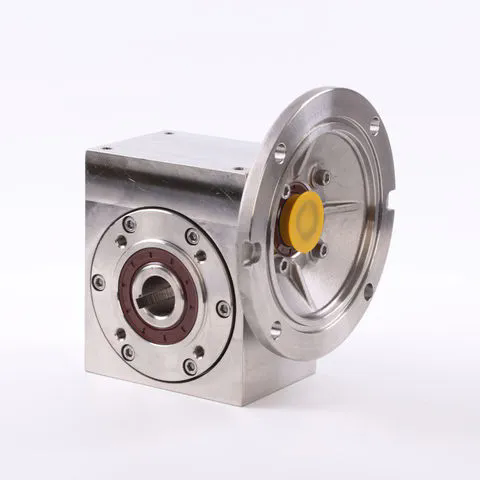
1. Why Is Oil Bath Lubrication More Effective Than Grease for a Worm Gearbox?
A Worm Gearbox operates with a sliding contact between the worm and the worm wheel. This sliding action generates heat and requires a lubricant that can form a continuous film between the surfaces. Grease is a semi-solid lubricant that is applied once and remains in place. It does not flow, so it cannot carry heat away from the contact zone. It also does not flush away wear particles. Oil bath lubrication uses a reservoir of liquid oil that circulates by the rotation of the worm and wheel. The oil carries heat to the housing walls, where it is dissipated. It also carries wear particles to the bottom of the sump, where they settle. The table below compares the two lubrication methods.
| Parameter | Grease lubrication | Oil bath lubrication |
| Heat dissipation | Poor (no circulation) | Good (circulation to housing) |
| Wear particle removal | None (particles remain in contact) | Good (settling in sump) |
| Oil film renewal | None (static) | Continuous (splash and circulation) |
| Operating temperature limit | 80°C | 100°C |
| Typical life of lubricant | 6 – 12 months | 2 – 5 years (depending on conditions) |
In our factory, we recommend oil bath lubrication for all Worm Gearbox units that operate continuously or at high ambient temperatures. The oil must be selected for the correct viscosity and must be maintained at the correct level. Saifu Vietnam Company Limited has been manufacturing Worm Gearbox units with oil bath lubrication for over 15 years.
2. What Is the Correct Oil Level and Why Does It Matter?
The oil level in a Worm Gearbox determines how much of the worm and wheel are immersed. If the level is too low, the oil cannot reach the contact zone, and the gearbox runs dry. If the level is too high, the oil churns, generates heat, and can leak through the seals. The correct level is typically the centerline of the worm shaft or the lowest point of the worm wheel. The table below shows the recommended oil level for different mounting positions.
| Mounting position | Recommended oil level | Inspection method | Consequence of wrong level |
| Horizontal (worm below wheel) | Center of worm shaft | Oil sight glass or level plug | Low: wear; High: overheating, leakage |
| Horizontal (worm above wheel) | Center of wheel shaft | Level plug | Low: inadequate splash; High: churning |
| Vertical (worm shaft vertical) | 70% of housing height | Dipstick or level plug | Low: top bearing starved; High: leakage |
| Inclined (up to 15°) | Slightly above centerline | Level plug at high point | Low: dry contact; High: foam |
Our factory provides a level mark on every Worm Gearbox housing. We also supply a sight glass for units that are difficult to access. If the gearbox is mounted in a non-standard position, the oil level must be recalculated. Saifu can provide the correct level for any mounting angle.
3. How Does Oil Viscosity and Additive Package Affect Gear Life?
The viscosity of the oil determines the thickness of the film between the worm and the wheel. If the viscosity is too low, the film is thin, and the surfaces can contact, causing wear. If the viscosity is too high, the oil does not flow into the contact zone, and the gearbox runs hot. The correct viscosity depends on the ambient temperature and the worm speed. The additive package determines the oil's resistance to oxidation, thermal degradation, and wear. EP (extreme pressure) additives are essential for worm gearboxes because the sliding contact creates high local pressures. The table below shows the recommended oil types for different operating conditions.
| Ambient temperature | Worm speed (RPM) | Recommended oil | Viscosity grade |
| -10°C to +10°C | Up to 1,500 | Mineral oil with EP additives | ISO VG 68 |
| +10°C to +30°C | Up to 1,500 | Mineral oil with EP additives | ISO VG 150 |
| +30°C to +50°C | Up to 1,500 | Synthetic oil (PAO) with EP | ISO VG 220 |
| +10°C to +40°C | Above 1,500 | Synthetic oil (PAO) with EP | ISO VG 100 |
| Above +50°C | Any | Synthetic oil (PAG) with EP | ISO VG 320 |
In our factory, we recommend ISO VG 150 mineral oil with EP additives for most industrial applications. For high-temperature or high-speed applications, we recommend a synthetic oil. We also provide a oil compatibility chart to ensure that the oil is compatible with the seals and the bronze wheel. Saifu tests every gearbox with the recommended oil before shipment.
4. How Should the Oil Change Interval Be Determined?
The oil change interval depends on the oil temperature, the contamination level, and the operating hours. The most accurate method is to sample the oil periodically and test for viscosity, acidity, water content, and particle count. The table below shows a practical schedule based on operating conditions.
| Operating condition | Oil temperature | Initial change | Subsequent changes |
| Light duty, intermittent | < 60°C | After 500 hours | Every 5,000 hours or 2 years |
| Medium duty, 8 hours/day | 60 – 80°C | After 500 hours | Every 3,000 hours or 1 year |
| Heavy duty, continuous | 80 – 95°C | After 300 hours | Every 1,500 hours or 6 months |
| Severe duty, high ambient | > 95°C | After 200 hours | Every 800 hours or 3 months |
Maintenance tip: The first oil change is the most important. During the running-in period, the worm and wheel wear slightly, and the oil carries the wear particles. Changing the oil after the first 300 to 500 hours removes these particles and prevents them from causing further wear. After the first change, the oil life is determined by the operating temperature. As a rule of thumb, the oil life halves for every 10°C increase in operating temperature above 70°C.
Frequently Asked Questions About Oil Bath Lubrication in Worm Gearboxes
Summary for Maintenance Engineers
Oil bath lubrication extends Worm Gearbox life by providing continuous oil film renewal, effective heat dissipation, and wear particle removal. The correct oil level, viscosity, and additive package are essential for reliable operation. The oil change interval should be based on the operating temperature and the results of oil analysis. By following a structured lubrication maintenance program, maintenance engineers can extend gearbox life from 5 years to 10 years or more. Saifu Vietnam Company Limited has been manufacturing Worm Gearbox units with oil bath lubrication for over 15 years and provides full lubrication support for our customers.
Saifu Vietnam Company Limited manufactures Worm Gearbox units with oil bath lubrication, sight glasses, and level plugs. We provide oil selection guides, change interval recommendations, and oil analysis support for all of our products.
