

How Does PTFE Packing Work in Sealing Applications?
2026-10-12
A maintenance technician replaces the PTFE Packing on a centrifugal pump. The pump runs for two weeks, then starts dripping. The technician tightens the gland nuts. The drip slows but does not stop. Two weeks later, the packing is compressed to a thin, hard ring, and the shaft is scored. The technician replaces the packing again, this time with a different brand. The new packing lasts six months. The difference is not the brand. It is the construction of the packing and the installation procedure. This guide explains how PTFE packing works and why the installation details determine whether it lasts two weeks or six months.
1. How Does Braided Packing Create a Seal?
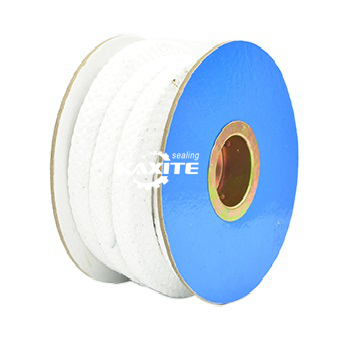
PTFE Packing is a braided rope that is compressed in a stuffing box to create a seal around a rotating or reciprocating shaft. The seal is not created by the packing alone. It is created by the combination of the packing, the shaft, and the gland. When the gland nuts are tightened, the packing is compressed axially. The axial compression causes the packing to expand radially against the shaft and the stuffing box wall. The radial pressure creates a seal that prevents the process fluid from leaking. The seal is dynamic, meaning that the shaft rotates or moves while the packing remains stationary. The interface between the packing and the shaft is lubricated by a small amount of leakage. This leakage is necessary to cool the packing and to prevent it from burning. The table below shows the relationship between gland load and leakage rate.
| Gland load (N) | Radial pressure (bar) | Leakage rate (drops/minute) | Packing temperature (°C) |
| 500 | 2.5 | 20 – 30 | 45 |
| 1,000 | 5.0 | 10 – 15 | 55 |
| 1,500 | 7.5 | 5 – 8 | 65 |
| 2,000 | 10.0 | 2 – 4 | 80 |
| 2,500 | 12.5 | 0 – 1 | 95 |
The optimal gland load is the one that produces a leakage rate of 5 to 10 drops per minute for a pump, or 1 to 2 drops per minute for a valve. A lower leakage rate reduces cooling and increases the risk of burning. A higher leakage rate wastes fluid and creates a mess. In our factory, we recommend that the gland be tightened gradually in 1/4 turn increments while the pump is running. The technician should wait 15 minutes between adjustments to allow the packing to settle. Ningbo Kaxite Sealing Materials Co., Ltd. has been manufacturing PTFE Packing for over 18 years.
2. How Does the Braiding Pattern Affect Sealing Performance?
The braiding pattern determines the density, flexibility, and leakage path of the packing. There are three common braiding patterns: square braid, braid-over-braid, and interlocked braid. Square braid is the simplest and least expensive. It has a square cross-section and is suitable for low-pressure applications. Braid-over-braid has a denser structure and is more resistant to extrusion. Interlocked braid is the most durable. Each strand passes through the center of the packing, which prevents the strands from separating under compression. The table below compares the three braiding patterns.
| Braiding pattern | Density (g/cm³) | Leakage path | Pressure rating (bar) | Typical application |
| Square braid | 1.2 – 1.4 | Straight through | 10 | Low-pressure water pumps |
| Braid-over-braid | 1.4 – 1.6 | Tortuous | 25 | General purpose pumps and valves |
| Interlocked braid | 1.6 – 1.8 | Tortuous and blocked | 40 | High-pressure chemical pumps |
The interlocked braid is the best choice for high-pressure applications because the leakage path is longer and more tortuous. The fluid must travel through multiple layers of strands, which increases the resistance to flow. In our factory, we manufacture PTFE Packing with all three braiding patterns. We recommend the interlocked braid for applications above 20 bar. Kaxite provides a braiding pattern selection guide for our customers.
3. What Is the Role of Impregnation in PTFE Packing?
PTFE packing is often impregnated with a lubricant or a filler to improve its performance. The impregnation fills the voids between the braided strands, which reduces the leakage path and improves the sealing efficiency. The most common impregnations are silicone oil, graphite, and molybdenum disulfide. Silicone oil improves the flexibility and reduces the friction. Graphite improves the thermal conductivity and the chemical resistance. Molybdenum disulfide improves the wear resistance. The table below shows the effect of different impregnations on packing performance.
| Impregnation | Friction coefficient | Thermal conductivity (W/mK) | Chemical resistance | Typical application |
| None (pure PTFE) | 0.10 | 0.25 | Excellent | Food and pharmaceutical |
| Silicone oil | 0.07 | 0.25 | Good | General purpose water pumps |
| Graphite | 0.12 | 0.50 | Good | Steam and hot oil |
| Molybdenum disulfide | 0.08 | 0.30 | Excellent | Chemical pumps |
In our factory, we impregnate our PTFE Packing with silicone oil for general purpose applications and with graphite for high-temperature applications. For food and pharmaceutical applications, we supply pure PTFE packing with no impregnation. The impregnation must be compatible with the process fluid. For example, silicone oil is not compatible with some solvents. Kaxite provides a compatibility chart for all of our impregnated packings.
4. How Should PTFE Packing Be Installed to Maximize Service Life?
The installation procedure is as important as the packing itself. There are four critical steps. First, the stuffing box must be cleaned and inspected. Any old packing, debris, or corrosion must be removed. The shaft must be smooth and free of scratches. Second, the packing must be cut to the correct length. The length is determined by the circumference of the shaft plus the stuffing box bore. The cut should be made at a 45-degree angle to ensure a tight joint. Third, the packing rings must be installed one at a time. Each ring should be seated firmly with a packing tamper before the next ring is installed. The joints should be staggered by 90 degrees. Fourth, the gland nuts should be tightened gradually. The initial tightening should be just enough to seat the packing. The final tightening should be done after the pump has run for 15 minutes. The table below shows the recommended installation parameters for different shaft sizes.
| Shaft diameter (mm) | Packing cross-section (mm) | Number of rings | Initial gland load (N) | Final leakage rate (drops/min) |
| 25 | 6 | 4 | 400 | 5 – 10 |
| 40 | 8 | 5 | 600 | 5 – 10 |
| 50 | 10 | 5 | 800 | 5 – 10 |
| 75 | 12 | 6 | 1,200 | 5 – 10 |
| 100 | 16 | 6 | 1,600 | 5 – 10 |
Installation tip: Never reuse old packing. The old packing has taken a set and will not seal properly. Always cut the new packing rings at a 45-degree angle. If the cut is straight, the joint will not seal. Stagger the joints by 90 degrees so that the leakage path is not aligned. Tighten the gland nuts by hand first, then use a wrench for the final 1/4 turn. Over-tightening is the most common cause of premature packing failure.
Frequently Asked Questions About PTFE Packing in Sealing Applications
Summary for Maintenance Technicians
PTFE packing works by creating a dynamic seal between the shaft and the stuffing box. The seal is maintained by the radial pressure that is generated when the gland compresses the packing. The braiding pattern, impregnation, and installation procedure determine the leakage rate and the service life. An interlocked braid with graphite impregnation is the best choice for high-pressure, high-temperature applications. A pure PTFE packing is required for food and pharmaceutical applications. The installation must be done carefully, with the correct cut angle, joint stagger, and gland load. Ningbo Kaxite Sealing Materials Co., Ltd. has been manufacturing PTFE Packing for over 18 years and provides full technical support for our customers.
Ningbo Kaxite Sealing Materials Co., Ltd. manufactures PTFE Packing in square braid, braid-over-braid, and interlocked braid patterns, with silicone oil, graphite, or molybdenum disulfide impregnation. We provide food-grade and metal-detectable options.
