

How Does the Cylinder Body Withstand Pressure in Steering Systems?
2026-10-10
A test engineer runs a pulse test on a batch of Steering Hydraulic Cylinder units. The test applies a pressure cycle from 5 bar to 120 bar at 1 Hz. The acceptance criterion is 1,000,000 cycles without leakage or deformation. Three of the ten cylinders fail before 200,000 cycles. The failures are not at the seals or the rod. They are at the weld between the cylinder body and the end cap. The engineer cuts open the failed samples and finds incomplete fusion at the weld root. The pressure containment of the cylinder body is not determined by the wall thickness alone. It is determined by the combination of material strength, wall thickness, weld quality, and internal surface finish. This guide explains how each factor contributes to pressure resistance.
1. How Is the Cylinder Body Stress Calculated Under Internal Pressure?
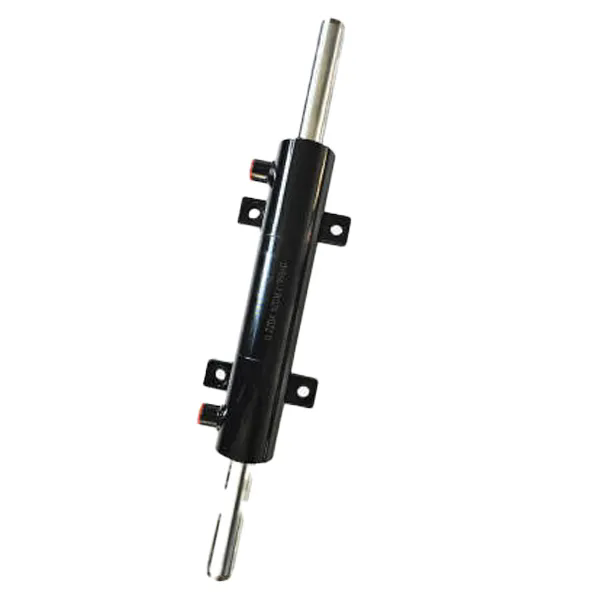
The cylinder body of a Steering Hydraulic Cylinder is a thick-walled pressure vessel. The stress distribution through the wall is calculated using the Lamé equations. The hoop stress is highest at the inner surface and decreases toward the outer surface. The longitudinal stress is half the hoop stress for a closed-end cylinder. The radial stress is compressive and equals the internal pressure at the inner surface and zero at the outer surface. The table below shows the stress values for a cylinder with a 40 mm bore and a 50 mm outer diameter at 120 bar internal pressure.
| Stress component | At inner surface (MPa) | At outer surface (MPa) | Allowable for 27MnCr5 (MPa) |
| Hoop stress | 92 | 38 | 450 (yield) |
| Longitudinal stress | 46 | 19 | 450 (yield) |
| Radial stress | -12 | 0 | N/A |
| Von Mises equivalent stress | 85 | 33 | 450 (yield) |
The von Mises equivalent stress at the inner surface is 85 MPa, which is well below the yield strength of 450 MPa for the 27MnCr5 material we use. The safety factor is 5.3. This means the cylinder body will not yield under normal operating pressure. The critical factor is not the static stress but the fatigue stress. The pressure cycles from low to high, and the stress cycles with it. The fatigue life depends on the stress amplitude and the number of cycles. In our factory, we use finite element analysis to calculate the stress concentration at the weld toe and the thread roots. Raydafon Technology Group Co.,Limited has been manufacturing Steering Hydraulic Cylinder units for over 20 years.
2. How Does Wall Thickness Affect Burst Pressure and Weight?
The wall thickness determines the burst pressure of the cylinder body. The burst pressure is the internal pressure at which the material reaches its ultimate tensile strength. For a thick-walled cylinder, the burst pressure is calculated using the Bailey-Norton equation or the more common ASME formula. A thicker wall increases the burst pressure but also increases the weight. The weight is a critical factor in steering systems because it affects the vehicle's unsprung mass and fuel consumption. The table below shows the relationship between wall thickness, burst pressure, and weight for a 40 mm bore cylinder.
| Wall thickness (mm) | Outer diameter (mm) | Burst pressure (bar) | Weight per 100 mm (kg) | Safety factor at 120 bar |
| 4 | 48 | 320 | 0.48 | 2.7 |
| 5 | 50 | 410 | 0.58 | 3.4 |
| 6 | 52 | 510 | 0.68 | 4.3 |
| 8 | 56 | 720 | 0.88 | 6.0 |
| 10 | 60 | 950 | 1.08 | 7.9 |
In our factory, we select the wall thickness based on the required burst pressure and the weight target. For a typical passenger car steering cylinder, a wall thickness of 5 mm provides a burst pressure of 410 bar, which is 3.4 times the working pressure of 120 bar. This meets the SAE J188 standard, which requires a minimum burst pressure of 3 times the working pressure. For heavy-duty applications, we increase the wall thickness to 6 or 8 mm. Raydafon provides burst pressure calculations for each cylinder design.
3. How Does Weld Quality Affect Pressure Containment?
The weld between the cylinder body and the end cap is the most critical area for pressure containment. The weld must have full penetration and no defects such as porosity, slag inclusion, or incomplete fusion. A defect at the weld root creates a stress concentration that can initiate a fatigue crack. The crack grows with each pressure cycle and eventually causes leakage or rupture. The table below shows the effect of weld quality on fatigue life.
| Weld quality | Defect size (mm) | Fatigue life at 120 bar (cycles) | Failure mode |
| Full penetration, no defects | 0 | > 1,000,000 | No failure |
| Full penetration, minor porosity | 0.2 | 500,000 – 800,000 | Leakage at weld |
| Partial penetration | 0.5 | 150,000 – 250,000 | Crack at weld root |
| Incomplete fusion | 1.0 | 50,000 – 100,000 | Rupture at weld |
In our factory, we use a friction welding process for the cylinder body to end cap joint. Friction welding produces a forged microstructure with full penetration and no porosity. We also perform a 100 percent ultrasonic inspection of the weld to detect any internal defects. The fatigue life of our friction-welded cylinders exceeds 1,000,000 cycles at 120 bar. Raydafon Technology Group Co.,Limited has invested in a fully automated friction welding cell to ensure consistent weld quality.
4. How Does Internal Surface Finish Affect Fatigue Life?
The internal surface finish of the cylinder body affects the fatigue life because surface roughness creates stress concentrations. A rough surface has microscopic peaks and valleys that act as stress risers. Under cyclic pressure, fatigue cracks initiate at these stress risers. The smoother the surface, the longer the fatigue life. The table below shows the relationship between internal surface roughness and fatigue life for a 40 mm bore cylinder at 120 bar.
| Surface roughness (Ra, µm) | Stress concentration factor | Fatigue life (cycles) | Manufacturing process |
| 1.6 | 1.8 | 120,000 – 200,000 | Turning only |
| 0.8 | 1.5 | 300,000 – 500,000 | Turning + fine boring |
| 0.4 | 1.3 | 600,000 – 900,000 | Honing |
| 0.2 | 1.1 | > 1,000,000 | Honing + polishing |
Test engineer's note: The internal surface finish is often overlooked in cylinder specifications. A cylinder with a 0.2 µm Ra finish can have a fatigue life 5 times longer than a cylinder with a 1.6 µm Ra finish. In our factory, we hone all steering cylinder bodies to a surface finish of 0.2 to 0.4 µm Ra. This is one of the reasons our cylinders pass the 1,000,000-cycle pulse test.
Frequently Asked Questions About Cylinder Body Pressure Resistance in Steering Systems
Summary for Test Engineers and Designers
The pressure resistance of a Steering Hydraulic Cylinder body is determined by the wall thickness, the material strength, the weld quality, and the internal surface finish. The static stress is well below the yield strength, so the critical factor is fatigue life. A full-penetration friction weld and a honed internal surface can increase the fatigue life from 150,000 cycles to over 1,000,000 cycles. By controlling these factors, manufacturers can produce cylinders that meet the most demanding pressure pulse requirements. Raydafon Technology Group Co.,Limited has been manufacturing Steering Hydraulic Cylinder units for over 20 years and provides full pressure test data for our products.
Raydafon Technology Group Co.,Limited manufactures Steering Hydraulic Cylinder bodies from E355 and 27MnCr5 seamless tube, with friction-welded end caps and honed internal surfaces. We provide burst pressure calculations, fatigue test reports, and material certificates for all of our products.
