

How Hollow Brick Mould Improves Modern Brick Production?
2026-02-11
Article Abstract
Hollow bricks have become a preferred building material in modern construction due to their lightweight structure, thermal insulation performance, and cost efficiency. At the core of hollow brick manufacturing lies the hollow brick mould, a precision tool that directly determines brick accuracy, strength consistency, and production efficiency. This article provides a comprehensive explanation of how hollow brick moulds function, what problems they solve for manufacturers, and how to select the right mould for long-term operational stability. The content is designed to help decision-makers, engineers, and procurement managers clearly understand performance factors, material considerations, and production value.
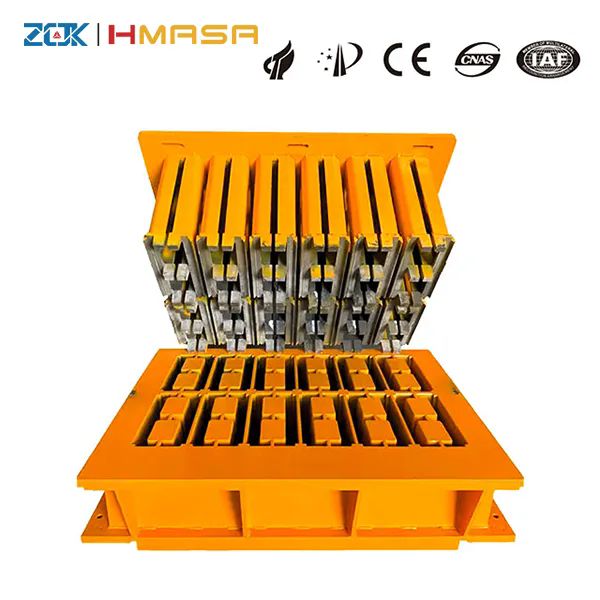
Table of Contents
- Article Outline
- What Is a Hollow Brick Mould?
- Key Manufacturing Challenges Addressed
- How Hollow Brick Moulds Work in Production
- Material and Structural Design Considerations
- How to Choose the Right Hollow Brick Mould
- Technical Parameter Overview
- Frequently Asked Questions
- Conclusion and Business Value
Article Outline
- Definition and industrial role of hollow brick moulds
- Common production pain points in brick manufacturing
- Operational principles and forming logic
- Material durability and structural precision
- Selection guidelines for different production scales
- Performance parameters and maintenance insights
What Is a Hollow Brick Mould?
A hollow brick mould is a specialized forming component used in brick-making machines to shape raw materials into hollow bricks with consistent internal cavities. These cavities reduce material usage while maintaining compressive strength, making hollow bricks suitable for load-bearing and non-load-bearing applications.
Unlike solid brick moulds, hollow brick moulds require higher dimensional accuracy and structural balance. Any deviation in cavity alignment can affect brick density, stacking stability, and curing performance.
Key Manufacturing Challenges Addressed
Brick manufacturers often encounter operational challenges that directly affect productivity and cost control. A well-designed hollow brick mould addresses the following issues:
- Inconsistent brick dimensions leading to construction defects
- High material waste due to poor cavity forming
- Excessive mould wear reducing service life
- Frequent downtime caused by difficult mould replacement
- Uneven brick strength after curing
By improving forming precision and durability, hollow brick moulds stabilize output quality and reduce long-term operational risk.
How Hollow Brick Moulds Work in Production
During the brick-forming process, prepared raw materials such as cement, sand, fly ash, or aggregates are fed into the mould cavity. The hollow brick mould defines the external shape and internal void structure while the forming machine applies vibration and pressure.
The mould’s internal cores are responsible for creating uniform hollow sections. Their alignment and surface finish directly influence brick release efficiency and surface smoothness. Once compacted, the green bricks are demoulded and transferred for curing.
A stable mould design ensures:
- Even material distribution
- Consistent cavity geometry
- Smooth demoulding without edge damage
Material and Structural Design Considerations
Hollow brick mould performance largely depends on material selection and structural reinforcement. High-quality moulds are typically manufactured using wear-resistant alloy steel combined with precision machining.
Important design considerations include:
- Surface hardness to resist abrasion
- Optimized wall thickness for structural balance
- Replaceable wear components to extend service life
- Accurate cavity spacing to maintain brick strength
Proper heat treatment further enhances fatigue resistance, especially in high-output production environments.
How to Choose the Right Hollow Brick Mould
Selecting a hollow brick mould should be based on production goals, machine compatibility, and material characteristics. Key evaluation factors include:
- Brick size and cavity configuration requirements
- Compatibility with existing brick-making equipment
- Expected daily production capacity
- Maintenance and replacement cost considerations
For manufacturers seeking long-term stability, investing in precision-engineered moulds reduces defect rates and improves overall production efficiency.
Technical Parameter Overview
| Parameter | Typical Range |
|---|---|
| Applicable Brick Type | Load-bearing and non-load-bearing hollow bricks |
| Mould Material | Alloy steel with heat treatment |
| Service Life | 80,000 – 120,000 cycles |
| Production Compatibility | Automatic and semi-automatic machines |
| Cavity Accuracy | ±0.2 mm tolerance |
Frequently Asked Questions
Q1: How does a hollow brick mould affect brick strength?
The mould controls cavity size and wall thickness, which directly influence compressive strength and load distribution after curing.
Q2: How often should hollow brick moulds be replaced?
Replacement depends on material quality, production intensity, and maintenance practices. High-grade moulds can operate reliably for extended cycles.
Q3: Can one mould be used for different raw material mixes?
Yes, but material flow characteristics must be considered. Adjustments in vibration and pressure settings may be required for optimal results.
Conclusion and Business Value
A hollow brick mould is not merely a forming tool but a critical investment that defines production stability, product quality, and cost efficiency. By focusing on precision design, durable materials, and proper selection, manufacturers can significantly enhance their competitive advantage in the construction materials market.
ZCJK specializes in providing engineered hollow brick mould solutions designed to support consistent output and long-term reliability. For customized configurations and technical consultation, contact us today to explore how ZCJK can support your production goals with dependable mould systems.
