

How Industrial Air Conditioner Serves Railway Communication and Signal Equipment Housings?
2026-10-19
A railway signal maintenance engineer reviews the alarm log for a remote relay station. The log shows three over-temperature alarms in the past month. Each alarm occurred between 2:00 PM and 4:00 PM, when the outdoor temperature exceeded 35°C. The Industrial Air Conditioner in the equipment housing was running, but the internal temperature reached 42°C, which is above the 40°C limit for the signal equipment. The engineer visits the site and finds that the air conditioner is undersized for the heat load and that the condenser coil is clogged with dust. The equipment housing is located next to a coal loading area, and the dust has reduced the cooling capacity by 30 percent. This is a common scenario in railway signaling. The equipment housing is exposed to harsh environments, and the air conditioner must be selected and maintained to handle the actual conditions. This guide explains how industrial air conditioners serve railway communication and signal equipment housings.
1. Why Is Temperature Control Critical for Railway Signal Equipment?
Railway communication and signal equipment is sensitive to temperature. The electronic components in the signal controllers, the communication radios, and the power supplies have a maximum operating temperature of 40°C to 45°C. Above this temperature, the failure rate increases exponentially. The Arrhenius equation predicts that every 10°C increase in temperature reduces the life of electronic components by half. The table below shows the relationship between internal housing temperature and equipment failure rate.
| Internal temperature (°C) | Relative failure rate | Expected equipment life | Typical alarm condition |
| 25 | 1.0 | 15 – 20 years | Normal |
| 30 | 1.6 | 10 – 12 years | Normal |
| 35 | 2.5 | 6 – 8 years | Warning |
| 40 | 4.0 | 4 – 5 years | Alarm |
| 45 | 6.3 | 2 – 3 years | Critical |
| 50 | 10.0 | 1 – 2 years | Failure |
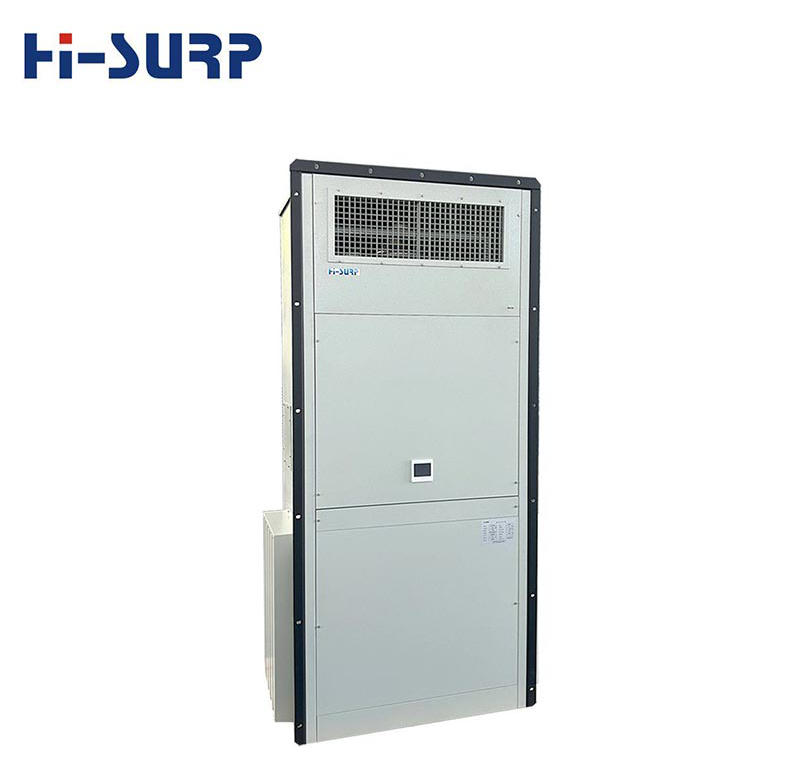
In our factory, we manufacture Industrial Air Conditioner units that are designed for railway equipment housings. The units maintain an internal temperature of 25°C to 30°C even when the outdoor temperature is 45°C. Ningbo Hicon Industry Co., Ltd. has been manufacturing industrial air conditioners for over 12 years and supplies to railway projects in Southeast Asia and Africa.
2. How Does Humidity Affect Railway Signal Equipment?
Humidity is as damaging as temperature for railway signal equipment. High humidity causes condensation on circuit boards, which leads to corrosion and short circuits. The relative humidity inside the equipment housing should be maintained below 60 percent to prevent condensation. An Industrial Air Conditioner removes moisture from the air as it cools. The condensate is drained away through a drain line. The table below shows the effect of humidity on equipment reliability.
| Relative humidity (%) | Corrosion risk | Condensation risk | Recommended action |
| < 40 | Low | None | No action |
| 40 – 60 | Moderate | Low | Monitor |
| 60 – 80 | High | Moderate | Dehumidify |
| 80 – 90 | Very high | High | Dehumidify and heat |
| > 90 | Severe | Very high | Emergency action |
The air conditioner must be sized to handle both the sensible heat load (from the equipment and the sun) and the latent heat load (from the moisture in the air). If the air conditioner is undersized, it will not remove enough moisture, and the humidity will remain high even if the temperature is acceptable. In our factory, we provide a load calculation service that includes both sensible and latent loads. We also offer a low-temperature option for cold climates, where the air conditioner may need to operate in reverse cycle to maintain the temperature.
3. What Are the Special Requirements for Unattended Railway Sites?
Most railway communication and signal equipment housings are unattended. The air conditioner must operate reliably without regular maintenance. The key requirements for unattended sites are: a robust compressor, a clog-resistant condenser coil, a remote monitoring interface, and a wide voltage tolerance. The table below shows the requirements and how they are addressed.
| Requirement | Challenge | Solution |
| Reliable operation | No maintenance for 6 – 12 months | Industrial-grade compressor; sealed bearings |
| Dust resistance | Coal dust, sand, pollen | Washable condenser coil; high-efficiency filter |
| Remote monitoring | No operator on site | RS485 or Ethernet interface; alarm contacts |
| Voltage tolerance | Unstable power supply | Wide voltage range (180 – 260 V); surge protection |
| Corrosion resistance | Coastal or industrial atmosphere | Epoxy-coated coil; stainless steel housing |
Maintenance engineer's note: The most common cause of air conditioner failure at railway sites is a clogged condenser coil. The dust reduces the airflow, which increases the condensing pressure and the compressor current. The compressor overheats and trips on the thermal overload. In our factory, we equip our Industrial Air Conditioner units with a washable condenser coil and a filter that can be cleaned without removing the unit from the housing. We also provide a remote monitoring module that sends an alarm to the maintenance center when the filter needs cleaning.
4. How Should the Air Conditioner Be Sized for a Railway Equipment Housing?
The air conditioner must be sized to handle the heat load of the equipment plus the heat gain from the housing. The heat load calculation includes the equipment power, the solar gain through the housing walls, the heat gain from the ambient air, and the latent load from the moisture. The table below shows a typical load calculation for a railway signal housing.
| Load component | Typical value | Calculation method |
| Equipment heat load | 1,500 W | Sum of the power ratings of the signal and communication equipment |
| Solar gain (walls and roof) | 400 W | Surface area × solar irradiance × U-factor |
| Ambient heat gain | 200 W | Surface area × temperature difference × U-factor |
| Latent load (moisture) | 300 W | Air changes per hour × humidity ratio difference × latent heat |
| Total cooling load | 2,400 W | Sum of all components |
| Recommended AC capacity | 2,800 W | Total load × 1.15 safety factor |
In our factory, we use a load calculation software that accounts for the housing dimensions, the insulation, the orientation, and the local climate. We recommend a safety factor of 15 to 20 percent to account for dust, aging, and unexpected heat loads. Ningbo Hicon Industry Co., Ltd. provides a free load calculation service for railway projects. We also recommend that the air conditioner be equipped with a low-ambient kit for operation below -10°C and a high-ambient kit for operation above 45°C.
Frequently Asked Questions About Industrial Air Conditioners for Railway Signal Housings
Summary for Railway Maintenance Engineers
Industrial Air Conditioner units are essential for railway communication and signal equipment housings because they maintain the temperature and humidity within the operating range of the electronic equipment. The air conditioner must be sized for the total heat load, including the equipment, the solar gain, the ambient gain, and the latent load. For unattended sites, the unit must be reliable, dust-resistant, and equipped with remote monitoring. Regular maintenance, especially cleaning the condenser coil and the filter, is essential for reliable operation. Ningbo Hicon Industry Co., Ltd. has been manufacturing Industrial Air Conditioner units for over 12 years and provides load calculation, product supply, and maintenance support for railway projects.
Ningbo Hicon Industry Co., Ltd. manufactures Industrial Air Conditioner units for railway signal housings with wide temperature operation (-20°C to +55°C), remote monitoring interfaces, and washable condenser coils. We provide load calculations, installation support, and maintenance training for all of our products.
