

How Industrial Air Conditioner Supports Data Center Prefabricated Pod Cooling Needs?
2026-09-24
A prefabricated pod data center is not a smaller version of a traditional data center. It is a different design philosophy. Traditional data centers are built around centralized chilled water plants, raised floors, and large air handling units. Prefabricated pods are built in a factory, shipped as a complete unit, and deployed in weeks rather than months. The cooling system must fit inside the pod envelope, connect to limited external utilities, and operate reliably without a dedicated mechanical room. An Industrial Air Conditioner is often the practical choice for this application because it is self-contained, factory-tested, and designed for harsh environments. This guide explains how to match the cooling system to the pod's power density, deployment site, and availability requirements.
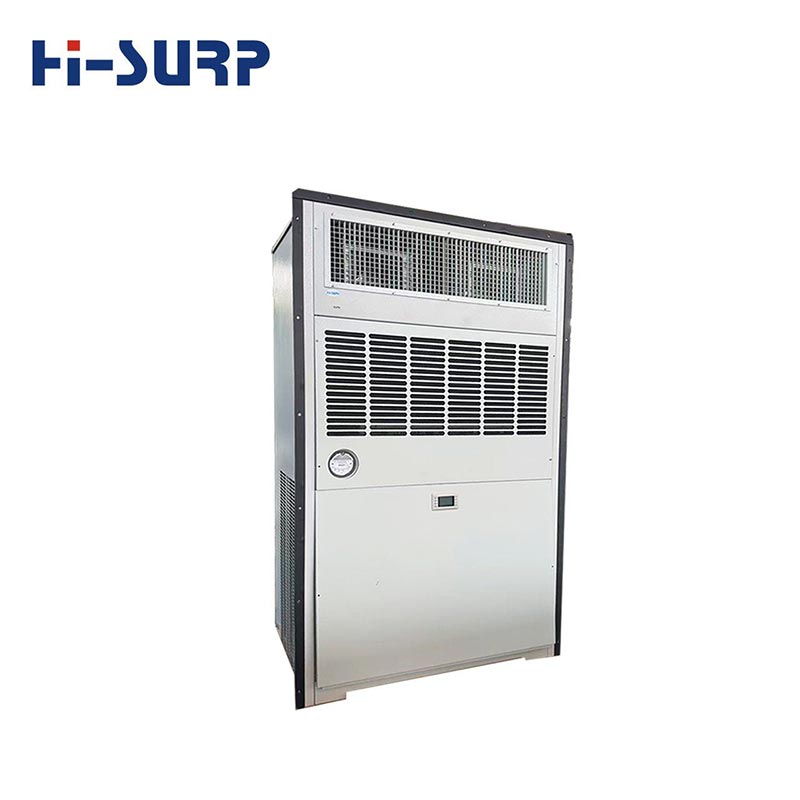
1. What Constraints Make Standard Data Center Cooling Unsuitable for Prefabricated Pods?
Standard data center cooling relies on three assumptions that do not hold for prefabricated pods. The first is space. A central chilled water plant requires a mechanical room, pumps, piping, and a cooling tower. A pod does not have this space. The second is time. A chilled water system takes months to design, install, and commission. A pod is deployed in 8 to 12 weeks. The third is infrastructure. A pod may be deployed in a location without a reliable water supply or a trained mechanical staff. The table below compares the requirements of a central chilled water system and a self-contained Industrial Air Conditioner for pod cooling.
| Requirement | Central chilled water system | Self-contained Industrial Air Conditioner |
| Mechanical room footprint | Large (30 – 50% of IT space) | None (integrated into pod) |
| Deployment time | 6 – 12 months | 4 – 8 weeks |
| Water supply | Required (evaporative or cooling tower) | Not required (air-cooled or DX) |
| On-site expertise | High (mechanical engineers) | Moderate (facility technicians) |
| Scalability | Central plant must be oversized | Modular; add units as needed |
| Typical PUE | 1.2 – 1.4 | 1.3 – 1.5 |
In our factory, we have supplied Industrial Air Conditioner units for over 30 prefabricated pod projects in Southeast Asia and the Middle East. The common requirement across all projects is a self-contained cooling system that can be installed, tested, and maintained without specialized mechanical support.
2. How Does Cooling Capacity Match the Pod's Power Density?
The cooling capacity is determined by the IT load, the enclosure heat gain, and the ambient design temperature. A typical prefabricated pod has an IT load of 50 to 300 kW. The cooling system must remove this heat plus the heat generated by the cooling system itself and the heat conducted through the pod walls. The table below shows the recommended Industrial Air Conditioner capacity for different pod power densities.
| Pod IT load (kW) | Recommended cooling capacity (kW) | Typical configuration | Redundancy level |
| 50 – 80 | 60 – 100 | 2 x 50 kW air-cooled | N+1 |
| 80 – 150 | 100 – 180 | 3 x 60 kW air-cooled | N+1 |
| 150 – 250 | 200 – 300 | 4 x 80 kW air-cooled or 2 x 150 kW chilled water | N+1 or 2N |
| 250 – 400 | 320 – 500 | 4 x 120 kW chilled water | 2N |
Ningbo Hicon Industry Co., Ltd. manufactures Industrial Air Conditioner units with capacities from 20 kW to 150 kW per unit. Our factory can configure multiple units in a modular arrangement to match any pod size. We also offer a controls package that allows the units to operate in a lead-lag configuration, which balances the runtime and extends the service interval.
3. What Are the Different Cooling Configurations for Prefabricated Pods?
There are three primary cooling configurations for prefabricated pods: direct expansion (DX) air-cooled, DX with a remote condenser, and chilled water. The DX air-cooled configuration is the simplest and most common for edge deployments. The condenser is integrated into the unit, and the heat is rejected directly to the outdoor air. The DX with a remote condenser configuration separates the condenser from the evaporator, which allows the evaporator to be placed inside the pod and the condenser to be placed outside. This is useful when the pod is installed indoors. The chilled water configuration uses a central chiller to supply cold water to the cooling coils. This is more efficient at high power densities but requires a chiller plant. The table below compares these configurations.
| Configuration | Typical capacity per unit | Efficiency (EER) | Installation complexity | Best for |
| DX air-cooled (integrated condenser) | 20 – 60 kW | 2.8 – 3.2 | Low | Outdoor edge pods |
| DX with remote condenser | 30 – 80 kW | 3.0 – 3.5 | Moderate | Indoor pods with outdoor condenser space |
| Chilled water | 50 – 150 kW | 4.0 – 5.5 | High (requires chiller plant) | Large pods with central plant |
In our factory, we manufacture DX air-cooled and chilled water Industrial Air Conditioner units. We also provide a remote condenser option for indoor pods. The selection depends on the site conditions, the power density, and the availability of a central chiller plant.
4. How Should Redundancy and Controls Be Configured for Pod Cooling?
Redundancy is critical for data center cooling because a cooling failure can lead to IT equipment shutdown within minutes. The two common redundancy levels are N+1 and 2N. In an N+1 configuration, one additional cooling unit is installed beyond the number required to carry the load. If one unit fails, the remaining units can carry the load. In a 2N configuration, two complete cooling systems are installed, each capable of carrying the full load. The controls must be designed to automatically start the standby unit when the primary unit fails. The table below shows the recommended redundancy and control features for different pod availability tiers.
| Availability tier | Typical redundancy | Control features | Failure response time |
| Tier II | N+1 | Automatic lead-lag, alarm notification | < 2 minutes |
| Tier III | N+1 (concurrent maintainable) | Automatic transfer, remote monitoring | < 1 minute |
| Tier IV | 2N | Dual power paths, automatic transfer, fault isolation | < 30 seconds |
Ningbo Hicon Industry Co., Ltd. provides Industrial Air Conditioner units with built-in redundancy controls. Our factory can supply a group controller that manages multiple units and provides automatic failover. The controller also provides remote monitoring via SNMP or Modbus, which allows the data center operations team to monitor the cooling status from a central location.
Frequently Asked Questions About Industrial Air Conditioners for Prefabricated Pod Cooling
Summary for Data Center Infrastructure Engineers
Prefabricated pod data centers require a cooling solution that is self-contained, quickly deployable, and scalable. An Industrial Air Conditioner meets these requirements by providing factory-tested cooling in a compact package. The selection depends on the pod's power density, the site conditions, and the required availability tier. DX air-cooled units are the simplest and most common configuration for edge deployments. Chilled water units are more efficient for high-density pods with a central plant. Redundancy and controls must be designed to meet the availability target. Ningbo Hicon Industry Co., Ltd. has been manufacturing Industrial Air Conditioner units for over 15 years and has supplied cooling systems for over 30 prefabricated pod projects.
Ningbo Hicon Industry Co., Ltd. manufactures Industrial Air Conditioner units for prefabricated pod cooling, with capacities from 20 kW to 150 kW. We provide high-ambient packages, redundancy controls, and remote monitoring options.
