

How Industrial Air Conditioner with High Sensible Heat Ratio Cools Electronics Efficiently?
2026-09-07
Walk into any server room or electronic equipment shelter, and you will feel the air. It is cold, dry, and often uncomfortable for people. That is intentional. Electronic equipment does not need humidity control. It does not need air motion for occupant comfort. It needs sensible cooling—the removal of heat without the removal of moisture. A standard comfort air conditioner spends 30 to 40 percent of its energy removing humidity that does not need to be removed. An industrial air conditioner with a high sensible heat ratio (SHR) focuses nearly all of its capacity on lowering the dry bulb temperature, which is exactly what electronics require. This guide explains the engineering and the economics behind that choice.
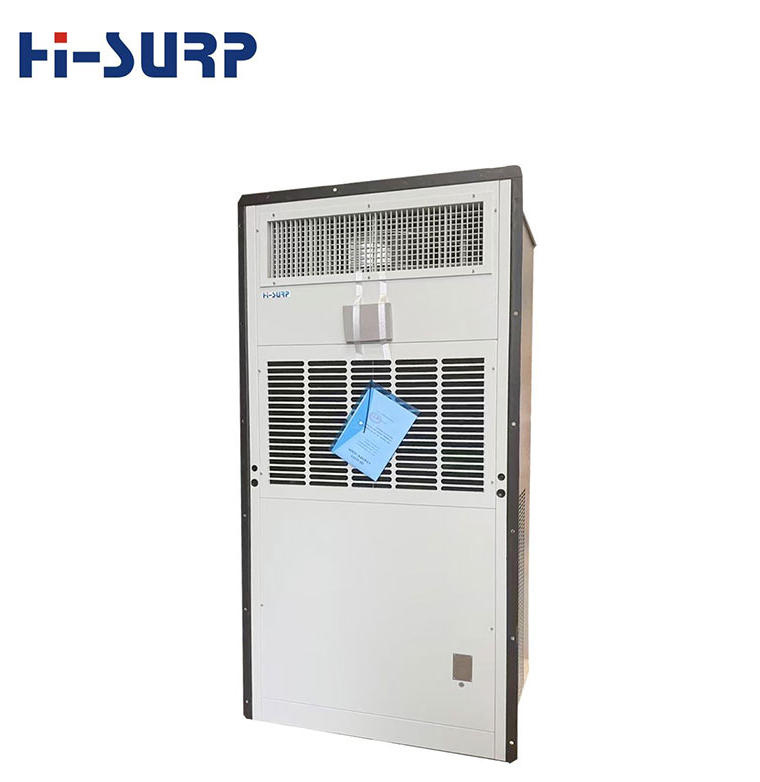
1. What Is Sensible Heat Ratio and Why Does It Matter for Electronics?
The sensible heat ratio is the proportion of the cooling capacity that is used to lower the air temperature (sensible cooling) versus the portion used to condense moisture from the air (latent cooling). A standard comfort air conditioner has an SHR of 0.65 to 0.75, meaning 65 to 75 percent of its capacity goes to temperature reduction and 25 to 35 percent goes to dehumidification. An industrial air conditioner designed for electronics cooling typically has an SHR of 0.85 to 0.95. The difference is significant. In a 10 kW cooling load application, a comfort unit would spend 2.5 to 3.5 kW of capacity on dehumidification that is not needed. That is wasted energy and wasted capacity.
Energy waste calculation: A 10 kW comfort air conditioner with SHR 0.70 spends 3.0 kW on latent cooling (dehumidification). A 10 kW industrial air conditioner with SHR 0.90 spends only 1.0 kW on latent cooling. The industrial unit provides 2.0 kW more sensible cooling for the same power input, or it can use a smaller compressor to achieve the same sensible cooling. This translates to a 20 to 25 percent reduction in compressor power consumption for the same cooling effect.
At Ningbo Hicon Industry Co., Ltd., we manufacture Industrial Air Conditioner units with SHR ratings of 0.85 to 0.92, depending on the operating conditions. Our factory tests every unit in a controlled environment to verify the SHR at the design conditions. We have found that a high SHR Industrial Air Conditioner can reduce the required cooling capacity by 15 to 25 percent compared to a comfort unit for the same electronic heat load.
2. How Does High SHR Cooling Affect Equipment Reliability and Lifespan?
Electronic equipment has a predictable relationship between temperature and failure rate. The Arrhenius equation shows that for every 10°C reduction in operating temperature, the failure rate roughly halves. A high SHR Industrial Air Conditioner maintains a consistent temperature without the cycling and humidity swings that are common with comfort units. In our factory, we have monitored the temperature stability of Industrial Air Conditioner units in telecom shelters. The temperature variation is ±1°C, compared to ±3°C for comfort units. This stability reduces thermal stress on electronic components, extending the mean time between failures (MTBF). The table below shows the projected equipment lifespan improvement based on temperature stability.
| Cooling system type | Temperature variation (±°C) | Relative humidity variation | Projected electronic equipment life (years) |
| Comfort air conditioner (SHR 0.70) | ±3.0 | ±10% | 5 – 7 |
| Industrial air conditioner (SHR 0.85) | ±1.5 | ±5% | 8 – 10 |
| High SHR industrial unit (SHR 0.92, our design) | ±1.0 | ±3% | 10 – 12 |
The extended equipment life is a significant economic benefit. A $50,000 telecom switch that lasts 10 years instead of 7 years saves $15,000 in capital cost over the facility's operating life. In our factory, we have documented these savings for customers who switched from comfort units to our high SHR Industrial Air Conditioner.
3. What Are the Real-World Energy Savings From High SHR Cooling?
The energy savings from high SHR cooling are measurable and significant. In a typical electronic equipment room with a 15 kW sensible heat load, a comfort air conditioner would require a nominal capacity of approximately 21.4 kW (15 kW / 0.70 SHR). A high SHR Industrial Air Conditioner with SHR 0.90 would require only 16.7 kW (15 kW / 0.90 SHR). The compressor power is roughly proportional to the cooling capacity. The table below compares the annual energy consumption of the two approaches.
| Parameter | Comfort air conditioner (SHR 0.70) | High SHR industrial unit (SHR 0.90) | Difference |
| Required cooling capacity for 15 kW sensible load | 21.4 kW | 16.7 kW | -4.7 kW |
| Compressor power consumption (at EER 3.0) | 7.1 kW | 5.6 kW | -1.5 kW |
| Annual operating hours | 8,760 | 8,760 | Same |
| Annual energy consumption (kWh) | 62,196 | 49,056 | -13,140 |
| Annual energy cost (at $0.12/kWh) | $7,464 | $5,887 | -$1,577 |
| 10-year energy cost | $74,640 | $58,870 | -$15,770 |
The 10-year energy saving of $15,770 is typically more than the initial cost difference between a comfort unit and an Industrial Air Conditioner. In our factory, we have helped customers calculate their specific savings based on their local electricity rates and cooling load.
4. How Does the System Design of a High SHR Industrial Air Conditioner Differ?
A high SHR Industrial Air Conditioner is not simply a comfort unit with a different control setting. The design differences are fundamental. The evaporator coil is designed with a lower face velocity and a different fin spacing to minimize condensation. The compressor is often a digital scroll type that can modulate capacity to match the load without cycling. The condenser is larger to allow lower condensing temperatures, which improves efficiency. The control system uses a temperature sensor, not a humidistat, as the primary control input. In our factory, we have designed Industrial Air Conditioner units with evaporator face velocities of 2.0 to 2.5 m/s, compared to 3.0 to 3.5 m/s for comfort units. This lower velocity reduces moisture carryover and increases the sensible heat ratio.
Frequently Asked Questions About High SHR Industrial Air Conditioners
Summary for Facility Managers
A high sensible heat ratio Industrial Air Conditioner is not a luxury. It is an engineering solution that matches the cooling output to the actual thermal load of electronic equipment. By eliminating unnecessary dehumidification, it reduces compressor power consumption, extends equipment life, and lowers the total cost of cooling. The initial cost premium is typically recovered within 2 to 3 years through energy savings alone. Our factory has specialized in high SHR cooling for electronic equipment rooms for over 15 years. We provide units with SHR ratings verified by independent testing.
Ningbo Hicon Industry Co., Ltd. manufactures Industrial Air Conditioner units with SHR ratings from 0.85 to 0.92. Each unit is tested in our factory to verify the SHR at the specified design conditions. We provide full performance documentation, including the SHR curve at different entering air conditions.
