

How Often Should I Flush and Refill a Marine Outboard Hydraulic Steering System
2026-08-18
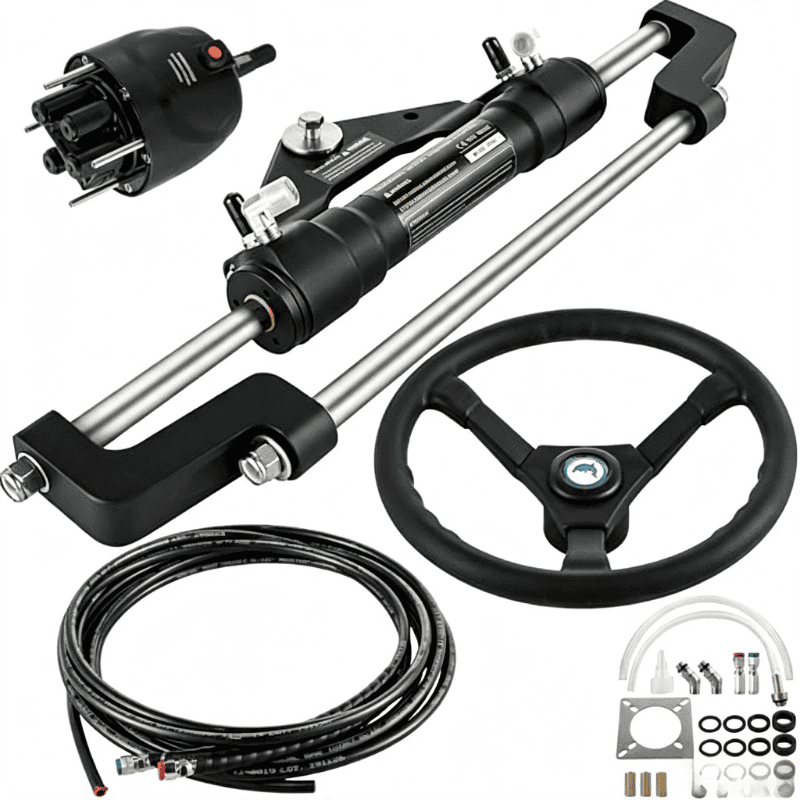
A well-maintained Marine Outboard Hydraulic Steering System delivers precise control, reduces helm fatigue, and extends the life of seals, hoses, and pumps. Yet one question consistently surfaces in service bays and online forums: what is the correct maintenance interval for flushing and refilling? According to HCIC’s field data and manufacturer guidelines, the answer depends on usage, environment, and system type—but a fixed rule does exist.
Recommended Service Intervals by Usage Profile
| Usage Type | Flush Interval | Full Refill Interval | Key Deterioration Factors |
|---|---|---|---|
| Light recreational (<50 hrs/year) | Every 2 years | Every 3 years | Moisture absorption, minor thermal cycling |
| Moderate coastal fishing (50–150 hrs/year) | Annually | Every 2 years | Salt spray, frequent lock-to-lock turns |
| Heavy offshore / charter (>150 hrs/year) | Every 6 months | Annually | Constant load, high vibration, temperature swings |
| Commercial / patrol duty | Quarterly | Every 6 months | Continuous operation, shock loads, debris ingress |
HCIC recommends that any Marine Outboard Hydraulic Steering System exposed to brackish or muddy water should receive a visual fluid inspection every 100 hours, regardless of calendar time.
Fluid Condition Checklist – When to Flush Early
Perform a simple draw-test using a clean syringe from the helm bleed port. Replace fluid immediately if you observe:
-
Milky or cloudy appearance (water contamination > 0.5%)
-
Dark brown or black colour (oxidation or seal wear)
-
Metallic particles or gritty texture (pump or cylinder wear)
-
Unusual odour (burnt or acrid – indicates overheating)
Step-by-Step Flush and Refill Procedure (HCIC Recommended)
| Step | Action | Tool / Fluid |
|---|---|---|
| 1 | Lift the outboard to full tilt – lock in place | Engine tilt bracket |
| 2 | Turn helm fully to port – hold for 5 sec | Helm pump |
| 3 | Open bleed screw on cylinder port side | 10 mm wrench + catch bottle |
| 4 | Turn helm to starboard – push old fluid out | Continue until clean fluid appears |
| 5 | Close bleed screw – refill reservoir with HCIC-approved hydraulic fluid | ISO VG 15 or Seastar equivalent |
| 6 | Cycle lock-to-lock 10 times – re-bleed all lines | Repeat until no air bubbles |
| 7 | Top off reservoir – check for leaks under load | Torque all fittings to 18–22 Nm |
Always use the fluid grade specified in your Marine Outboard Hydraulic Steering System manual. HCIC offers pre-blended, anti-foam hydraulic fluid that meets OEM viscosity requirements for both helm and cylinder units.
Common Mistakes That Shorten Fluid Life
-
Mixing different fluid brands (incompatible additives cause gelling)
-
Overfilling the reservoir (thermal expansion leads to seal blow-out)
-
Ignoring the helm vent cap (vacuum lock draws in humid air)
-
Using automotive power-steering fluid (lacks marine-grade anti-corrosion packages)
Marine Outboard Hydraulic Steering System FAQ
Q: Can I flush only one side of the hydraulic circuit, or must I flush the entire loop?
A: You must flush the entire closed-loop circuit – both port and starboard lines, plus the helm pump and cylinder chambers. Flushing a single side leaves contaminated fluid in the return path, which will mix with new fluid during the first turn. HCIC’s service protocol requires a full 360° loop flush: turn hard over, open the opposite bleed screw, and pump at least two full reservoir volumes through the system to ensure complete exchange.
Q: What is the maximum allowable water content in a Marine Outboard Hydraulic Steering System before internal corrosion starts?
A: The threshold is 0.2% by volume (about 2 mL per litre). Above this level, free water separates from the base oil and settles at low points—typically the cylinder end caps. This initiates pitting on the chrome-plated piston rod within 200 operating hours. HCIC uses a dielectric moisture test strip during inspections; if the reading exceeds 0.15%, we recommend an immediate flush, even if the calendar interval has not elapsed.
Q: How do I know if air remains trapped after a refill, and what symptoms should I look for?
A: Trapped air manifests as a spongy or delayed helm response, especially when reversing from full port to full starboard. You may also hear a chattering noise from the helm pump during slow turns. To verify, perform the “10‑turn test”: turn the wheel fully to one side, count 10 complete revolutions to the opposite lock, and observe the fluid level in the reservoir. If the level drops more than 5 mm after resting for 2 minutes, air is still compressing in the lines. HCIC recommends a pressure-bleed adapter that pulls a light vacuum (‑0.3 bar) to collapse microscopic bubbles – this cuts bleeding time by 60%.
Professional Recommendation from HCIC
For most recreational boaters, HCIC advises a mandatory annual flush before the start of each season, plus a full refill every second year – regardless of hour meter readings. This rhythm accounts for condensation, seal permeation, and additive depletion that occur even during winter storage. For twin-engine installations, double the frequency because higher steering loads accelerate fluid shear.
Why Fluid Freshness Matters More Than You Think
Old hydraulic fluid loses its boundary-lubrication properties, increasing metal-to-metal contact inside the helm rotary valve. Over time, this produces fine wear particles that act as abrasives, scoring the cylinder bore. A $40 fluid change can prevent a $1,200 helm replacement – a cost ratio that HCIC documents in every preventive-maintenance audit.
Final Checklist Before Your Next Trip
-
□
Fluid colour – clear amber or light straw (not dark or milky)
-
□
Reservoir level – between MIN and MAX marks with engine trimmed down
-
□
Bleed screws – snug, no weeping
-
□
Helm torque – less than 2.5 Nm measured at the wheel rim
-
□
Steering lag – less than ½ turn from neutral to full lock under load
Contact Us
HCIC supplies complete Marine Outboard Hydraulic Steering System kits, replacement cylinders, helms, and maintenance fluids for single and twin outboards up to 500 HP. Our technical team provides free interval planning sheets and remote bleed guidance via video call. Contact us today for a custom service schedule or to order your next flush kit – we ship globally with same‑day technical support. Your steering reliability starts with one message. Reach out now.
