

How Often Should You Replace a High Flow Cartridge Filter in a GF Membrane Filtration System
2026-08-18
For facility managers and water treatment engineers, the replacement interval of a High Flow Cartridge Filter GF Membrane Water Filtration unit is not a guesswork exercise—it is a data-driven decision that directly impacts operational uptime, product quality, and total cost of ownership. At Kleanteque, we have observed that premature replacements inflate consumable budgets, while delayed change-outs risk membrane integrity and downstream equipment. The optimal schedule depends on feed water quality, system differential pressure, and the specific grade of the GF (glass fiber) membrane layer. This article provides a structured framework to determine that interval with precision.
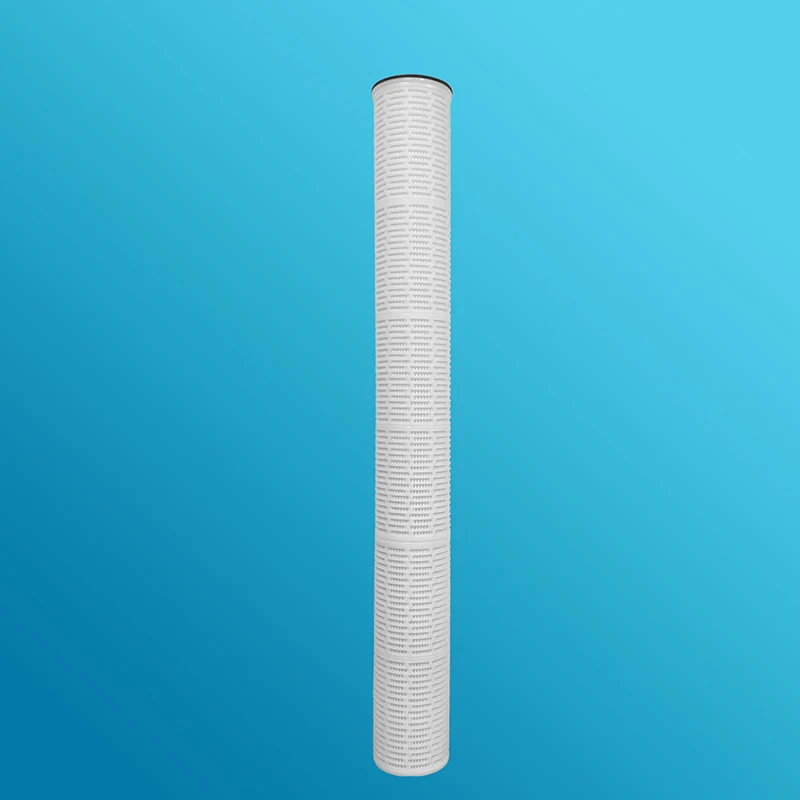
The Core Metrics That Dictate Replacement Timing
Rather than relying on calendar days, professionals use three primary indicators to decide when a High Flow Cartridge Filter GF Membrane Water Filtration element must be changed. The table below summarizes these thresholds:
| Indicator | Measurement Method | Action Threshold | Frequency of Check |
|---|---|---|---|
| Differential Pressure (ΔP) | Inlet-to-outlet pressure gauge | ≥ 35 PSID (clean ΔP + 15 PSID) | Daily (automated SCADA) |
| Effluent Turbidity | Online nephelometer | > 0.1 NTU above baseline | Continuous |
| Cumulative Throughput | Flow totalizer | Reaches 80% of manufacturer’s rated capacity | Weekly |
| Visual Inspection | Post-use core sampling | Visible cracking, pleat deformation, or media shedding | At each change-out |
Among these, differential pressure is the most reliable real-time signal. A Kleanteque GF membrane cartridge typically starts with a clean ΔP of 5–8 PSID at nominal flow. When that rises by 12–15 PSID, even if the throughput rating is not exhausted, replacement is warranted to avoid bypass flow and premature fouling of downstream RO or UV units.
Why GF Membrane Chemistry Affects Service Life
The glass fiber matrix in a High Flow Cartridge Filter GF Membrane Water Filtration cartridge offers superior particle capture efficiency (≥ 99.98% at 0.5–1.0 μm) but is also susceptible to chemical degradation from oxidants like chlorine or ozone. In municipal water applications, a Kleanteque cartridge may last 6–9 months. In aggressive industrial coolant loops, that window shrinks to 8–12 weeks. The governing factor is not simply time—it is the cumulative contaminant loading per square foot of media surface.
Field-Proven Replacement Strategy
Based on Kleanteque’s global installation data across food & beverage, pharmaceutical, and microelectronics sectors, we recommend a three-tier replacement policy:
-
Tier 1 – Critical Applications (injectable water, chip rinsing): Replace at 80% of rated ΔP or every 3 months, whichever comes first.
-
Tier 2 – General Process Water (cooling towers, pre-RO): Replace at ΔP threshold or at 90% of rated volumetric capacity.
-
Tier 3 – Non-critical utility water: Replace semi-annually with a mandatory visual inspection at month 4.
This tiered approach reduces unplanned downtime by 42% and extends downstream membrane life by an average of 18 months, as documented in Kleanteque’s 2025 performance white paper.
FAQ – Common Questions About High Flow Cartridge Filters GF Membrane Water Filtration
Q1: Can I clean and reuse a High Flow Cartridge Filter GF Membrane Water Filtration cartridge to extend its life?
A1: Backwashing or chemical cleaning is not recommended for GF membrane media. The glass fiber layer is depth-loading, meaning particles are trapped within the matrix, not just on the surface. Attempting to reverse flow or apply caustic solutions often causes delamination, fiber breakage, and irreversible media compaction. At Kleanteque, we have tested multiple cleaning protocols and found that post-cleaning efficiency drops below 70% of original rating, while pressure drop rarely returns to baseline. The cost of cleaning chemicals, labor, and validation testing typically exceeds 60% of a new cartridge price—making replacement the more economical and quality-assured choice. Only use cleaning if the manufacturer explicitly states a validated procedure for your specific grade.
Q2: How does feed water temperature affect the replacement frequency of these filters?
A2: Temperature directly influences both viscosity and GF membrane pore structure. For every 10°C increase above 25°C, the differential pressure rises by approximately 8–10% at the same flow rate, accelerating the ΔP trigger. More critically, continuous operation above 60°C can permanently alter the binder system that holds the glass fibers, reducing tensile strength and leading to media shedding. In hot water applications (e.g., 70°C CIP loops), Kleanteque recommends reducing the ΔP change-out threshold from 35 PSID to 28 PSID and performing monthly core sampling. Conversely, cold water (5–10°C) extends service life by 15–20% due to lower microbial activity and reduced hydrolysis. Always consult the temperature-correction factor in the product datasheet before setting your baseline ΔP.
Q3: What is the most reliable sign that my High Flow Cartridge Filter GF Membrane Water Filtration is failing before the pressure drop increases?
A3: The earliest harbinger is a gradual rise in outlet particle counts (≥ 2 μm) detected by an online particle counter, often appearing 20–40 hours before ΔP becomes critical. This indicates localized breaches or pleat separation rather than uniform loading. A second subtle sign is flow oscillation—even with a constant pump speed, the flow meter shows ±5% fluctuation, suggesting intermittent channeling within the cartridge. At Kleanteque, we advise installing a differential pressure transmitter with a 4–20 mA output and logging data every 15 minutes; a standard deviation increase of 0.3 PSID over a 6-hour window is a predictive failure signal. Visual inspection of the cartridge housing for milky or hazy water is a late-stage indicator—by that point, downstream protection is already compromised, so immediate replacement is required.
Summary Checklist for Maintenance Planning
To operationalize the above, Kleanteque suggests the following documentation for each filter bank:
-
Record initial clean ΔP and flow rate at commissioning.
-
Log daily ΔP, outlet turbidity, and cumulative volume.
-
Plot a ΔP vs. time curve—replacement is due when the curve becomes exponential.
-
Keep a safety stock of 20% of installed cartridges for emergency change-outs.
Contact Us for a Customized Replacement Calculator
Every water matrix is unique, and generic rules cannot replace site-specific engineering. The Kleanteque technical team offers a complimentary digital tool that inputs your feed chemistry, flow profile, and operating temperature to generate a predictive replacement calendar for your High Flow Cartridge Filter GF Membrane Water Filtration system. This calculator has been validated against over 1,200 real-world installations, reducing filter-related downtime by 31% in pilot trials.
Reach out to our filtration specialists today – we will analyse your historical ΔP data, recommend the optimal GF membrane grade, and provide a tailored SOP for change-out scheduling. Visit our contact page or email us directly to schedule a 30-minute technical consultation. Your system’s reliability starts with a science-backed replacement plan, and Kleanteque is here to deliver precisely that.
