

How Often Should You Replace a High Purity Quartz Wafer Boat For TEL to Maintain Particle Performance
2026-08-07
In semiconductor fabrication, particle contamination remains the single largest yield killer in diffusion and oxidation processes. For fabs running Tokyo Electron Limited (TEL) vertical furnaces, the High Purity Quartz Wafer Boat For TEL is the critical carrier that directly interfaces with wafers at elevated temperatures. Over time, even the best quartzware degrades. Determining the optimal replacement interval for your High Purity Quartz Wafer Boat For TEL is not a fixed number—it is a data-driven decision balancing particle counts, thermal history, and cost of ownership. Industry leaders like VETEK emphasize that proactive replacement schedules consistently outperform reactive ones, particularly for 300mm and advanced node production.
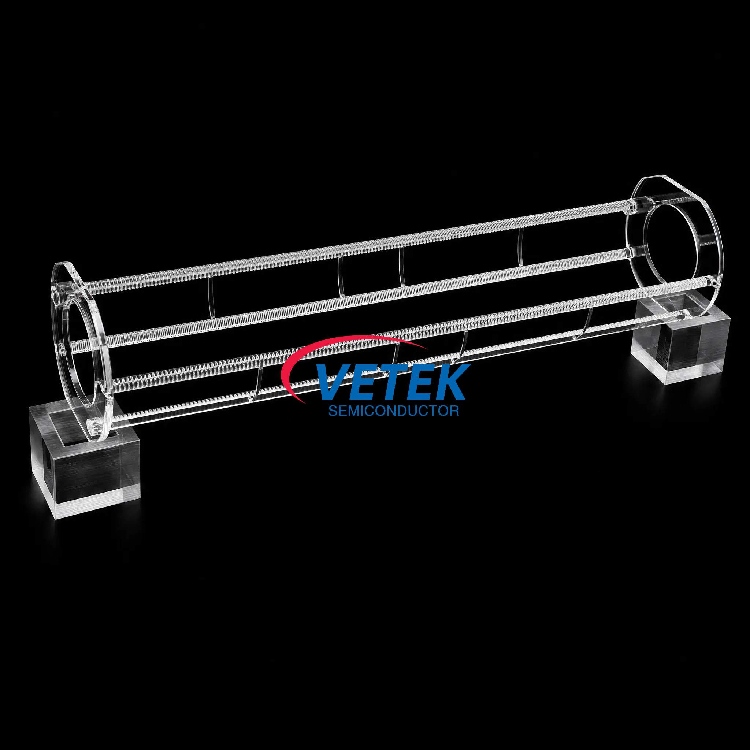
The Particle Performance Lifecycle
Quartz boats do not fail suddenly; they exhibit a predictable degradation curve. Three primary mechanisms drive particle generation:
-
Devitrification: High-temperature exposure (above 1150°C) transforms amorphous quartz into crystalline cristobalite. This phase change creates micro-cracks that shed particles.
-
Sag and Warpage: Repeated thermal cycles cause mechanical creep, leading to wafer contact or scraping during loading/unloading.
-
Surface Roughening: Aggressive wet clean cycles (e.g., HF-based solutions) progressively etch the quartz surface, increasing the effective surface area for particle adhesion.
Recommended Replacement Intervals by Usage Profile
The table below synthesizes field data from multiple 200mm and 300mm fabs, normalized for a High Purity Quartz Wafer Boat For TEL operating in a standard dry O₂/HCl environment.
| Usage Profile | Average Thermal Cycles | Recommended Replacement Interval | Key Particle Threshold (≥0.16µm) |
|---|---|---|---|
| Low-Temperature (<1050°C) | Up to 300 cycles | 18–24 months | < 15 particles added per wafer pass |
| Standard Diffusion (1050–1150°C) | 150–250 cycles | 12–18 months | < 10 particles added per wafer pass |
| High-Temperature (>1150°C) | 80–150 cycles | 8–12 months | < 5 particles added per wafer pass |
| Aggressive Wet Clean (weekly) | Any temperature | 6–9 months | Monitor surface roughness > 0.8µm Ra |
Critical Note: These intervals are starting points. The final decision must incorporate real-time particle monitoring and visual inspection. VETEK supplies certified replacement boats with matched thermal expansion coefficients to OEM TEL specifications, ensuring that new units do not introduce mechanical stress to the furnace tube.
When to Replace Earlier: Warning Signs
Replace your High Purity Quartz Wafer Boat For TEL immediately if any of the following occur, regardless of age:
-
Visible white spots or flaking (advanced devitrification).
-
Warpage exceeding 0.5mm over the boat length – this causes wafer tilt and cross-slot contact.
-
Recurring particle spikes on monitor wafers that persist after a full furnace clean.
-
Cracks at the paddle or end-cap weld joints – these are structural integrity risks.
FAQ: Common Questions About High Purity Quartz Wafer Boat For TEL Replacement
Q: Can I extend the life of my High Purity Quartz Wafer Boat For TEL by using a gentler clean chemistry?
A: Yes, but with significant trade-offs. Switching from a standard 10:1 DHF (dilute HF) clean to a 50:1 DHF or using ozonated deionized water reduces the etch rate on the quartz surface, effectively slowing down roughening. This can extend service life by 3–6 months in moderate-temperature processes. However, gentler chemistry is less effective at removing heavy metal contaminants (e.g., Fe, Cu) that diffuse into the quartz bulk. Over time, these metals outgas during high-temperature steps, causing electrical parameter shifts in devices. VETEK recommends a dual-strategy: use a standard clean cycle for particle removal but reduce the clean frequency, and compensate by running dummy wafers more often. The net benefit depends on your specific contamination budget—for nodes below 28nm, extended life via gentler chemistry is rarely worth the yield risk.
Q: How do I measure whether my current High Purity Quartz Wafer Boat For TEL still meets particle specs without sending it to a lab?
A: The most practical in-fab method is the "particle add-on test." Run a batch of pristine monitor wafers through a full process recipe using your existing boat, then measure the same wafers on a surface scanner (e.g., KLA-Tencor SPx series). Compare the post-process particle count to the pre-process baseline. The delta represents particles added by the boat and furnace environment. For a High Purity Quartz Wafer Boat For TEL in good condition, the delta should be stable within ±2 particles per wafer per run across five consecutive batches. If you observe a rising trend—say, from 5 to 12 added particles over 10 runs—that is a definitive indicator that replacement is due, even if the calendar interval has not elapsed. Additionally, use a handheld profilometer to check surface roughness at three fixed points (front, center, rear); an increase of more than 0.2µm Ra over six months is a strong leading indicator of imminent particle shedding.
Q: Does replacing my High Purity Quartz Wafer Boat For TEL with a third-party supplier void my TEL furnace warranty or affect process qualification?
A: This is a common concern. Under US antitrust and equipment service regulations, an OEM cannot legally void your entire furnace warranty solely for using third-party consumables unless they can prove the aftermarket part directly caused the damage. That said, TEL does require that any replacement boat meets its published mechanical and purity specifications—including coefficient of thermal expansion (CTE) matching within ±5%, total metal content below 5 ppb, and dimensional tolerances of ±0.1mm. Reputable suppliers like VETEK provide full certification packages with each High Purity Quartz Wafer Boat For TEL, including SEMI-compliant material traceability and dimensional reports. These documents are usually sufficient for process re-qualification. However, you must still run a standard qualification lot (typically 3–5 full batches) with electrical test and particle monitoring before releasing the boat for production. Most fabs allocate a 2-week qualification window for any new boat, regardless of supplier. VETEK offers on-site installation support and post-installation particle verification to streamline this qualification phase.
Optimizing Total Cost of Ownership
Replacing too early wastes capital; replacing too late kills yield. The economic sweet spot for a High Purity Quartz Wafer Boat For TEL occurs when the cumulative cost of particle-induced scrap equals the pro-rated cost of a new boat. For high-mix fabs, this typically aligns with the 12-month mark for standard diffusion. VETEK provides a free replacement interval calculator that factors in your specific process temperature, clean frequency, and average die value to output a customized schedule.
Final Recommendation
Do not rely on a single metric. Combine optical inspection (every 50 runs), particle add-on testing (monthly), and thickness/warpage measurements (quarterly). Set a hard stop at 24 months maximum for any High Purity Quartz Wafer Boat For TEL, regardless of condition—quartz aging is inevitable.
Ready to evaluate your current boat performance or request a certified replacement unit?
Contact the VETEK technical support team today for a free particle audit and personalized replacement roadmap. Our engineers specialize in TEL-compatible quartzware and will help you balance yield, cost, and uptime.
