

How Reverse Osmosis Equipment Turns Groundwater into Safe Drinking Water?
2026-09-01
Groundwater is not naturally "pure." It dissolves minerals from soil and rock as it moves underground. In many regions, it also picks up agricultural runoff, industrial contaminants, and naturally occurring arsenic or fluoride. The question for water treatment engineers is not whether the groundwater needs treatment—it is how to design a system that reliably removes the specific contaminants present, at the lowest possible operating cost. This article walks through the complete process train, from raw groundwater extraction to finished drinking water, focusing on the role of Reverse Osmosis Equipment in achieving potable quality.
1. What Contaminants Are Typically Found in Groundwater That RO Must Remove?
The composition of groundwater varies widely by region. A well in a coastal area may have high chlorides and sodium. A well near agricultural land may have elevated nitrates and pesticides. A well in a volcanic area may have arsenic or fluoride.
The table below shows typical groundwater quality parameters and the corresponding removal mechanisms in a Reverse Osmosis Equipment system.
| Contaminant | Typical groundwater concentration | WHO guideline | RO removal efficiency |
| Total dissolved solids (TDS) | 500 – 3000 mg/L | < 1000 mg/L | 95 – 99% |
| Nitrate (NO3-N) | 5 – 50 mg/L | < 11 mg/L | 85 – 95% |
| Arsenic (As) | 5 – 50 μg/L | < 10 μg/L | > 98% |
| Fluoride (F) | 1 – 8 mg/L | < 1.5 mg/L | 90 – 95% |
| Hardness (CaCO3) | 200 – 600 mg/L | < 200 mg/L | 95 – 98% |
Before water reaches the Reverse Osmosis Equipment, it must be pre treated to remove suspended solids and adjust pH. In our factory, we design pre treatment trains that include media filtration, activated carbon, and antiscalant injection. This protects the RO membranes from fouling and scaling.
2. How Does the RO Membrane Separate Contaminants at the Molecular Level?
The core of any Reverse Osmosis Equipment system is the semi permeable membrane. These membranes are made of polyamide thin film composite with a pore size of approximately 0.0001 microns. Water molecules pass through by diffusion, while dissolved ions and organic molecules are rejected. The driving force is pressure—typically 15 to 25 bar for brackish water, and up to 80 bar for seawater.
Key engineering consideration: The pressure requirement is directly proportional to the feed water TDS and the desired recovery rate. Higher recovery (more water as product) requires higher pressure and increases the risk of scaling. For groundwater treatment, we typically design for 65 to 75 percent recovery.
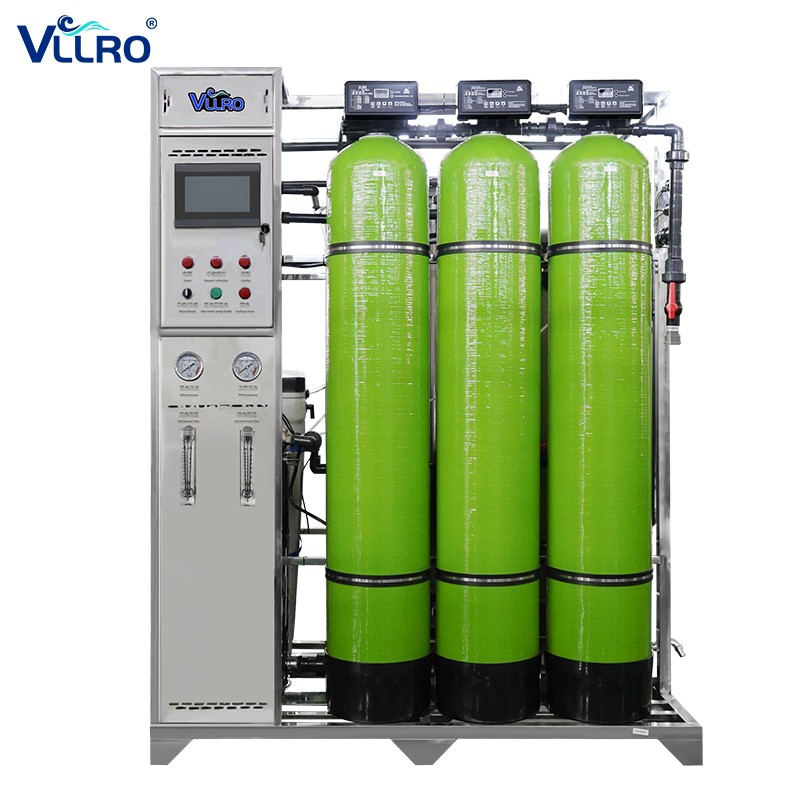
Our Reverse Osmosis Equipment uses spiral wound membrane elements with a membrane area of 30 to 45 square meters per element. A typical system for a community water supply might use 6 to 12 membrane elements in series. The feed water flows across the membrane surface, and the permeate (clean water) passes through the membrane to the central collection tube. The concentrate (brine) containing the rejected contaminants is discharged separately. This cross flow design prevents contaminants from accumulating on the membrane surface.
3. What Is the Typical Performance of a Reverse Osmosis System for Groundwater?
Performance is measured by three key metrics: permeate quality (TDS), recovery rate, and energy consumption. The table below shows typical operating parameters for a Reverse Osmosis Equipment system treating groundwater with a feed TDS of 1200 mg/L.
| Parameter | Typical value | Comment |
| Feed TDS | 1200 mg/L | Based on actual groundwater samples |
| Permeate TDS | < 20 mg/L | Well below WHO guideline of 1000 mg/L |
| Recovery rate | 70% | Optimized for membrane life and energy |
| Operating pressure | 18 bar | Depends on membrane type and temperature |
| Energy consumption | 1.8 – 2.2 kWh/m3 | Includes high pressure pump only |
| Membrane flux | 18 – 22 L/m2/hr | Design flux for groundwater applications |
In our factory, we use a computer simulation tool to predict the performance of Reverse Osmosis Equipment based on the actual feed water analysis. The simulation accounts for temperature variations, membrane fouling factors, and seasonal changes in water quality. We provide a guaranteed performance report with every system we design.
4. What Post Treatment Is Required After RO Permeate Production?
Reverse Osmosis Equipment produces water that is very low in minerals. While this is excellent for removing contaminants, it can be aggressive to distribution pipes and may have a flat taste. The typical post treatment steps include pH adjustment (adding sodium hydroxide or lime), re mineralization (adding calcium carbonate or a blend of mineral salts), and disinfection (ultraviolet light or chlorine).
In many of our projects, we use a calcite contactor to add calcium and alkalinity back into the permeate. This stabilizes the water and prevents it from leaching metals from pipes. The table below shows the typical post treatment parameters for a groundwater RO system.
| Post treatment parameter | Target range | Method used |
| pH | 6.8 – 7.8 | Lime or NaOH injection |
| Alkalinity | 40 – 80 mg/L as CaCO3 | Calcite contactor |
| Calcium hardness | 30 – 60 mg/L | Calcite contactor |
| Free chlorine residual | 0.2 – 0.5 mg/L | Sodium hypochlorite injection |
Frequently Asked Questions About Reverse Osmosis for Groundwater Treatment
Summary for Water Treatment Engineers and Facility Managers
Reverse Osmosis Equipment is a proven technology for turning groundwater into safe drinking water. The process is not complex—it is a physical separation using pressure and a semi permeable membrane. But the engineering decisions about pretreatment, recovery rate, membrane selection, and post treatment have a direct impact on operating cost and water quality. A well designed system will produce consistent permeate quality for 5 to 7 years with minimal intervention.
Jianyun Zhishui (Qingdao) Industrial Technology Co., Ltd. specializes in designing and manufacturing Reverse Osmosis Equipment for municipal water supply, industrial water treatment, and community water systems. We provide full design documentation, performance testing, and operator training.
