

How Split-Type Industrial Air Conditioner Serves Complex Electrical Room Layouts?
2026-10-16
An electrical room in a manufacturing plant houses 18 switchgear cabinets, 4 transformer bays, and a battery bank. The room was built 15 years ago without air conditioning. The original ventilation fans are no longer sufficient because the load has increased. The room temperature reaches 42°C in summer, which exceeds the maximum operating temperature of the switchgear. The facility manager needs a cooling solution, but the room has no ceiling plenum, no floor space for a ducted system, and only one external wall. A central chiller with air handling units is not feasible. This is where a split-type Industrial Air Conditioner becomes the practical solution. This guide explains how split systems adapt to complex electrical room layouts.
1. What Makes Electrical Room Heat Loads Different From Comfort Cooling?
The heat load in an electrical room is dominated by the electrical equipment, not by people or solar gain. The heat is generated by transformer losses, switchgear resistance, and cable losses. The heat load is constant and does not vary with the time of day. The temperature setpoint is also lower than for comfort cooling: 25°C instead of 24°C, with a tighter tolerance. The table below compares the design parameters for comfort cooling and electrical room cooling.
| Parameter | Comfort cooling | Electrical room cooling |
| Design temperature | 24 – 26°C | 22 – 25°C |
| Temperature tolerance | ±2°C | ±1°C |
| Heat load source | People, solar, equipment | Transformers, switchgear, cables |
| Load variation | High (day/night) | Low (constant) |
| Humidity control | Moderate | Low (avoid condensation) |
| Air filtration | Standard | High (dust control) |
In our factory, we design Industrial Air Conditioner units for electrical rooms with a temperature tolerance of ±1°C. The units use a high-efficiency scroll compressor and an electronic expansion valve to maintain precise temperature control. Ningbo Hicon Industry Co., Ltd has been manufacturing industrial air conditioners for over 12 years.
2. How Does a Split System Solve the Space Constraint Problem?
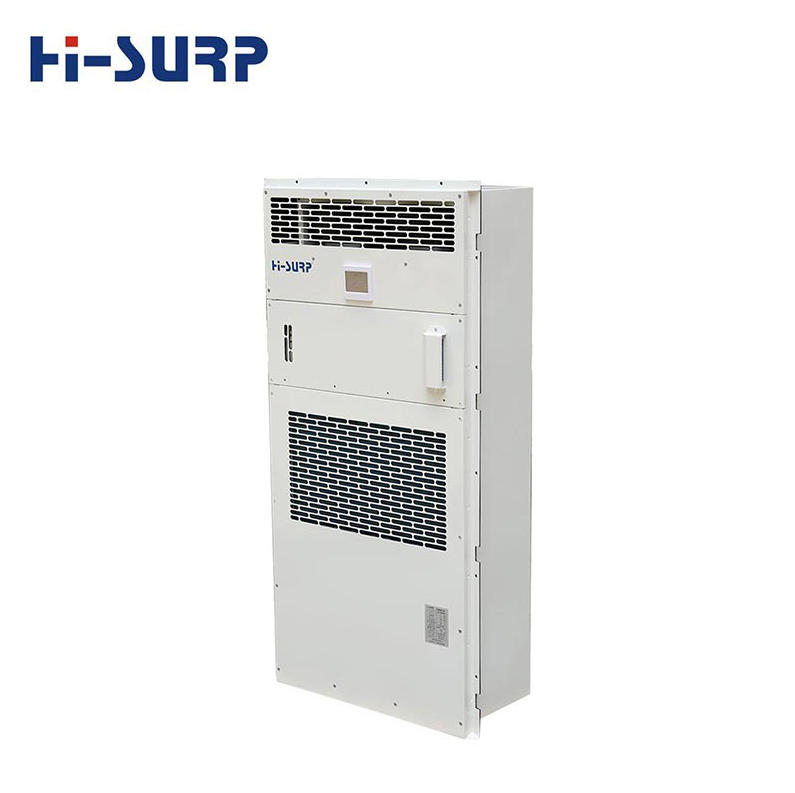
A split-type Industrial Air Conditioner separates the evaporator (indoor unit) from the condenser (outdoor unit). The indoor unit can be mounted on a wall, on the ceiling, or on a floor stand. The outdoor unit is placed outside the building. Only the refrigerant pipes and the electrical cable connect the two. This eliminates the need for large ductwork and a central plant room. The table below shows the space requirements for different cooling system types.
| System type | Indoor space required | Outdoor space required | Suitability for complex layouts |
| Central chiller + AHU | High (plant room + ducts) | High (chiller yard) | Low |
| Ducted split system | Moderate (ceiling plenum) | Moderate | Moderate |
| Split system (wall-mounted) | Low (wall area only) | Low | High |
| Split system (ceiling cassette) | Low (ceiling void) | Low | High |
| Split system (floor-standing) | Low (floor corner) | Low | High |
For the electrical room in the example, three wall-mounted split units were installed on the only external wall. The indoor units were positioned to discharge air along the aisle between the switchgear rows. The outdoor units were placed on a concrete pad outside the wall. The installation took two days. In our factory, we provide split Industrial Air Conditioner units with wall, ceiling, and floor mounting options. Ningbo Hicon Industry Co., Ltd provides a site survey service to determine the optimal indoor unit placement.
3. How Should Indoor Units Be Placed to Avoid Hot Spots?
The placement of the indoor units determines the airflow pattern and the temperature distribution. In an electrical room, the goal is to direct cool air into the aisles and across the equipment faces. The air should not be blocked by cabinets or cable trays. The table below shows the recommended placement for different room layouts.
| Room layout | Recommended indoor unit placement | Airflow direction | Typical temperature variation |
| Single row of cabinets | Wall opposite the cabinets | Horizontal across the aisle | ±1.5°C |
| Double row of cabinets (back to back) | Both end walls, facing the aisle | Along the aisle | ±1.0°C |
| Perimeter cabinets with center aisle | Ceiling cassettes over the aisle | Downward, then spread | ±1.0°C |
| Transformer bay adjacent to switchgear | Wall near the switchgear, not the transformer | Toward the switchgear | ±2.0°C |
Design tip: In electrical rooms with transformers, the heat load is concentrated near the transformer. The indoor unit should not be placed directly above or adjacent to the transformer because the hot air will short-cycle back to the return. In our factory, we recommend a minimum distance of 1.5 meters between the indoor unit and any transformer. We also recommend using a ceiling cassette with a 360-degree discharge for rooms with a center aisle. This provides uniform air distribution without creating drafts on the equipment.
4. How Are Multiple Split Units Controlled for Uniform Temperature?
In a large electrical room, a single split unit is not sufficient. Multiple units are required, and they must be controlled as a group to prevent one unit from cooling while another is heating. The control system should have a master-slave configuration with a single temperature sensor. The table below shows the control options for multiple split units.
| Control method | Description | Temperature variation | Cost |
| Independent thermostats | Each unit controls its own temperature | ±3°C | Low |
| Master-slave with one sensor | One unit is master; others follow | ±1.5°C | Moderate |
| Building management system (BMS) | Central controller with multiple sensors | ±0.5°C | High |
| Redundant control (N+1) | One standby unit; rotates duty | ±1.0°C | Moderate to high |
In our factory, we provide Industrial Air Conditioner units with a master-slave control option. The master unit receives the signal from a single temperature sensor located in the center of the room. The slave units receive the same signal and operate in unison. This prevents the units from fighting each other and maintains a uniform temperature. Ningbo Hicon Industry Co., Ltd also offers a BMS gateway that allows the units to be controlled from a central building management system.
Frequently Asked Questions About Split-Type Industrial Air Conditioners for Electrical Rooms
Summary for HVAC Design Engineers and Facility Managers
A split-type Industrial Air Conditioner is the practical solution for complex electrical room layouts because it requires minimal indoor space, can be mounted on walls, ceilings, or floors, and does not require ductwork. The indoor units should be placed to direct cool air into the aisles and across the equipment faces. Multiple units should be controlled with a master-slave configuration or a BMS to maintain uniform temperature. The cooling capacity should be calculated from the actual heat load of the electrical equipment, with a 20 percent safety margin. Ningbo Hicon Industry Co., Ltd has been manufacturing industrial air conditioners for over 12 years and provides full design support for electrical room cooling.
Ningbo Hicon Industry Co., Ltd manufactures split-type Industrial Air Conditioner units with wall, ceiling, and floor mounting options, master-slave control, and high-dust filter packages. We provide heat load calculations, site surveys, and installation support.
