

How to Select the Best Mold for Concrete Block According to Project Needs?
2026-02-11
In the concrete products industry, selecting the right Mold for Concrete Block begins with a clear understanding of project specifications. Contractors and precast manufacturers across North America and Europe typically start by reviewing block type, compressive strength requirements, dimensional tolerances, production capacity, and local ASTM or EN standards. Without aligning the mold configuration with these criteria, even the most advanced block machine cannot deliver consistent output.
Project type plays a decisive role. For example, hollow load-bearing blocks used in commercial construction require strict dimensional stability and high compaction performance. Landscape retaining wall units, on the other hand, demand precise face textures and split finishes. Municipal paving blocks require tight height tolerance to meet interlocking pavement standards. Our factory evaluates these application variables before recommending a specific cavity design and wear-resistant treatment.
Production scale is equally important. A small batching plant producing 3000 to 5000 blocks per shift has very different tooling expectations compared with a fully automated production line running 24 hours per day. Cycle time, vibration frequency, and hydraulic pressure all influence cavity geometry and material selection. When working with Quangong Machinery Co., Ltd., clients typically provide machine model, pallet size, block drawing, and daily output targets so our engineers can tailor the tooling configuration.
Local terminology such as pallet size compatibility, vibration box alignment, tamper head precision, and demolding tolerance should never be overlooked. These factors directly impact block edge sharpness and density uniformity. A properly engineered Mould ensures smooth stripping and reduced surface defects, which translates into higher sellable yield.
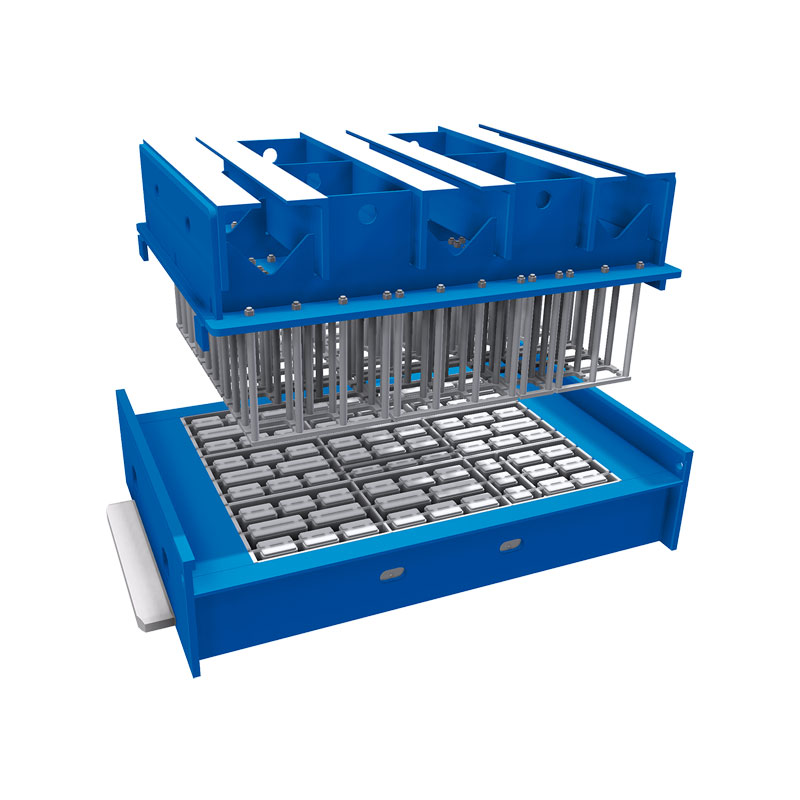
How Do Technical Parameters Influence the Performance of a Mould?
The technical specifications of a Mould determine its durability, wear resistance, and long-term production stability. High-quality tooling is typically manufactured from high-strength alloy steel, often treated with carburizing or nitriding processes to improve surface hardness. Our production team focuses on heat treatment depth and machining accuracy to ensure cavity longevity even under heavy vibration.
| Parameter | Standard Range | Recommended Specification from our factory |
| Steel Material | Q345 or equivalent | High-strength alloy steel with reinforced ribs |
| Surface Hardness | HRC 48-52 | HRC 58-62 after heat treatment |
| Wear Plate Thickness | 6-8 mm | 8-12 mm heavy-duty configuration |
| Dimensional Tolerance | ±0.5 mm | ±0.2 mm precision machining |
| Expected Service Life | 80,000-120,000 cycles | Up to 150,000 cycles under proper maintenance |
Higher hardness increases wear resistance, but excessive brittleness can lead to cracking under vibration. That is why the balance between toughness and hardness is critical. Our engineers adjust alloy composition and heat treatment curves to match the compaction force of the block machine. For high-output lines, reinforced rib structures prevent deformation and maintain cavity geometry.
Another key parameter is interchangeable liner design. Replaceable wear plates reduce long-term maintenance costs and minimize downtime. Many contractors prefer modular tooling systems because they allow quick replacement without removing the entire Mold for Concrete Block from the production line.
Quangong Machinery Co., Ltd. integrates CNC machining centers and precision grinding systems to guarantee dimensional accuracy. Consistent cavity alignment ensures uniform block height, which is essential for interlocking paving blocks and architectural masonry units.
How Does Machine Compatibility Affect Mold Selection?
Machine compatibility is often underestimated. Each block machine brand has specific vibration frequency, amplitude range, and pallet size configuration. Selecting tooling that does not match these parameters may result in incomplete compaction or premature wear.
Before finalizing a Mold for Concrete Block, it is essential to verify the following technical alignment:
| Compatibility Factor | Why It Matters | Verification Method |
| Pallet Size | Determines cavity layout and block quantity per cycle | Confirm machine drawing and pallet dimensions |
| Vibration System | Influences compaction density | Check vibration motor power and frequency |
| Tamper Head Design | Affects block surface finish | Review tamper clearance and stroke length |
| Hydraulic Pressure | Impacts demolding stability | Match pressure range with cavity structure |
In high-speed European-style block machines, synchronization between vibration box and tamper head is critical. Misalignment can cause flashing or uneven edges. Our factory conducts pre-delivery testing to simulate actual working conditions, ensuring that the tooling operates smoothly within the specified machine framework.
For contractors upgrading production lines, compatibility also involves automation level. Fully automatic plants require stable stripping and minimal manual intervention. A precisely engineered Mould reduces operator adjustments and improves cycle efficiency.
Why Do Surface Treatment and Design Details Matter in Different Applications?
Surface finish requirements vary widely depending on end use. Structural blocks prioritize compressive strength and dimensional accuracy, while architectural blocks require aesthetic precision. For split-face units, cavity depth and knife-edge alignment must be engineered carefully.
Our manufacturing process includes optional shot blasting, nitriding, and anti-corrosion coatings to extend service life in humid or coastal environments. These treatments prevent rust formation and maintain smooth demolding surfaces. When producing colored pavers or decorative blocks, polished cavity interiors reduce surface adhesion and improve finish clarity.
Drainage blocks and permeable pavers demand complex core pin structures. Precision welding and CNC machining ensure that void geometry remains stable during vibration. Our design team focuses on maintaining structural integrity while achieving intricate shapes.
Quangong Machinery Co., Ltd. supports custom drawings and sample-based development. Clients provide CAD files or physical samples, and our factory refines cavity angles, draft design, and rib reinforcement to ensure reliable mass production.
How Can Maintenance Planning Extend Mold Service Life?
Even the most advanced Mold for Concrete Block requires systematic maintenance. Daily cleaning prevents concrete residue buildup. Weekly inspection of wear plates and bolts ensures tight assembly. Regular lubrication of guide components reduces friction and vibration stress.
Operational best practices include maintaining consistent mix design and moisture control. Excessively wet mixtures increase adhesion, while overly dry mixtures reduce compaction density and accelerate cavity wear. Training operators to monitor vibration frequency and demolding timing also protects tooling from unnecessary stress.
Spare parts planning is another practical strategy. Keeping replacement liners and bolts in inventory minimizes downtime. Our after-sales team provides maintenance guidelines and recommended inspection intervals tailored to specific production conditions.
FAQ: How to Select the Best Mold for Concrete Block According to Project Needs?
Question 1: How do I determine the correct cavity configuration for my project?
Answer: Start by defining block dimensions, load-bearing requirements, and production output targets. Review local construction standards such as ASTM or EN specifications. Then match cavity number and layout with pallet size and machine capacity. A detailed drawing review with technical engineers ensures dimensional tolerance and compaction efficiency.
Question 2: What material grade is most suitable for heavy-duty production?
Answer: High-strength alloy steel with proper heat treatment is generally recommended for high-cycle production lines. Surface hardness around HRC 58 to 62 provides optimal wear resistance while maintaining structural toughness. Reinforced rib structures and replaceable liners further enhance durability.
Question 3: How often should molds be replaced in a commercial plant?
Answer: Replacement cycles depend on production volume, material quality, and maintenance discipline. Under standard operating conditions and routine inspection, service life can reach 120,000 to 150,000 cycles. Monitoring dimensional deviation and surface wear is the best way to determine replacement timing.
Conclusion
Selecting the right Mold for Concrete Block is a strategic investment that influences production efficiency, block quality, and long-term operating cost. By aligning technical parameters, machine compatibility, and application requirements, manufacturers can achieve stable output and reduced downtime. Quangong Machinery Co., Ltd. provides customized engineering solutions, precision machining, and comprehensive technical support. Contact our sales team today to discuss your project requirements and receive a tailored solution from our factory.
