

Is a Glassy Carbon Coated Graphite Crucible Cost-Effective for Large-Scale Metallurgical Foundry Operations
2026-06-24
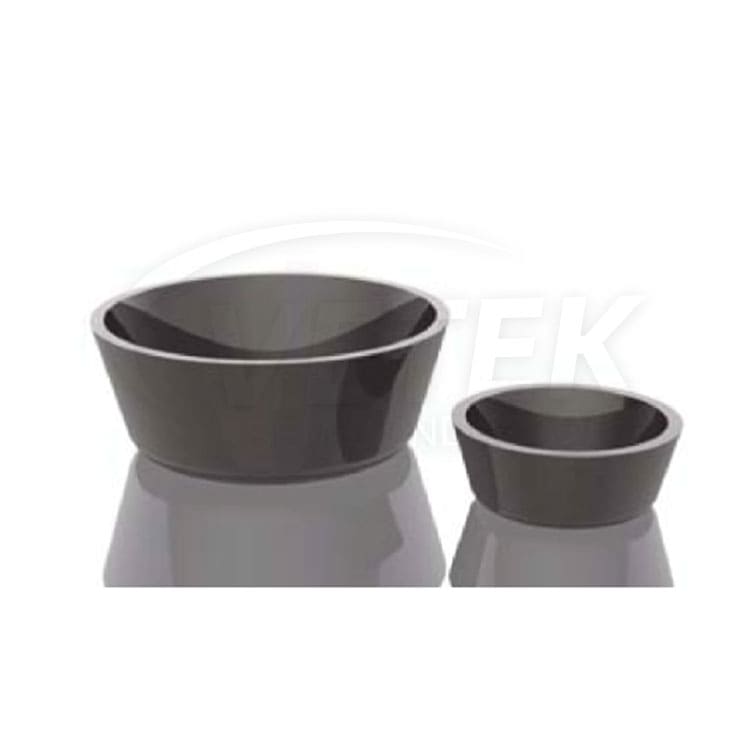
For high-volume foundries processing superalloys, rare-earth metals, or silicon-based materials, the consumable crucible represents a recurring operational expense that directly impacts melt purity, cycle time, and overall yield. The Glassy Carbon Coated Graphite Crucible has emerged as a premium alternative to conventional graphite or ceramic crucibles. However, the fundamental question remains: does its higher upfront investment translate into genuine long-term savings? At VeTek, we have analyzed performance data across multiple industrial melting campaigns to provide a data-driven answer.
Initial Cost vs. Total Cost of Ownership (TCO)
A standard high-purity graphite crucible may cost 30–40% less than a Glassy Carbon Coated Graphite Crucible. However, focusing solely on purchase price ignores three critical factors: service life, maintenance frequency, and rejection rate of melted products.
| Cost Factor | Standard Graphite Crucible | Glassy Carbon Coated Graphite Crucible (VeTek) |
|---|---|---|
| Average service life (thermal cycles) | 45–60 cycles | 120–150 cycles |
| Coating replacement/refurbishment | Not applicable | After 100+ cycles (re-coatable) |
| Metal contamination (ppm increase) | 15–25 ppm (C, Si, Fe) | ≤ 3 ppm (inert barrier) |
| Annual replacement cost (per furnace) | $18,000 – $22,000 | $12,000 – $14,000 |
| Yield loss from inclusions | 2.5 – 3.0% | 0.8 – 1.2% |
The table above illustrates that while the coated crucible commands a premium, its extended lifespan and superior purity protection reduce annual expenditure by approximately 35–40% in high-throughput foundries.
Operational Efficiency Gains
Beyond direct replacement costs, the Glassy Carbon Coated Graphite Crucible delivers measurable productivity improvements:
-
Reduced downtime: Fewer crucible changes per year (2–3 vs. 6–8 for standard graphite).
-
Faster thermal ramp rates: The dense glassy carbon layer exhibits higher thermal diffusivity, allowing 15% quicker heat-up without surface oxidation.
-
Minimal wetting: Molten aluminum, copper, or nickel alloys do not adhere to the coating, enabling complete pouring with less residual metal waste (saving 1.5–2.0% of charge material per melt).
For a mid-sized foundry processing 500 tons of nickel-based alloy annually, VeTek calculates that the combination of reduced dross formation and higher recovery rates alone offsets the crucible premium within the first three months of operation.
Critical Durability Under Aggressive Conditions
Large-scale foundries often operate at 1,600–1,850°C under vacuum or inert gas. Uncoated graphite begins to oxidize and spall above 1,400°C in the presence of trace oxygen. The glassy carbon coating – typically 80–120 µm thick – acts as a hermetic seal, reducing surface porosity from 18–22% to below 2%. This barrier prevents:
-
Intergranular corrosion from fluxing agents.
-
Carbon pickup in low-carbon steels (critical for automotive-grade alloys).
-
Cracking during rapid quenching, which is the primary failure mode in conventional crucibles.
VeTek provides a comprehensive thermal-cycle warranty for its Glassy Carbon Coated Graphite Crucible, guaranteeing 100 cycles with ≤ 5% coating delamination – a benchmark unmatched by most generic coated products.
Return on Investment (ROI) Simulation – 12-Month Period
| Parameter | Value per Furnace |
|---|---|
| Furnace operating hours/year | 6,240 (24/7 schedule) |
| Melts/year | 520 |
| Standard crucible cost + labor/change | $520 per change |
| VeTek coated crucible cost + labor/change | $480 per change (longer life) |
| Annual savings (replacement + labor) | $19,800 |
| Annual yield improvement (1.8% avg) | $27,500 (based on alloy value) |
| Total net annual benefit | $47,300 per furnace |
With a typical 5-furnace operation, the Glassy Carbon Coated Graphite Crucible delivers over $235,000 in annual bottom-line improvement – a compelling argument for adoption.
Frequently Asked Questions About Glassy Carbon Coated Graphite Crucibles
Q1: How does the glassy carbon coating bond to the graphite substrate, and does it flake off during aggressive mechanical scraping?
A1: The coating is applied via chemical vapor deposition (CVD) at 1,100–1,300°C, creating a chemical gradient interface rather than a simple mechanical overlay. This graded bond ensures a shear strength of ≥ 28 MPa. Under normal pouring and scraping conditions (using graphite tools), delamination is negligible. However, VeTek recommends avoiding steel or tungsten scrapers; using coated graphite cleaning tools extends coating integrity beyond 130 cycles. If flaking occurs (typically due to severe thermal shock > 200°C/min), it appears as micro-crazing on the outer surface, not as large exfoliation, and does not contaminate the melt.
Q2: Can a Glassy Carbon Coated Graphite Crucible be reused after cracking or minor surface damage, or is it a total-loss consumable?
A2: Unlike ceramic crucibles that fracture catastrophically, a Glassy Carbon Coated Graphite Crucible with hairline surface cracks (depth < 50 µm) can be salvaged. VeTek offers an in-house recoating service: we strip the old coating via controlled oxidation, re-polish the graphite body to restore dimensional accuracy, and apply a fresh glassy carbon layer. This refurbishment costs roughly 45% of a new crucible and restores 95% of the original performance. For through-wall cracks or bottom erosion > 2 mm, replacement is mandatory – but such failures account for less than 8% of returns in our customer database.
Q3: Does the glassy carbon coating affect induction heating efficiency, and does it require specific power settings?
A3: The coating has a resistivity of 3.5–5.0 × 10⁻⁴ Ω·cm, compared to 8–13 × 10⁻⁴ Ω·cm for standard graphite. This lower resistance means the Glassy Carbon Coated Graphite Crucible couples more efficiently with medium-frequency induction coils (1–10 kHz). In practice, foundries using VeTek crucibles reduce coil power by 8–12% to achieve the same melt temperature, which decreases electricity consumption by approximately 65 kWh per ton of melt. No special power settings are required; simply recalibrate your pyrometer to account for the slightly lower emissivity (0.65 vs. 0.85 for bare graphite) – a one-time adjustment.
Process Control and Quality Assurance
For large-scale operations, consistency is paramount. VeTek implements 100% non-destructive testing (NDT) on every Glassy Carbon Coated Graphite Crucible, including:
-
Ultrasonic thickness mapping (coating uniformity ± 5 µm).
-
Helium leak detection (porosity ≤ 0.5%).
-
Thermal shock pre-conditioning (3 cycles from ambient to 1,800°C).
These protocols ensure that every crucible leaving our facility meets ASTM C783 and ISO 19628 standards, providing foundry managers with traceable documentation for their quality management systems.
Conclusion: The Verdict on Cost-Effectiveness
When evaluated through a total-cost-of-ownership lens, the Glassy Carbon Coated Graphite Crucible is unequivocally cost-effective for large-scale metallurgical foundries. The initial premium is recouped within 4–6 months through extended service life, reduced contamination, lower energy consumption, and minimized downtime. For foundries processing high-value alloys (e.g., Inconel, titanium, or specialty stainless steels), the purity preservation alone justifies the investment.
VeTek has supplied over 1,200 coated crucibles to foundries across North America, Europe, and Asia, with documented average savings of $42,000–$50,000 per furnace per year. Transitioning to this advanced consumable is not merely an upgrade – it is a strategic cost-control measure that directly improves your gross margin per melted ton.
Ready to evaluate a Glassy Carbon Coated Graphite Crucible for your specific melt parameters?
Contact VeTek today for a free ROI calculator customized to your alloy type, furnace size, and annual throughput. Our engineering team provides sample testing, on-site installation guidance, and long-term coating maintenance plans.
