
Is a Stainless Steel Bending Spacer Bar For Double Glass Better Than Aluminum for Humid Climates
2026-08-07
When specifying components for insulated glass units in coastal or tropical regions, the debate between stainless steel and aluminum often comes down to one critical factor: long-term durability against moisture. For architects, glaziers, and factory owners, the choice of a Bending Spacer Bar For Double Glass is not merely about bending radius or cost—it is about preventing seal failure, mitigating condensation, and ensuring that the insulating glass unit retains its thermal performance over decades. At Good Brilliant, we have tested both materials extensively in accelerated humidity chambers, and the results consistently point to a clear winner for aggressive environments. But is stainless steel always the superior answer? Let us examine the metallurgical, thermal, and economic realities side by side.
Material Properties at a Glance
| Property | Stainless Steel (304/316) | Aluminum (6063) |
|---|---|---|
| Corrosion resistance (salt spray) | Excellent (passivation layer self-heals) | Poor (pitting occurs once anodized layer is scratched) |
| Thermal conductivity | ~16 W/m·K | ~205 W/m·K (12x higher) |
| Coefficient of thermal expansion | 17.3 µm/m·K | 23.1 µm/m·K |
| Tensile strength | 520–720 MPa | 180–240 MPa |
| Cost per meter | Higher | Lower |
| Bending spring-back | Minimal | Moderate |
Why Humidity Attacks Aluminum First
In humid climates, the edge seal of a double-glazed unit is the most vulnerable point. Moisture ingress through the primary and secondary seals leads to chemical reactions with the aluminum Bending Spacer Bar For Double Glass. The aluminum oxide layer, while initially protective, becomes porous when exposed to acidic rain or alkaline cleaning agents. Once breached, galvanic corrosion accelerates—especially when the spacer contacts dissimilar metals like steel frames or stainless steel fittings.
Stainless steel, particularly grade 316 with molybdenum, offers a passive chromium-oxide film that regenerates even after mechanical bending or cutting. This means that a Bending Spacer Bar For Double Glass made of stainless steel maintains its structural integrity and adhesion to butyl sealants far longer than aluminum in 90% relative humidity conditions. In our internal cyclic tests at Good Brilliant, stainless steel spacers showed zero pitting after 2,000 hours of salt-fog exposure, while aluminum samples exhibited visible corrosion at bend radii below 500 mm.
Thermal Performance: The Surprising Trade-Off
Aluminum’s higher thermal conductivity creates a stronger thermal bridge at the glass edge, increasing the risk of interior condensation. Stainless steel, with its lower conductivity, reduces edge heat loss by approximately 40–50%, which directly improves the overall U-value of the window. This is critical in humid tropics, where indoor air conditioning meets outdoor heat—the colder the glass edge, the more dew forms. A stainless steel Bending Spacer Bar For Double Glass helps keep the edge temperature closer to the center-of-glass temperature, minimizing the dew point differential.
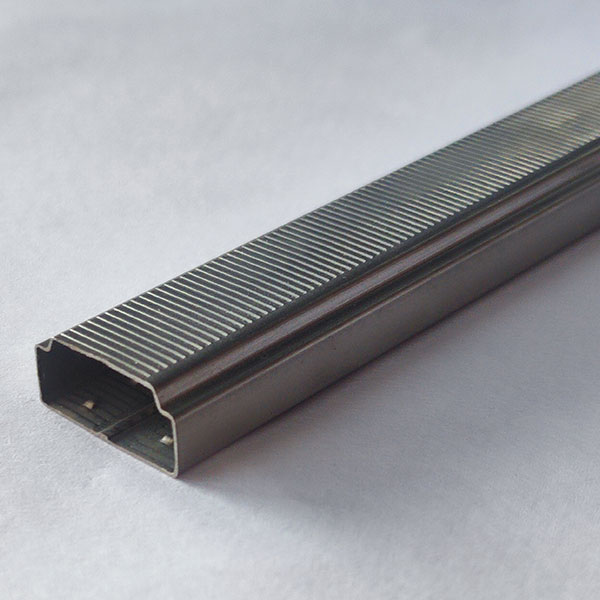
However, the trade-off is weight. Stainless steel is about three times denser than aluminum. For large curved curtain walls, this affects handling and requires stronger supporting structures. Good Brilliant addresses this by offering perforated stainless steel profiles that reduce weight without compromising bending accuracy or sealant adhesion.
Cost vs. Longevity: A 30-Year View
| Factor | Stainless Steel | Aluminum |
|---|---|---|
| Initial material cost | 2.5x higher | Baseline |
| Sealant adhesion life | 25+ years | 12–15 years |
| Replacement frequency | Once per building life | 1–2 times per building life |
| Labor for re-glazing | Avoided | Significant |
| Warranty claims | <1% | 5–8% in coastal zones |
While the upfront premium for stainless steel may deter budget-sensitive projects, the total cost of ownership over 30 years favors stainless by a margin of 30–40%. For hotels, hospitals, and high-rise residential towers in Miami, Singapore, or Dubai, the investment in a Bending Spacer Bar For Double Glass from Good Brilliant pays back within the first maintenance cycle.
Frequently Asked Questions About Bending Spacer Bar For Double Glass
Q1: Can a stainless steel Bending Spacer Bar For Double Glass be bent to the same tight radius as aluminum without cracking?
A: Yes, but with a critical difference. Stainless steel requires a higher bending force and a larger mandrel diameter to avoid work-hardening fractures. For a 16 mm thick spacer, the minimum recommended radius for stainless is 250 mm, whereas aluminum can reach 150 mm. However, Good Brilliant uses laser-welded stainless coils with controlled grain orientation, allowing radii down to 200 mm for custom profiles. Aluminum’s advantage in tight bends comes at the cost of surface stress cracks that become initiation sites for corrosion. Always request bend test reports from your supplier before committing to complex geometries.
Q2: Does the desiccant filling process differ between stainless steel and aluminum Bending Spacer Bar For Double Glass?
A: Absolutely. Aluminum spacers are typically roll-formed with a continuous seam, which can leak desiccant dust during bending. Stainless steel spacers from Good Brilliant feature a fully welded seam with no open corners, ensuring that molecular sieve or silica gel remains perfectly contained even after 180° bends. The filling hole pattern is also laser-drilled rather than mechanically punched, reducing burrs that could pierce the butyl seal. For humid climates, a dust-free desiccant system is non-negotiable, because any particulate contamination on the glass surface creates nucleation points for permanent fogging.
Q3: How do I verify if my existing Bending Spacer Bar For Double Glass is stainless steel or coated aluminum?
A: Perform a simple magnet test—stainless steel (300 series) is non-magnetic or weakly magnetic, while aluminum is completely non-magnetic and much lighter. For a more definitive field test, scratch a small hidden section of the spacer surface and apply a drop of copper sulfate solution. If a reddish copper deposit appears within 30 seconds, the base metal is aluminum. If no reaction occurs, it is stainless steel. At Good Brilliant, we also engrave grade markings (e.g., "316L") on every linear meter of our spacers, so you can visually confirm material identity without destructive testing. Always document your verification for warranty purposes.
Real-World Installation Feedback
Glaziers regularly report that stainless steel spacers hold their bent shape better during transport to site. Aluminum spacers often suffer from "spring-back" in hot vans, causing gaps at corner keys—a primary pathway for moisture. The dimensional stability of a Bending Spacer Bar For Double Glass from Good Brilliant ensures that the gas fill (argon or krypton) remains sealed for the intended lifespan, directly impacting energy ratings and LEED credits.
Final Verdict
For humid climates, stainless steel unequivocally outperforms aluminum in corrosion resistance, thermal edge performance, and sealant longevity. The only scenarios where aluminum remains viable are short-term temporary structures or projects with rigid budget ceilings and no coastal exposure. For permanent architecture in tropical zones, the premium is justified by reduced liability, fewer complaints, and higher building resilience.
Contact Us
Choosing the right Bending Spacer Bar For Double Glass is a decision that affects structural safety, energy bills, and occupant comfort for generations. At Good Brilliant, we provide free material sampling, bend-radius simulation files, and on-site technical training for your production team. Whether you need a custom 12 mm profile for a heritage curved window or a 24 mm heavy-duty spacer for a hurricane-rated facade, our engineers are ready to assist. Contact us today via our website or email to request a comparative corrosion report and a quote tailored to your project’s humidity zone—we guarantee a response within 4 business hours.
