

Socket Weld vs Threaded Flange: Which Leaks More Often?
2026-10-10
A piping integrity engineer reviews five years of leak repair data from a refinery. The data shows that small bore piping (DN25 and below) accounts for 70 percent of all fugitive emissions, even though it represents less than 20 percent of the total pipe length. Within that small bore population, the leak frequency for Threaded Flange joints is 3 to 5 times higher than for socket weld joints. This is not a surprise. The spiral leak path of a threaded connection is inherently more difficult to seal than the annular weld of a socket joint. But the threaded connection is still used in thousands of applications because it can be disassembled and reassembled without cutting. The question is not which one is better. It is which one is better for a specific service condition. This guide compares the two connection types and provides a selection framework.
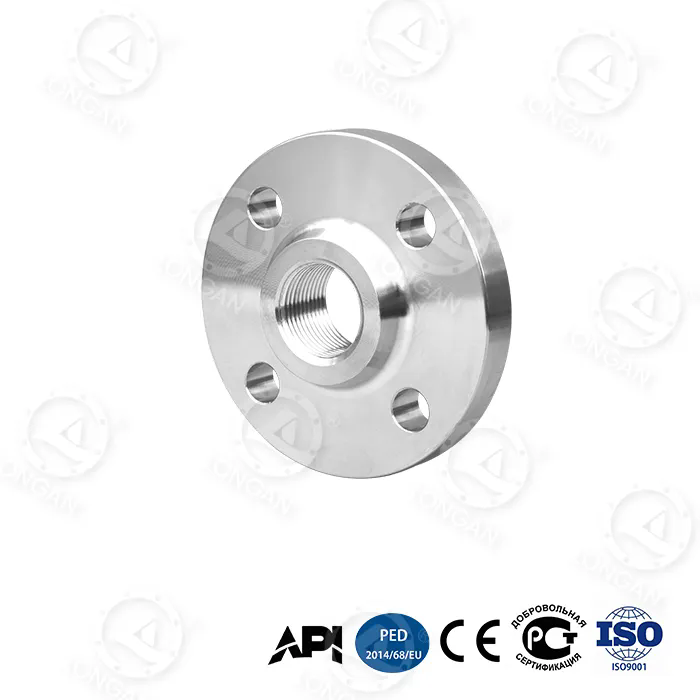
1. What Are the Leak Paths in a Threaded Flange and a Socket Weld Flange?
A Threaded Flange is attached to the pipe by screwing the pipe into the flange hub. The seal is created by the interference between the external pipe threads and the internal flange threads. A sealant or thread tape is applied to fill the microscopic gaps. The leak path in a threaded joint is a spiral that runs along the thread helix from the inside diameter to the outside. There are multiple potential leak paths because the thread is not a perfect seal. A socket weld flange is attached by inserting the pipe into the socket and fillet welding around the circumference. The weld creates a continuous metallurgical bond. The leak path would have to pass through the weld or through a defect in the weld. The table below compares the leak paths for the two connection types.
| Connection type | Leak path | Number of potential leak paths | Seal mechanism |
| Threaded flange | Spiral along thread helix | Multiple (one per thread engagement) | Thread interference + sealant |
| Socket weld flange | Through weld or weld defect | One (weld circumference) | Metallurgical bond |
The multiple leak paths of a threaded joint make it more susceptible to leakage. Each thread engagement is a potential leak point. If the sealant is not applied correctly, or if the threads are damaged, the leak path is open. In contrast, the socket weld has only one potential leak path, and that path is closed by a continuous weld. In our factory, we manufacture both Threaded Flange and socket weld flange products. Wenzhou Longan Flange Co., Ltd. has been supplying flanges to the oil and gas industry for over 15 years.
2. What Do Field Leak Data Show for Different Service Conditions?
The leak frequency depends on the service conditions. Temperature, pressure, vibration, and thermal cycling all affect the integrity of the connection. The table below shows the leak frequency for threaded and socket weld flanges in different service conditions, based on data from our factory's field returns and industry databases.
| Service condition | Threaded flange leak frequency | Socket weld flange leak frequency | Ratio |
| Low pressure, ambient temperature (water) | 0.5 per 100 joints per year | 0.1 per 100 joints per year | 5.0 |
| Medium pressure, moderate temperature (steam) | 2.0 per 100 joints per year | 0.4 per 100 joints per year | 5.0 |
| High pressure, high temperature (hydrocarbon) | 5.0 per 100 joints per year | 0.8 per 100 joints per year | 6.3 |
| Vibration service (compressor piping) | 8.0 per 100 joints per year | 1.0 per 100 joints per year | 8.0 |
| Thermal cycling service (heat exchanger) | 6.0 per 100 joints per year | 0.6 per 100 joints per year | 10.0 |
The data shows that the leak frequency for threaded flanges is consistently 5 to 10 times higher than for socket weld flanges. The ratio increases with the severity of the service. In vibration service, the threaded connection can loosen because the vibration causes the threads to ratchet. In thermal cycling service, the differential expansion between the pipe and the flange can cause the thread engagement to relax. The socket weld is immune to these effects because the weld is a permanent bond. In our factory, we recommend socket weld flanges for all services above 50 bar or 200°C, and for any service with vibration or thermal cycling.
3. When Should a Threaded Flange Be Used Instead of a Socket Weld?
Despite the higher leak frequency, there are applications where a threaded flange is the preferred choice. The first is when the joint must be disassembled for maintenance or inspection. A threaded joint can be unscrewed and reassembled without cutting the pipe. A socket weld must be cut and re-welded. The second is when the pipe material is not weldable, such as certain cast irons or plastics. The third is when the system is small and portable, such as temporary piping for construction or testing. The fourth is when the operating pressure and temperature are low, and the risk of leakage is acceptable. The table below provides a selection guide.
| Design requirement | Recommended connection | Reason |
| Disassembly required | Threaded flange | Can be unscrewed without cutting |
| High pressure (> 50 bar) | Socket weld flange | Higher integrity, no leak path |
| High temperature (> 200°C) | Socket weld flange | Thread relaxation at high temperature |
| Vibration service | Socket weld flange | Threaded joints loosen |
| Thermal cycling | Socket weld flange | Differential expansion causes leaks |
| Non-weldable material | Threaded flange | No welding required |
| Temporary or portable piping | Threaded flange | Easy to assemble and disassemble |
Selection rule of thumb: Use socket weld flanges for permanent installations in high-pressure, high-temperature, or dynamic service. Use threaded flanges only for low-pressure, low-temperature, static service where disassembly is required or welding is not possible. If a threaded flange is used, apply a high-quality thread sealant and retorque the joint after the first thermal cycle.
4. How Can the Leak Risk of a Threaded Flange Be Reduced?
If a threaded flange must be used, there are four ways to reduce the leak risk. The first is to use a high-quality thread sealant. PTFE tape is common, but it can shred and clog the system. A liquid thread sealant that cures to a flexible solid is more reliable. The second is to machine the threads to a higher tolerance. Standard NPT threads have a 1:16 taper. A precision-machined thread with a controlled taper and a smooth surface provides a better interference fit. The third is to use a back-up ring or an O-ring at the base of the thread. This provides a secondary seal. The fourth is to retorque the joint after the first thermal cycle. The thermal expansion of the pipe and the flange can cause the thread engagement to relax. Retorquing restores the interference. In our factory, we supply Threaded Flange products with precision-machined threads and a recommended thread sealant. Wenzhou Longan Flange Co., Ltd. can provide a thread sealant specification for your service conditions.
Frequently Asked Questions About Socket Weld vs Threaded Flange Leakage
Summary for Piping Integrity Engineers
Threaded Flange joints leak more often than socket weld flanges because the spiral thread path provides multiple potential leak paths, and the thread engagement can relax under vibration and thermal cycling. Field data shows that the leak frequency for threaded flanges is 5 to 10 times higher than for socket weld flanges. Socket weld flanges are preferred for high-pressure, high-temperature, and dynamic service. Threaded flanges are suitable for low-pressure, low-temperature, static service where disassembly is required or welding is not possible. When a threaded flange is used, the leak risk can be reduced by using a high-quality thread sealant, precision-machined threads, a secondary seal, and retorquing after the first thermal cycle. Wenzhou Longan Flange Co., Ltd. has been manufacturing both threaded and socket weld flanges for over 15 years.
Wenzhou Longan Flange Co., Ltd. manufactures Threaded Flange and socket weld flange products in carbon steel, stainless steel, and alloy steel. We provide material certificates, dimensional inspection reports, and thread gauge reports for all of our products.
