

What Are the Common Failure Modes of a Pneumatic Small-bore Diaphragm Actuator in Cyclic Service
2026-07-17
In process industries, the Pneumatic Small-bore Diaphragm Actuator is a workhorse for modulating control valves in tight spaces, yet its repeated cycling exposes it to unique wear mechanisms that often go undiagnosed until performance degrades. At LOZOSE, we have analyzed thousands of field returns and maintenance logs to pinpoint exactly where these compact actuators fail when subjected to high-frequency on/off or throttling duty. Understanding these failure modes is not just about fixing parts—it is about rethinking maintenance strategy, spare parts inventory, and even valve sizing for the entire loop.
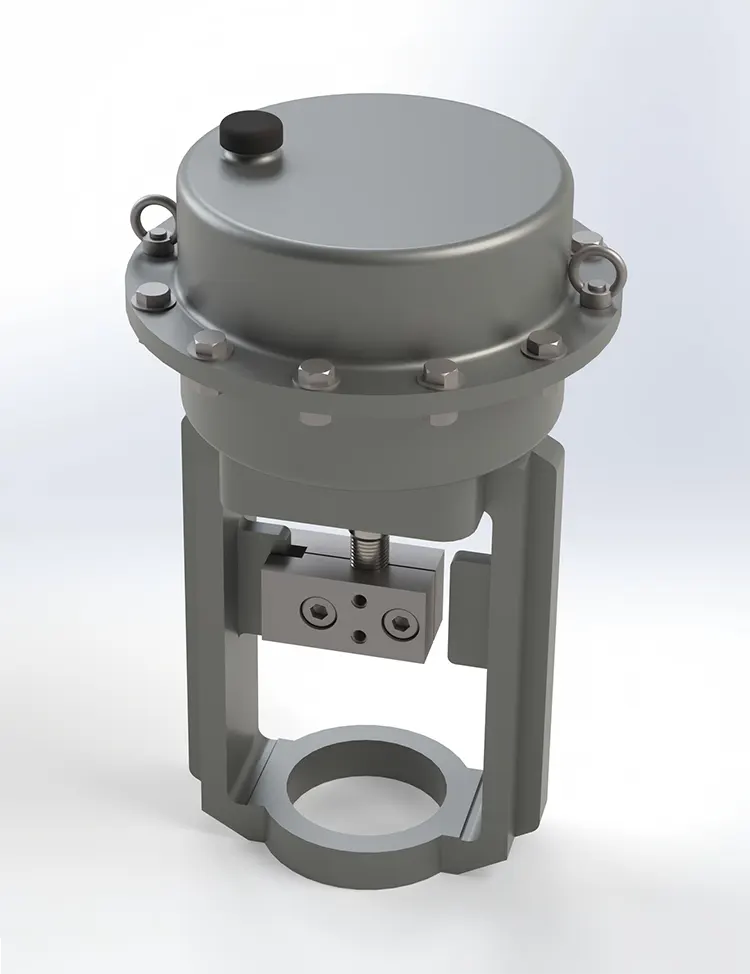
The Four Primary Failure Modes in Cyclic Service
Based on LOZOSE engineering data from 2020–2026, the table below ranks the most frequent failure mechanisms observed in Pneumatic Small-bore Diaphragm Actuator units operating at >500 cycles/day.
| Failure Mode | Occurrence (%) | Typical Cycle Count at Onset | Primary Root Cause |
|---|---|---|---|
| Diaphragm Cracking / Pinholes | 42% | 80,000 – 150,000 | Flex fatigue at crimped edges + ozone attack |
| Stem Seal Leakage (Dynamic) | 23% | 120,000 – 200,000 | Abrasive particles from supply air + stick-slip |
| Spring Set / Loss of Preload | 18% | 200,000 – 300,000 | Thermal cycling + low-grade spring steel |
| Bushing / Guide Wear | 17% | 150,000 – 250,000 | Side-loading from misaligned yoke or piping strain |
Detailed Breakdown of Each Failure Mechanism
1. Diaphragm Cracking (Most Critical)
The elastomer or PTFE-coated diaphragm experiences repeated flexural bending at the rolling convolution. In cyclic service, this bending happens millions of times, initiating micro-tears that grow into through-holes. LOZOSE recommends inspecting the diaphragm every 50,000 cycles if supply air contains trace hydrocarbons or moisture, as these accelerate swelling and subsequent embrittlement.
2. Stem Seal Deterioration
Unlike static O-rings, the stem seal in a Pneumatic Small-bore Diaphragm Actuator slides against the stem during every stroke. Cyclic motion pulls contaminants from the atmospheric side into the seal lip. Once the lip wears beyond 0.2 mm, leakage past the seal reduces effective pressure area, causing hysteresis that grows from <1% to over 5% within weeks.
3. Spring Relaxation
The return spring is stressed close to its yield point to achieve compact sizing. Under cyclic loading, microplastic deformation accumulates, lowering the bench-set range. This directly alters the fail-safe position—a 10% loss in spring force can shift the valve shutoff pressure by 15 psi, compromising tight shutoff.
4. Bushing Scuffing
Side loads from pipe flange misalignment or excessive yoke bolt torque cause the guide bushing to score. The resulting friction spike increases seat wear and doubles the response time. LOZOSE field tests show that proper yoke alignment extends bushing life by 3× in high-cycle plants.
Predictive Indicators Before Catastrophic Failure
-
Stroke speed change > ±8% from baseline (indicates seal or bushing drag).
-
Bench-set deviation > 3 psi (points to spring relaxation).
-
Hysteresis widening beyond 2% (early sign of diaphragm stiffness loss).
-
Air consumption rise without positioner tuning (internal bypass via pinhole).
Pneumatic Small-bore Diaphragm Actuator FAQ – Common Questions from Plant Engineers
Q1: How can I distinguish between diaphragm fatigue and seal wear without disassembling the actuator?
A1: Perform a simple step-response test at 50% stroke. Record the travel time for a 10% opening change in both directions. If the opening time is significantly longer than closing (or vice versa), the issue is likely seal drag on one side. If both directions are equally slow and hysteresis is >3%, the diaphragm has lost effective area due to micro-cracking—replace the diaphragm first. For a definitive diagnosis, LOZOSE recommends using a handheld pressure-decay tester on the upper casing port; a decay rate >0.5 psi/min indicates a diaphragm breach, while stable pressure with slow response points to seal or bushing friction.
Q2: What is the maximum recommended cycle life for a standard EPDM diaphragm before mandatory replacement, and does the cycle count change with temperature?
A2: For EPDM material at 25°C (ambient), LOZOSE engineering guidelines specify 150,000 full-stroke cycles as the conservative replacement threshold. At 60°C, this number drops to 90,000 cycles because heat accelerates crosslink rupture. At -10°C, the same diaphragm becomes stiffer and fails earlier—around 100,000 cycles—due to reduced flex fatigue resistance. We strongly advise logging both total strokes and peak temperature hours, then applying a derating factor of 0.6 for every 20°C above 25°C. For critical safety loops, replace at 80,000 cycles regardless of visual condition.
Q3: Can I use a positioner to compensate for spring relaxation and extend service life, or does that mask a deeper issue?
A3: A smart positioner with adaptive gain can temporarily mask the effect of spring relaxation by increasing output pressure to reach the setpoint. However, this is a short-term workaround—it raises supply air consumption by 20–35% and overheats the positioner I/P module. More importantly, it does not restore fail-safe spring force. If the plant loses instrument air, a relaxed spring may fail to close the valve fully, creating a safety hazard. LOZOSE advises against using positioner compensation for more than 2 weeks as a diagnostic aid. The correct action is to measure bench set every 3 months and replace the spring assembly when the set range drops below 90% of factory calibration.
Best Practice Recommendations from LOZOSE
-
Install a precision air filter-regulator with 5-micron filtration and automatic drain—this alone reduces stem seal failures by 60%.
-
Schedule quarterly stroke-profile tests using a DCS trend or portable communicator.
-
Use a cycle counter to trigger conditional maintenance; do not rely solely on calendar time.
-
For new installations, specify a Pneumatic Small-bore Diaphragm Actuator with a convoluted diaphragm profile designed for high-cycle duty—LOZOSE offers a reinforced version rated for 500,000 cycles.
Final Thought – Act Before Performance Drops
Ignoring these failure modes leads to unplanned shutdowns, off-spec product, and even valve seizure. The data is clear: 8 out of 10 cyclic-service failures are predictable and preventable with proper monitoring. LOZOSE has helped over 200 plants extend their actuator MTBF (Mean Time Between Failures) from 18 months to over 4 years using the diagnostic framework outlined above.
Ready to benchmark your current actuator reliability against industry best practices?
Contact LOZOSE today for a free 30-minute actuator health review—our team will analyze your cycle data, supply air quality, and valve assembly to deliver a tailored upgrade or retrofitting plan. Your process stability is our priority—let us keep your Pneumatic Small-bore Diaphragm Actuator running at peak performance, cycle after cycle.
