

What Are the Design Differences Between Cement Concrete Brick Mold Types?
2026-10-27
A block plant engineer notices a change in the production line. The same machine that produced 1,800 blocks per hour with the old mold now produces 1,400 blocks per hour with the new mold. The cycle time has increased from 15 seconds to 20 seconds. The engineer inspects the mold and finds that the new design has a different cavity layout, a different core bar arrangement, and a different vibration path. The Cement Concrete Brick Mold is not a passive shape. It controls how the concrete fills the cavities, how the vibration reaches the mix, and how easily the block releases from the mold. This guide explains the design differences between mold types and how those differences affect production.
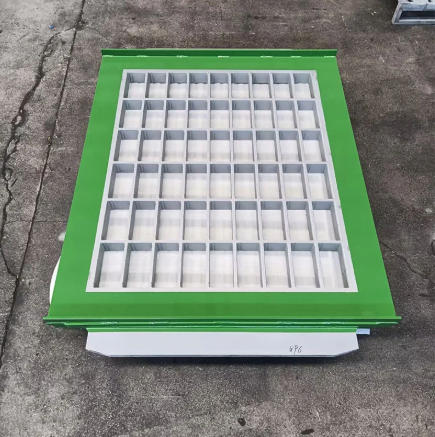
1. Why Does Mold Design Determine Whether a Block Machine Can Run at Full Cycle Speed?
The mold determines three things that directly affect the cycle time. The first is the filling time. The cavity geometry and the feed box design determine how quickly the concrete mix fills the cavities. A mold with narrow or deep cavities requires a longer feed time. The second is the vibration transmission. The mold must transfer the vibration from the machine table to the concrete mix. A mold with a rigid frame and well-designed ribs transmits the vibration efficiently. A mold with a flexible frame absorbs the vibration and requires a longer vibration time. The third is the demolding resistance. The draft angle and the surface finish determine how easily the block releases from the mold. A mold with insufficient draft or a rough surface requires a longer demolding time and may cause edge damage. In our factory, we design Cement Concrete Brick Mold units with the cavity layout and the frame stiffness matched to the machine. PRO Industry Group Co., Ltd. has been manufacturing block machine molds for over 12 years.
The cycle time difference between a well-designed mold and a poorly designed mold can be 20 to 30 percent. For a plant that runs 20 hours per day, this is a significant loss of output. The mold design is therefore a production decision, not just a tooling purchase.
2. How Do Single-Cavity and Multi-Cavity Mold Designs Differ in Production Output and Block Consistency?
A single-cavity mold produces one block per cycle. A multi-cavity mold produces two, four, six, or more blocks per cycle. The multi-cavity design increases the output per cycle, but it also introduces a challenge: the concrete must fill all the cavities evenly, and the vibration must compact all the cavities to the same density. If the feed system is not designed correctly, the cavities at the far end of the mold receive less material or less vibration, and the blocks have different densities. The table below compares the output and consistency of single-cavity and multi-cavity molds.
| Parameter | Single-cavity mold | Multi-cavity mold (4 cavities) |
| Blocks per cycle | 1 | 4 |
| Typical cycle time | 12 – 15 seconds | 15 – 20 seconds |
| Output per hour | 240 – 300 blocks | 720 – 960 blocks |
| Density variation between cavities | Not applicable | 2 – 5% |
| Feed system requirement | Simple | Requires distribution auger or vibrating feed box |
The multi-cavity mold is the standard for high-volume production. The density variation between cavities can be controlled by using a vibrating feed box that distributes the mix evenly, and by designing the mold frame to transmit the vibration uniformly. In our factory, we test the density of blocks from each cavity and adjust the feed system until the variation is below 3 percent. PRO Industry Group Co., Ltd. provides the density test report with each multi-cavity mold.
3. What Changes in Mold Geometry Are Required for Hollow Blocks Versus Solid Pavers?
Hollow blocks and solid pavers require different mold geometries because the block shape and the demolding behavior are different. A hollow block has one or more cores that form the voids. The cores are mounted on a core bar that is fixed to the mold frame. The core bar must be rigid enough to resist the vibration and the demolding force. The draft angle on the cores must be sufficient to release the block without tearing the inner walls. A solid paver has no cores, but it has a textured surface and chamfered edges. The mold surface must be hardened and polished to reproduce the texture and to release the paver without sticking. The table below compares the key geometry parameters for hollow block and paver molds.
| Geometry parameter | Hollow block mold | Solid paver mold |
| Core bars | Required (one per void) | Not required |
| Draft angle on cores | 1.5 – 3.0 degrees | Not applicable |
| Draft angle on side walls | 0.5 – 1.0 degree | 0.5 – 1.0 degree |
| Surface finish | Ra 1.6 – 3.2 microns | Ra 0.8 – 1.6 microns |
| Edge chamfer | Small (1 – 2 mm) | Larger (2 – 4 mm) for paver appearance |
Block plant engineer's note: The draft angle on the cores is the most common cause of demolding problems in hollow block molds. If the angle is too small, the block sticks to the core and the inner walls tear. If the angle is too large, the void dimension changes and the block does not meet the specification. In our factory, we recommend a draft angle of 2 degrees for standard hollow blocks and 3 degrees for blocks with thin walls. PRO Industry Group Co., Ltd. provides a core bar inspection gauge with each hollow block mold.
4. Why Does Mold Material and Heat Treatment Affect Service Life Under Abrasive Concrete Mixes?
Concrete is abrasive. The sand and the aggregate wear the mold surfaces with every cycle. The wear is most severe at the edges of the cavities and on the core bars. The mold material and the heat treatment determine how long the mold can maintain its dimensions and surface finish. The most common materials are carbon steel and alloy steel. Carbon steel is economical but wears faster. Alloy steel with a hardened surface wears more slowly. The heat treatment must produce a hard surface without making the mold brittle. In our factory, we use alloy steel with a surface hardness of 50 to 55 HRC for the wear-prone areas. We also apply a surface coating for highly abrasive mixes. PRO Industry Group Co., Ltd. verifies the hardness of every mold before shipment.
The service life of a mold is measured in cycles. A well-made mold with proper heat treatment can last 100,000 to 200,000 cycles. A poorly made mold may last only 30,000 to 50,000 cycles. The difference in cost per block is significant. Our factory provides a service life estimate for each mold design based on the abrasive content of the mix and the cycle rate.
5. How Should Block Producers Specify and Verify a Cement Concrete Brick Mold?
The specification of a Cement Concrete Brick Mold should include six items. The first is the block type and the dimensions, including the tolerances. The second is the number of cavities. The third is the machine model and the mounting interface dimensions. The fourth is the core bar material and the draft angle. The fifth is the surface treatment and the hardness. The sixth is the expected service life and the warranty terms. The verification should include three checks. The first is the first-article dimensional inspection. The second is the density test on blocks from each cavity. The third is a continuous run test to check the temperature rise and the demolding behavior. In our factory, we perform all three checks before shipment and provide the inspection report with the mold.
We also recommend that the producer keep a spare set of core bars and wear plates. The core bars wear faster than the mold frame, and replacing them extends the life of the entire mold. PRO Industry Group Co., Ltd. offers a spare parts kit with every mold order.
Frequently Asked Questions About Cement Concrete Brick Mold Design
Summary for Block Plant Engineers and Mold Buyers
The design differences between Cement Concrete Brick Mold types are found in the cavity count, the geometry, the material, and the heat treatment. The cavity count determines the output per cycle and the density consistency. The geometry determines the filling, the vibration transmission, and the demolding behavior. The material and the heat treatment determine the service life under abrasive mixes. The specification should include the block type, the cavity count, the machine interface, the core bar design, the surface treatment, and the expected life. The verification should include the first-article inspection, the density test, and the continuous run test. PRO Industry Group Co., Ltd. has been manufacturing Cement Concrete Brick Mold units for over 12 years and provides full design and verification support for block plants.
