

What Are the Key Differences Between Brick Machine Mould and Block Machine Mould?
2026-10-23
A production supervisor at a concrete products plant is reviewing the defect log. The plant runs two product lines on the same block making machine. The solid brick line produces 200 x 100 x 60 mm bricks with a reject rate of 1.2 percent. The hollow block line produces 390 x 190 x 190 mm blocks with a reject rate of 6.8 percent. The most common defects on the block line are cracked ribs and uneven wall thickness. The supervisor inspects the two moulds. The Brick Machine Mould has a simple rectangular cavity with a flat top plate. The Block Machine Mould has a complex cavity with two large cores and several narrow ribs. The supervisor realizes that the two moulds require different concrete mixes, different vibration settings, and different changeover procedures. This guide explains the key differences.
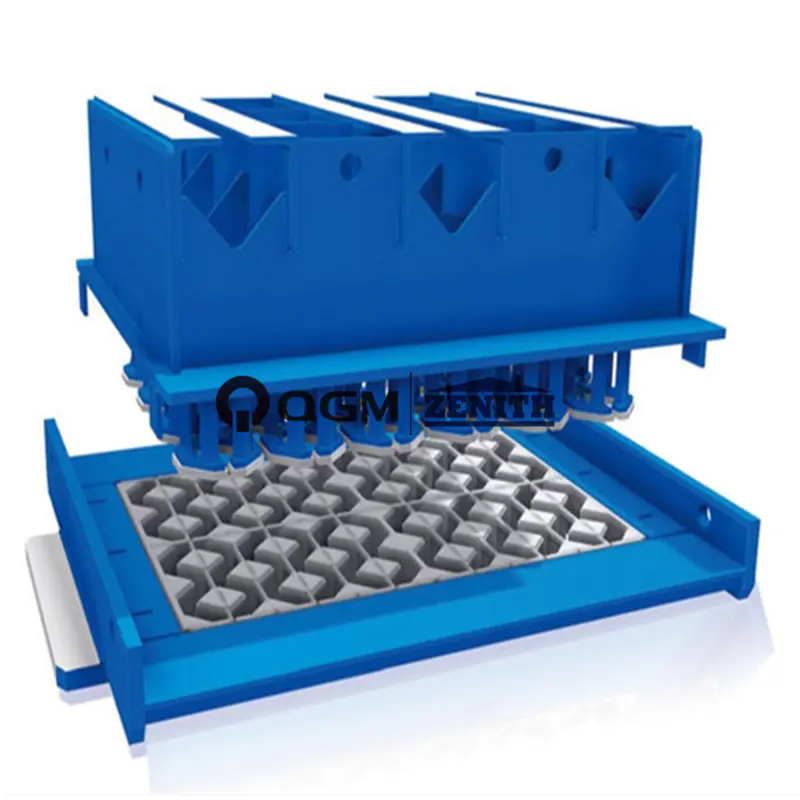
1. How Do the Cavity and Core Designs Differ Between the Two Moulds?
The most fundamental difference is the cavity design. A Brick Machine Mould produces solid bricks. The cavity is a simple rectangular box with a flat top plate. There are no cores and no narrow ribs. The concrete fills the entire cavity. A Block Machine Mould produces hollow blocks. The cavity contains core bars that form the voids in the block. The cores are mounted on a core frame that moves up and down during the cycle. The ribs between the cores are narrow, typically 25 to 40 mm. The table below compares the cavity and core designs.
| Design feature | Brick Machine Mould | Block Machine Mould |
| Cavity type | Simple rectangular | Complex with cores |
| Core bars | None | 2 – 4 per block |
| Minimum wall thickness | N/A (solid) | 25 – 40 mm |
| Top plate | Flat, no openings | With core bar openings |
| Mould weight (typical) | 150 – 250 kg | 300 – 500 kg |
In our factory, we manufacture Brick Machine Mould units with hardened steel cavities and precision-ground top plates. The simple design allows for fast filling and even compaction. Fujian Quangong Mould Co.,Ltd has been manufacturing moulds for over 12 years.
2. Why Do Hollow Blocks Require Different Concrete Mixes and Vibration Settings?
The narrow ribs and the core bars in a Block Machine Mould create two challenges. First, the concrete must flow around the cores and fill the narrow ribs without leaving voids. Second, the concrete must compact evenly in the ribs and in the solid sections. These challenges require a different mix design and different vibration settings than a solid brick. The table below shows the recommended mix and vibration parameters for the two products.
| Parameter | Solid brick (Brick Machine Mould) | Hollow block (Block Machine Mould) |
| Cement content | 10 – 12% | 12 – 15% |
| Aggregate size | 0 – 8 mm | 0 – 10 mm (with fines) |
| Water content | 6 – 7% | 7 – 9% |
| Vibration frequency | 50 – 55 Hz | 55 – 65 Hz |
| Vibration amplitude | 0.8 – 1.2 mm | 1.2 – 1.8 mm |
| Compaction pressure | 120 – 140 bar | 100 – 120 bar |
Production supervisor's note: The hollow block requires a higher cement content and a higher water content to ensure that the concrete flows into the narrow ribs. The vibration frequency is higher, and the amplitude is larger, to compact the concrete in the ribs. The compaction pressure is lower to avoid crushing the cores. If the solid brick settings are used for the hollow block, the ribs will crack and the wall thickness will be uneven. In our factory, we provide a parameter card with each mould that lists the recommended mix and vibration settings.
3. How Does the Changeover Procedure Differ Between the Two Moulds?
The changeover from one mould to the other requires more than just swapping the mould. The core frame, the tamper head, and the feeding system must also be adjusted. The Brick Machine Mould has no cores, so the core frame is removed or locked in the up position. The Block Machine Mould requires the core frame to be installed and aligned. The table below shows the changeover steps and the time required for each mould.
| Changeover step | Brick Machine Mould | Block Machine Mould |
| Mould removal | 15 – 20 minutes | 25 – 35 minutes |
| Core frame installation | Not required | 30 – 45 minutes |
| Tamper head adjustment | 10 – 15 minutes | 20 – 30 minutes |
| Feeding system adjustment | 10 – 15 minutes | 15 – 20 minutes |
| Trial run and adjustment | 20 – 30 minutes | 40 – 60 minutes |
| Total changeover time | 55 – 80 minutes | 130 – 190 minutes |
In our factory, we design the moulds with quick-release clamps and alignment pins to reduce the changeover time. The core frame for the Block Machine Mould has a self-aligning feature that reduces the installation time. Fujian Quangong Mould Co.,Ltd provides a changeover checklist with each mould.
4. What Are the Common Defects and Their Causes for Each Mould?
The defects that occur in each product are different because the mould designs are different. The table below shows the common defects and their causes for the two moulds.
| Defect | Brick Machine Mould | Block Machine Mould |
| Edge chipping | Low cement content; fast demolding | Low cement content; fast demolding |
| Rib cracking | Not applicable | Low water content; high compaction pressure |
| Uneven wall thickness | Not applicable | Core misalignment; worn core bars |
| Lamination | Poor vibration; air trapped | Poor vibration; air trapped in ribs |
| Sticking | Worn top plate; inadequate release agent | Worn cores; inadequate release agent |
In our factory, we recommend that the production supervisor check the core alignment every 500 cycles and replace the core bars when the wear exceeds 0.5 mm. We also recommend that the release agent be applied evenly to the cores and the cavity walls. Fujian Quangong Mould Co.,Ltd provides a maintenance manual and a spare parts list with each mould.
Frequently Asked Questions About Brick Machine Moulds and Block Machine Moulds
Summary for Production Supervisors
The Brick Machine Mould and the Block Machine Mould differ in cavity design, core bars, mix requirements, vibration settings, changeover time, and common defects. The Brick Machine Mould is simple and produces solid bricks with a low reject rate. The Block Machine Mould is complex and requires higher cement content, higher water content, and higher vibration frequency to produce hollow blocks without rib cracking. The changeover from brick to block takes longer because the core frame must be installed and aligned. The production supervisor should maintain separate parameter cards for each mould and inspect the core bars regularly. Fujian Quangong Mould Co.,Ltd has been manufacturing both types of moulds for over 12 years and provides full technical support for our customers.
Fujian Quangong Mould Co.,Ltd manufactures Brick Machine Mould units and Block Machine Mould units with hardened steel cavities, precision core bars, and quick-release clamps. We provide parameter cards, changeover checklists, and spare parts for all of our products.
