

What are the key specifications to evaluate when selecting a Single Mode Fiber Coupled Laser Module
2026-05-12
Selecting the right Single Mode Fiber Coupled Laser Module is a technical decision that directly impacts system performance, stability, and integration complexity. For engineers and system integrators, understanding core specifications ensures alignment with application requirements such as LiDAR, spectroscopy, or coherent communications. At Wavespectrum, we specialize in precision-engineered laser modules designed for demanding optical environments. This guide outlines the critical parameters to evaluate before making a selection.
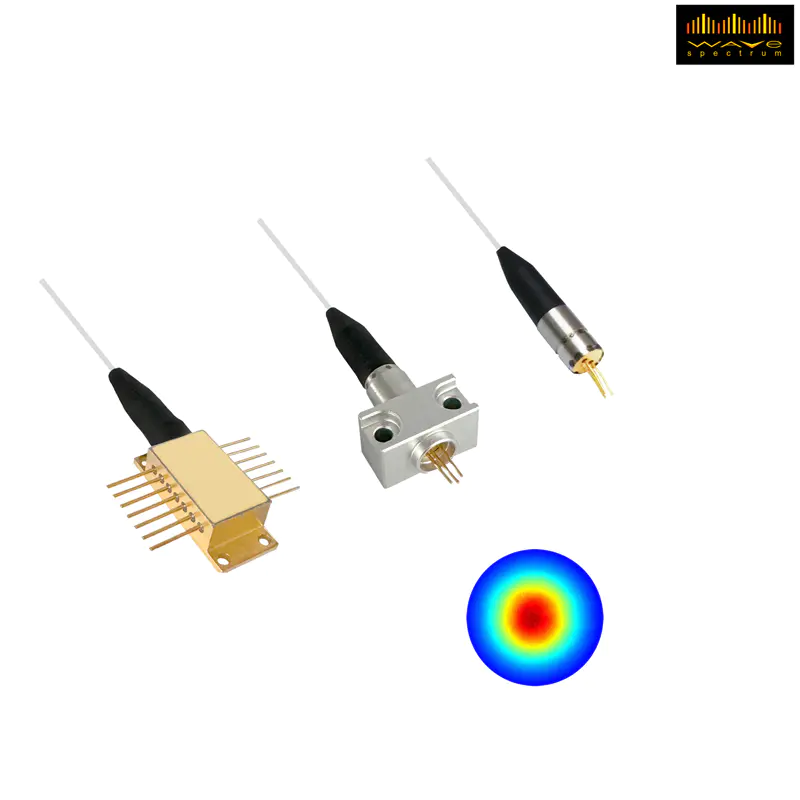
Key Specifications at a Glance
| Specification | Description | Why It Matters |
|---|---|---|
| Central Wavelength | Nominal output wavelength (e.g., 635 nm, 1064 nm) | Determines material interaction and transmission medium |
| Fiber Core Diameter | Typically 4–9 µm for single mode fibers | Affects alignment tolerance and coupling stability |
| Output Power | Optical power delivered from fiber end (mW to W) | Defines signal strength and system sensitivity |
| Linewidth | Spectral width (FWHM) | Critical for coherence length and resolution |
| Side Mode Suppression Ratio (SMSR) | Ratio of main mode to next strongest mode | Indicates spectral purity and noise performance |
| Coupling Efficiency | Percentage of laser power entering fiber | Directly impacts overall system loss |
| Thermal Wavelength Shift | nm/°C variation | Essential for temperature-uncontrolled environments |
Detailed Evaluation Criteria
Beyond basic numbers, practical selection requires understanding how specifications interact. For example, a laser module with high output power but poor coupling efficiency will underperform. Below are the most influential parameters:
-
Wavelength Stability over Temperature
This is often overlooked. A Single Mode Fiber Coupled Laser Module without active temperature control may drift by >0.1 nm/°C. For dense wavelength division multiplexing (DWDM) or molecular spectroscopy, Wavespectrum offers modules with <0.01 nm/°C stability. -
Polarization Extinction Ratio (PER)
Single mode fiber does not maintain polarization unless polarization-maintaining fiber is used. If your system requires linear polarization (e.g., interferometry), confirm PER >20 dB. -
Modulation Bandwidth
For applications like frequency-modulated continuous wave (FMCW) LiDAR, built-in direct modulation capability and bandwidth (DC to several GHz) become vital.
Single Mode Fiber Coupled Laser Module FAQ
Question 1: What is the typical lifetime of a Single Mode Fiber Coupled Laser Module under continuous operation?
Answer: Under proper thermal management and rated current, most modules last over 10,000 hours. Wavespectrum modules typically exceed 20,000 hours MTBF (Mean Time Between Failures) due to hermetic sealing and controlled coupling interfaces.
Question 2: Can I replace the fiber connector type on an existing module without recalibrating alignment?
Answer: No. The fiber is often factory-aligned and permanently affixed. Changing the connector (e.g., from FC/APC to FC/PC) risks misalignment and power loss. Always specify required connector type – such as collimator or bare fiber – at order time.
Question 3: How does coupling efficiency degrade if the input laser beam has an elliptical profile?
Answer: Coupling into single mode fiber requires a circular, Gaussian-profile beam. Ellipticity above 10% reduces coupling efficiency significantly (often by >30%) and induces modal noise. Wavespectrum integrates beam shaping optics to maintain >75% coupling even with slightly asymmetric sources.
Practical Selection Checklist
-
Confirm central wavelength ± tolerance
-
Verify output power at operating temperature
-
Measure or request SMSR test data (>30 dB recommended)
-
Specify fiber jacket and bend radius limits
-
Check if TE cooler is included for stable wavelength
Final Recommendation
The right Single Mode Fiber Coupled Laser Module balances spectral purity, mechanical stability, and environmental resilience. Low-cost modules may save initial budget but introduce thermal drift and poor mode matching. Wavespectrum provides fully characterized modules with individual test reports, ensuring each unit meets your system’s optical budget and reliability targets.
Contact us today to discuss your wavelength, power, and fiber interface requirements. Our engineering team provides datasheets, sample testing, and integration support for volume deployments of Single Mode Fiber Coupled Laser Modules. Reach out to Wavespectrum directly for a consultation.
