

What Are the Main Differences Between Hollow Block Mould and Paver Block Mould?
2026-10-13
A production manager at a block plant runs two shifts. In the morning, the plant produces hollow blocks with a 200 mm width. In the afternoon, the same brick machine is switched to paver blocks with a 60 mm thickness. The morning shift produces 4,200 blocks per hour. The afternoon shift produces only 2,800 pavers per hour. The manager asks why. The answer is not the machine. It is the Brick Machine Mould. The hollow block mould and the paver block mould are designed for different products, different concrete mixes, and different production rates. Understanding these differences is essential for planning production, selecting the right mould, and achieving the target output.
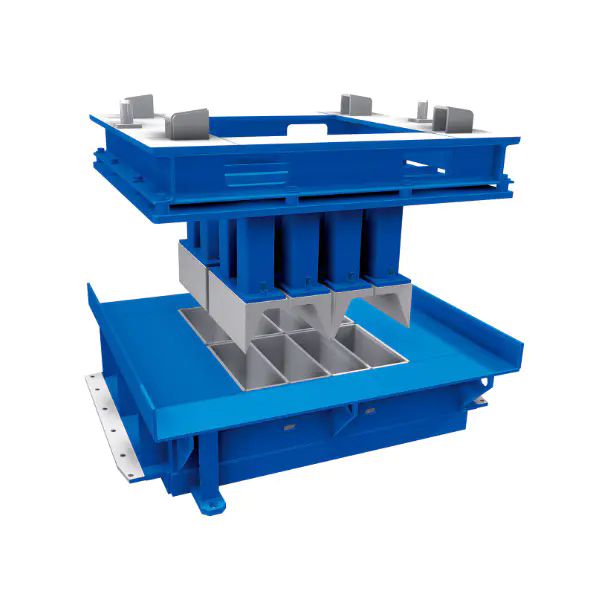
1. How Does the Core and Cavity Design Differ Between the Two Moulds?
The most visible difference between a hollow block mould and a paver block mould is the internal structure. A hollow block mould has cores that form the voids in the block. These cores are typically large and deep, occupying 40 to 60 percent of the block volume. The cores must be rigid enough to withstand the compaction force and the vibration. A paver block mould has a solid cavity with no cores. The paver is a solid unit with a thickness of 40 to 100 mm. The cavity walls are shorter and the ejection pins are more numerous. The table below compares the core and cavity design for the two mould types.
| Design feature | Hollow block mould | Paver block mould |
| Core type | Large, deep cores (2-4 per block) | None (solid cavity) |
| Core height | 100 – 300 mm | N/A |
| Cavity depth | 100 – 300 mm | 40 – 100 mm |
| Ejection pins | 4 – 8 per block | 8 – 16 per paver |
| Mould weight (per 400 mm block) | 120 – 180 kg | 60 – 100 kg |
The core design of a hollow block mould requires a different steel grade and heat treatment than the cavity of a paver block mould. The cores are subjected to high bending stress during stripping. They are usually made from hardened tool steel with a core hardness of 50 to 55 HRC. The paver cavity is subjected to abrasive wear from the concrete mix. The cavity walls are made from wear-resistant steel with a hardness of 58 to 62 HRC. In our factory, we manufacture both types of Brick Machine Mould and can advise on the best material for your application. Fujian Quangong Mould Co.,Ltd has been producing block moulds for over 15 years.
2. How Does the Stripping Process Differ Between the Two Moulds?
Stripping is the process of removing the mould from the formed block. The stripping method determines the production rate and the product quality. A hollow block mould strips vertically. The cores are pulled out of the block while the block is still supported by the pallet. The stripping force is high because the cores have a large surface area in contact with the concrete. A paver block mould strips by lifting the mould while the paver remains on the pallet. The stripping force is lower because the paver has a shorter height and a smaller contact area. The table below compares the stripping parameters for the two mould types.
| Stripping parameter | Hollow block mould | Paver block mould |
| Stripping direction | Vertical (cores pulled up) | Vertical (mould lifted) |
| Stripping force (per block) | 8 – 12 kN | 3 – 6 kN |
| Stripping speed | Slow (controlled) | Fast |
| Cycle time (typical) | 15 – 20 seconds | 8 – 12 seconds |
| Risk of edge damage | Moderate (core drag) | Low (mould lift) |
The stripping force of a hollow block mould is 2 to 3 times higher than that of a paver block mould. This is why the hollow block mould requires a more robust stripping mechanism and a slower stripping speed. The paver block mould can be stripped faster, which is why the production rate for pavers is higher. In our factory, we design the stripping angle and the core taper to minimize the stripping force. Fujian Quangong Mould Co.,Ltd provides a stripping force calculation with every mould order.
3. How Do Wear Patterns Differ Between the Two Moulds?
The wear patterns are different because the abrasion mechanisms are different. A hollow block mould wears on the core surfaces and the core tips. The wear is caused by the sliding friction of the concrete as the cores are pulled out. The core tips wear faster because they have the highest contact pressure. A paver block mould wears on the cavity walls and the bottom edges. The wear is caused by the abrasive action of the concrete as it is compacted and stripped. The table below shows the typical wear rates and the recommended maintenance for the two mould types.
| Wear location | Hollow block mould | Paver block mould |
| Primary wear area | Core surfaces and tips | Cavity walls and bottom edges |
| Wear rate (mm per 10,000 cycles) | 0.05 – 0.10 | 0.08 – 0.15 |
| Typical life (cycles) | 80,000 – 120,000 | 60,000 – 100,000 |
| Maintenance method | Core replacement or hard facing | Cavity welding or insert replacement |
| Dimensional check | Core diameter and taper | Cavity width and depth |
Production manager's note: The wear rate of a paver block mould is 30 to 50 percent higher than a hollow block mould because the paver mix is often drier and more abrasive. This means the paver mould requires more frequent maintenance. When planning production, account for the additional downtime for mould maintenance. In our factory, we recommend keeping a spare paver mould on hand to avoid production interruptions. Fujian Quangong Mould Co.,Ltd offers a mould exchange program for high-volume producers.
4. How Does the Mould Choice Affect the Overall Production Plan?
The choice between hollow block and paver block moulds affects the production plan in four ways. First, the cycle time is different. A paver mould can produce 30 to 50 percent more units per hour than a hollow block mould. Second, the concrete mix is different. Hollow blocks use a mix with a higher slump and more cement. Pavers use a drier mix with a lower water-cement ratio. Third, the curing time is different. Hollow blocks require 24 to 48 hours of curing before they can be handled. Pavers require 12 to 24 hours. Fourth, the pallet requirement is different. Hollow blocks are heavier and require stronger pallets. The table below summarizes the production planning factors for the two mould types.
| Production factor | Hollow block mould | Paver block mould |
| Cycle time (seconds) | 15 – 20 | 8 – 12 |
| Units per hour (typical) | 3,600 – 4,800 | 5,400 – 7,200 |
| Concrete slump | 50 – 80 mm | 0 – 20 mm |
| Cement content | 8 – 12% | 6 – 10% |
| Curing time | 24 – 48 hours | 12 – 24 hours |
| Pallet strength requirement | High | Moderate |
When planning production, the manager must match the mould to the product demand and the available curing space. If the plant has limited curing space, the faster cycle time of the paver mould may not be useful because the pavers cannot be cured fast enough. If the plant has limited pallets, the heavier hollow blocks may require more pallets. In our factory, we provide a production planning worksheet with every Brick Machine Mould to help our customers optimize their schedules. Fujian Quangong Mould Co.,Ltd also offers mould design consultation for new production lines.
Frequently Asked Questions About Hollow Block Moulds and Paver Block Moulds
Summary for Production Managers
The main differences between a hollow block mould and a paver block mould are the core design, the stripping method, the wear pattern, and the production planning factors. The hollow block mould has cores, a deep cavity, and a slower cycle time. The paver block mould has a solid cavity, a shallow depth, and a faster cycle time. The choice of mould affects the production rate, the concrete mix, the curing time, and the pallet requirement. By understanding these differences, production managers can select the right mould for each product and optimize their production schedule. Fujian Quangong Mould Co.,Ltd has been manufacturing Brick Machine Mould units for over 15 years and provides full production planning support for our customers.
Fujian Quangong Mould Co.,Ltd manufactures Brick Machine Mould units for hollow blocks, solid blocks, and pavers. We provide mould design consultation, production planning worksheets, and quick-change mould systems for all of our products.
