

What Changes in Class 900 vs Class 150 Threaded Flange?
2026-10-23
A piping buyer receives an inquiry for DN50 Threaded Flange in two pressure classes: Class 150 and Class 900. The buyer requests quotations from two suppliers. One supplier quotes the same price for both classes and states that the material is the same. The other supplier quotes a 4 to 5 times higher price for Class 900 and provides a dimensional drawing that shows a significantly thicker flange with more bolts. The buyer investigates and discovers that the first supplier is offering a Class 150 flange machined down to fit a Class 900 bolt pattern. This is not a Class 900 flange. It is a mislabeled Class 150 flange that will fail under high pressure. This guide explains the dimensional and design changes between Class 150 and Class 900 threaded flanges.
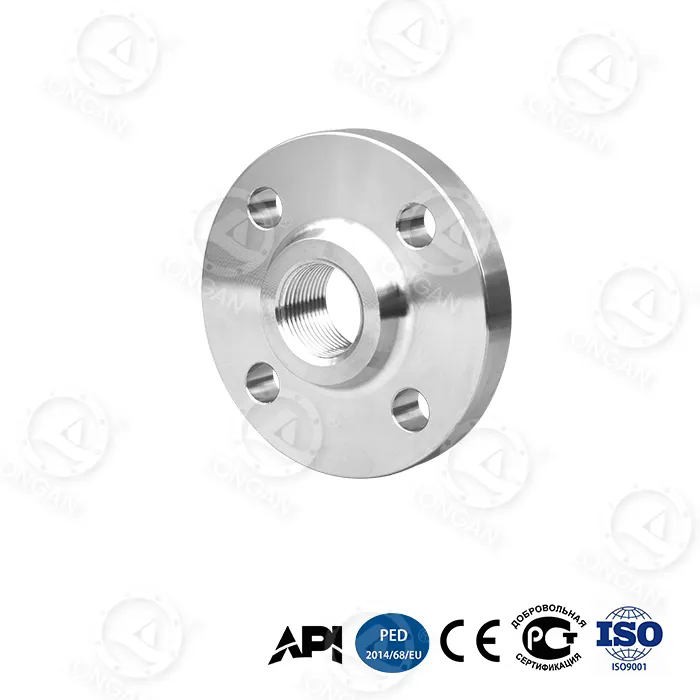
1. How Does Pressure Class Change the Flange Thickness and Bolt Pattern?
The pressure class determines the wall thickness, the flange diameter, and the number and size of the bolts. As the class increases from 150 to 900, the flange must contain higher internal pressure. The ASME B16.5 standard specifies the dimensions for each class. For a DN50 flange, the Class 150 flange has a thickness of 17.5 mm and 4 bolts of M16. The Class 900 flange has a thickness of 38.1 mm and 4 bolts of M30. The bolt circle diameter also increases from 120.7 mm to 139.7 mm. The table below shows the dimensional comparison for DN50 threaded flanges.
| Dimension | Class 150 (DN50) | Class 900 (DN50) | Change |
| Flange thickness (mm) | 17.5 | 38.1 | +118% |
| Flange outer diameter (mm) | 152.4 | 177.8 | +17% |
| Bolt circle diameter (mm) | 120.7 | 139.7 | +16% |
| Number of bolts | 4 | 4 | Same |
| Bolt size | M16 | M30 | +88% |
| Thread size | NPT 2 inch | NPT 2 inch | Same |
In our factory, we manufacture Threaded Flange units to ASME B16.5 and EN 1092-1 standards. The Class 900 flanges are forged from A105 or F316 material and machined to the specified dimensions. Wenzhou Longan Flange Co., Ltd. has been manufacturing threaded flanges for over 15 years.
2. Why Does Thread Engagement Change With Pressure Class?
The threaded connection must transfer the axial load from the pipe to the flange. The axial load is the product of the internal pressure and the pipe cross-sectional area. For a DN50 pipe at Class 900, the design pressure is 153 bar. The axial load is 153 bar multiplied by the internal area of the pipe (approximately 20.4 cm²), which equals 31.2 kN. The thread must engage enough turns to distribute this load without stripping. The Class 900 flange has a longer thread engagement length than the Class 150 flange. The table below shows the thread engagement requirements for the two classes.
| Parameter | Class 150 | Class 900 |
| Design pressure (bar) | 19.6 | 153 |
| Axial load on thread (kN) | 4.0 | 31.2 |
| Minimum thread engagement (mm) | 15 | 25 |
| Number of engaged threads | 8 – 10 | 14 – 16 |
| Thread type | NPT or BSPT | NPT or BSPT |
Piping buyer's note: The thread engagement is not visible from the outside of the flange. A supplier can machine a Class 150 flange to the external dimensions of a Class 900 flange, but the internal thread length will be too short. The flange may pass a visual inspection but will fail under pressure. The buyer should request the mill certificate and the dimensional inspection report for each batch. The report should include the thread engagement length and the pressure test results. In our factory, we provide a dimensional inspection report with every Threaded Flange order.
3. How Does the Sealing Surface Differ Between the Two Classes?
The sealing surface is the face of the flange that contacts the gasket. For a Threaded Flange, the sealing surface is typically a raised face (RF) or a flat face (FF). The Class 150 flange uses a raised face with a height of 2 mm. The Class 900 flange uses a raised face with a height of 7 mm. The higher raised face provides more gasket compression and a more reliable seal at high pressure. The table below shows the sealing surface specifications for the two classes.
| Sealing surface parameter | Class 150 | Class 900 |
| Raised face height (mm) | 2 | 7 |
| Surface finish (Ra, µm) | 3.2 – 6.3 | 1.6 – 3.2 |
| Gasket type | Non-asbestos fiber or PTFE | Spiral wound or ring joint |
| Gasket seating stress (MPa) | 30 – 50 | 70 – 100 |
In our factory, we machine the raised face of each Class 900 Threaded Flange to a surface finish of Ra 1.6 to 3.2 microns. We also verify the raised face height with a depth gauge. Wenzhou Longan Flange Co., Ltd. provides a sealing surface inspection report for high-pressure flanges.
4. What Are the Consequences of Mixing Class 150 and Class 900 Flanges?
Mixing flanges of different pressure classes in the same joint is dangerous. The bolt holes may not align. The raised face heights may differ, which prevents the gasket from seating properly. The bolts may be too short or too long. The joint may leak under pressure or fail catastrophically. The table below shows the consequences of mixing classes.
| Mixing scenario | Consequence | Risk level |
| Class 150 flange with Class 900 flange | Bolt holes misaligned; gasket not compressed | High (leak or blowout) |
| Class 150 flange machined to Class 900 dimensions | Thread engagement too short; flange may strip | Very high (catastrophic failure) |
| Class 900 flange with Class 150 bolts | Bolts too small; insufficient clamping force | High (leak) |
| Class 900 flange with Class 150 gasket | Gasket not rated for pressure; blows out | Very high (blowout) |
In our factory, we mark every Threaded Flange with the pressure class, the size, and the material grade. The marking is stamped on the outer diameter of the flange and is visible after installation. We also provide a certificate of conformity that states the pressure class and the applicable standard. Wenzhou Longan Flange Co., Ltd. recommends that the buyer verify the marking and the certificate before installing any flange.
Frequently Asked Questions About Class 900 vs Class 150 Threaded Flanges
Summary for Piping Buyers and Engineers
The difference between a Class 150 and a Class 900 Threaded Flange is not just the pressure rating. It is the wall thickness, the bolt size, the bolt circle diameter, the thread engagement length, and the raised face height. A Class 900 flange is significantly thicker and uses larger bolts to contain the higher pressure. The thread engagement is longer to transfer the axial load. The raised face is higher to compress the gasket. Mixing classes or using a modified Class 150 flange in a Class 900 system is dangerous. The buyer should verify the dimensions, the marking, and the certificate before accepting the shipment. Wenzhou Longan Flange Co., Ltd. has been manufacturing Threaded Flange units for over 15 years and provides full dimensional and pressure test documentation for our products.
Wenzhou Longan Flange Co., Ltd. manufactures Threaded Flange units in Class 150, 300, 600, 900, and 1500, in A105 and F316 materials. We provide dimensional inspection reports, pressure test certificates, and pressure-temperature rating tables for all of our products.
