

What Efficiency Can You Expect from a Worm Gearbox?
2026-10-19
A selection engineer specifies a Worm Gearbox for a conveyor drive. The catalog states an efficiency of 85 percent for the selected ratio. The engineer calculates the motor power based on this figure. After installation, the measured input power is 18 percent higher than expected, and the gearbox oil temperature reaches 92°C instead of the predicted 75°C. The engineer investigates and finds that the catalog efficiency was for a single-stage unit at full load and optimum viscosity. The actual application uses a double-stage unit at 60 percent load with a lubricant that is too viscous for the ambient temperature. The actual efficiency is 62 percent, not 85 percent. This guide explains what efficiency to expect from a worm gearbox and how to calculate it for a specific application.
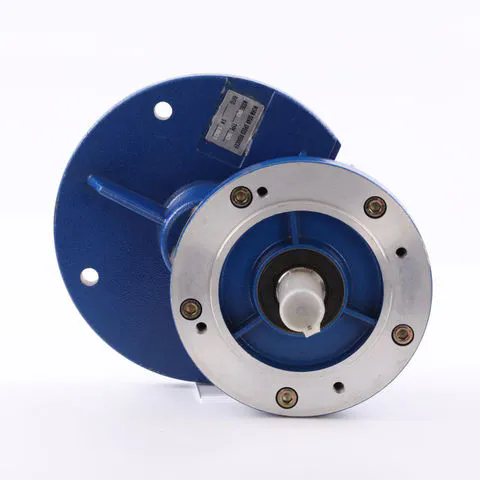
1. How Does the Number of Stages Affect Worm Gearbox Efficiency?
A Worm Gearbox can be single-stage or multi-stage. Each stage introduces a loss. The losses come from sliding friction between the worm and the wheel, bearing friction, and oil churning. The efficiency of a single stage is typically 70 to 90 percent, depending on the lead angle and the load. The efficiency of a two-stage unit is the product of the two stage efficiencies. For example, if each stage has an efficiency of 85 percent, the total efficiency is 0.85 x 0.85 = 72 percent. The table below shows the typical efficiency for different stage counts and ratios.
| Configuration | Typical ratio range | Efficiency at full load | Efficiency at 50% load |
| Single-stage | 5:1 – 60:1 | 75 – 90% | 65 – 80% |
| Two-stage | 60:1 – 600:1 | 60 – 80% | 50 – 70% |
| Three-stage | 200:1 – 3,000:1 | 50 – 70% | 40 – 60% |
| Double-enveloping single-stage | 5:1 – 60:1 | 80 – 92% | 70 – 85% |
In our factory, we manufacture Worm Gearbox units in single-stage, two-stage, and three-stage configurations. We provide the efficiency for each stage and the total efficiency for the assembly. Saifu Vietnam Company Limited has been manufacturing worm gearboxes for over 15 years and provides efficiency data for all of our products.
2. How Does the Lead Angle Affect Efficiency?
The lead angle is the angle between the worm thread and the plane perpendicular to the worm axis. A larger lead angle reduces the sliding velocity and increases the efficiency. However, a larger lead angle also reduces the self-locking capability. The efficiency of a worm gearbox is approximately equal to (cos α - μ tan α) / (cos α + μ cot α), where α is the lead angle and μ is the friction coefficient. For a lead angle of 5 degrees and a friction coefficient of 0.05, the efficiency is approximately 50 percent. For a lead angle of 20 degrees, the efficiency is approximately 85 percent. The table below shows the relationship between lead angle and efficiency.
| Lead angle (degrees) | Friction coefficient | Theoretical efficiency | Self-locking |
| 3 | 0.05 | 35 – 45% | Yes |
| 5 | 0.05 | 45 – 55% | Yes |
| 10 | 0.05 | 65 – 75% | Marginal |
| 15 | 0.05 | 78 – 85% | No |
| 20 | 0.05 | 85 – 90% | No |
| 25 | 0.05 | 88 – 92% | No |
Selection engineer's note: The lead angle is a trade-off between efficiency and self-locking. If the application requires self-locking, the lead angle must be below the friction angle, which limits the efficiency to 45 to 55 percent. If the application does not require self-locking, a larger lead angle can be used to achieve 85 to 90 percent efficiency. In our factory, we help customers select the lead angle based on the application requirements. For conveyor drives that do not require self-locking, we recommend a lead angle of 15 to 20 degrees.
3. How Do Load, Lubrication, and Temperature Affect Actual Efficiency?
The catalog efficiency is typically measured at full load, optimum viscosity, and 20°C ambient temperature. In a real application, these conditions are rarely met. The efficiency decreases at part load because the friction losses become a larger percentage of the transmitted power. The efficiency also decreases if the lubricant is too viscous (at low temperature) or too thin (at high temperature). The table below shows the effect of load and temperature on efficiency.
| Operating condition | Relative efficiency | Typical efficiency (single-stage, 15° lead) |
| Full load, 20°C, optimum viscosity | 100% | 85% |
| 75% load, 20°C | 95% | 81% |
| 50% load, 20°C | 88% | 75% |
| Full load, 0°C (high viscosity) | 85% | 72% |
| Full load, 60°C (low viscosity) | 92% | 78% |
| 50% load, 0°C | 75% | 64% |
In our factory, we test the efficiency of our Worm Gearbox units at different loads and temperatures. The test data is used to generate an efficiency map for each model. Saifu provides this efficiency map to our customers so that they can calculate the actual power consumption and heat generation for their specific operating conditions.
4. How Does Efficiency Loss Translate to Heat Generation?
The efficiency loss is converted to heat. The heat generation is calculated as the input power multiplied by (1 - efficiency). For a 5.5 kW input and 75 percent efficiency, the heat generation is 5.5 x 0.25 = 1.375 kW. This heat must be dissipated through the gearbox housing. If the heat generation exceeds the housing's thermal capacity, the oil temperature rises, and the gearbox may overheat. The table below shows the heat generation for different input powers and efficiencies.
| Input power (kW) | Efficiency | Heat generation (kW) | Required cooling |
| 2.2 | 85% | 0.33 | Natural convection |
| 2.2 | 65% | 0.77 | Natural convection (marginal) |
| 5.5 | 85% | 0.83 | Natural convection |
| 5.5 | 65% | 1.93 | Fan cooling recommended |
| 11.0 | 85% | 1.65 | Fan cooling recommended |
| 11.0 | 65% | 3.85 | Oil cooler required |
In our factory, we calculate the heat generation for each application and recommend the appropriate cooling method. For applications with high input power and low efficiency, we recommend a fan cooling unit or an oil cooler. Saifu provides thermal ratings for our gearboxes at different ambient temperatures and cooling methods.
Frequently Asked Questions About Worm Gearbox Efficiency
Summary for Selection Engineers
The efficiency of a Worm Gearbox depends on the number of stages, the lead angle, the load, the lubricant viscosity, and the operating temperature. A single-stage gearbox at full load and optimum conditions can achieve 75 to 90 percent efficiency. A two-stage gearbox achieves 60 to 80 percent. The efficiency decreases at part load and at temperature extremes. The efficiency loss is converted to heat, which must be dissipated to prevent overheating. By understanding these factors, selection engineers can calculate the actual power consumption and heat generation for their specific application. Saifu Vietnam Company Limited has been manufacturing Worm Gearbox units for over 15 years and provides efficiency maps and thermal ratings for all of our products.
Saifu Vietnam Company Limited manufactures Worm Gearbox units in single-stage, two-stage, and three-stage configurations, with lead angles from 3 to 25 degrees. We provide efficiency maps, thermal ratings, and lubricant selection guides for all of our products.
