

What innovations are shaping the future of brick pallet technology?
2026-02-26
Across North America and Europe, block plants are upgrading their board systems to improve output stability, reduce downtime, and meet stricter durability expectations. Traditional timber boards and low-density plastic plates are increasingly replaced by engineered composite structures that deliver higher load-bearing capacity and longer service life. In high-throughput automatic block plants, the performance of a Brick Machinery Pallet directly affects stacking precision, curing consistency, and overall cycle time.
Our factory has focused on high-density PVC, glass-fiber reinforced composites, and hybrid polymer formulations that are engineered for vibration resistance and dimensional stability. These materials are designed to withstand long-term exposure to moisture, alkaline cement slurry, and temperature fluctuations inside curing chambers. At Quangong Machinery Co., Ltd., we integrate advanced extrusion and pressing processes to ensure uniform density distribution across the board surface, reducing deformation during continuous vibration molding.
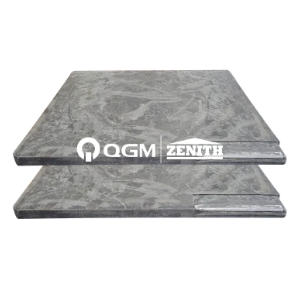
In practical applications, our boards are commonly used in fully automatic concrete block machines, paver lines, and multi-layer racking systems. Because our production lines operate under strict quality control, we maintain tight tolerances on thickness and flatness. This is critical for plants using servo-controlled block machines, where even minor deviation may cause mold misalignment.
| Material Type | High-Density PVC Composite | Glass Fiber Reinforced Board |
| Density | 1800–2100 kg per cubic meter | 1900–2200 kg per cubic meter |
| Thickness Range | 25–50 mm | 30–60 mm |
| Bending Strength | Above 55 MPa | Above 65 MPa |
| Water Absorption | Less than 0.5 percent | Less than 0.3 percent |
| Service Life | 6–8 years under standard operation | 8–10 years under heavy-duty operation |
With these material upgrades, the modern Brick Machinery Pallet no longer acts as a simple support plate. It becomes a structural component engineered for vibration endurance, high load repetition, and compatibility with automated handling systems.
How Is Structural Engineering Improving Load Distribution and Vibration Resistance?
In high-output block plants, vibration frequency and mold pressure continue to increase. This shift has required structural redesign of every Brick Machinery Pallet used in production. Reinforced rib structures, internal stress-balancing layers, and multi-layer lamination techniques are now standard in advanced facilities.
At Quangong Machinery Co., Ltd., we design our boards with internal stress-relief zones that reduce cracking under repeated compaction cycles. Our engineers conduct dynamic load simulations to ensure each unit can handle heavy concrete blocks, interlocking pavers, and hollow blocks without warping. Because our factory serves large-scale turnkey projects, we understand how pallet rigidity affects product dimensional accuracy.
Our boards are widely adopted in markets where freeze-thaw resistance and humidity variation are major concerns. By combining mechanical strength with controlled elasticity, we ensure stable support during vibration and smooth demolding after pressing. The result is higher block consistency and reduced rejection rates, which improves plant profitability.
| Parameter | Standard Model | Heavy-Duty Model |
| Maximum Static Load | 2000 kg | 3500 kg |
| Impact Resistance | High | Very High |
| Thermal Stability | Minus 20 to 70 degrees Celsius | Minus 30 to 80 degrees Celsius |
| Flatness Tolerance | Within 0.5 mm | Within 0.3 mm |
| Compatibility | Single-layer block machines | Multi-layer and servo systems |
Through structural innovation, each Brick Machinery Pallet supports faster cycle times and higher mold precision, which are critical in competitive construction material markets.
Why Is Automation Compatibility Becoming a Core Requirement?
Modern block plants rely heavily on automated stackers, cubers, and pallet return systems. If board dimensions fluctuate or surface friction is inconsistent, automation systems may experience positioning errors. For this reason, manufacturers now demand higher dimensional accuracy and anti-slip surface treatments.
Our factory applies CNC finishing and calibrated surface treatment to guarantee stable friction coefficients. This ensures reliable movement through conveyors and smooth interaction with robotic grippers. At Zenith, we align board production with smart factory standards, allowing seamless integration into Industry 4.0 ready plants.
In automated curing chambers, boards must endure repeated moisture cycles without swelling. Our production process controls internal density gradients to prevent water ingress. By improving chemical resistance, we extend operational lifespan and reduce replacement frequency. In large turnkey projects delivered by Quangong Machinery Co., Ltd., this integration of board precision and automation has proven essential for stable daily output.
Because our customers operate high-capacity plants, we engineer solutions that match both mechanical performance and digital production systems. The future of the Brick Machinery Pallet lies not only in strength but also in intelligent compatibility with automated logistics.
How Are Sustainability and Lifecycle Cost Driving Innovation?
Environmental regulations and cost efficiency are reshaping purchasing decisions in the construction materials sector. Buyers are no longer focused solely on initial price. Instead, lifecycle cost, recyclability, and reduced downtime have become decisive factors.
Our composite formulations are designed for recyclability and long-term structural stability. By extending service life, we help plants reduce material waste and maintenance interruptions. Our factory also optimizes energy consumption during production, lowering overall carbon footprint per unit manufactured.
A longer-lasting Brick Machinery Pallet decreases replacement frequency, transportation costs, and storage demand. This directly reduces total operating expenses. Because our boards are engineered for durability in demanding environments, customers benefit from predictable performance across multiple production cycles.
In markets with strict environmental standards, such improvements support compliance while maintaining productivity. Sustainable engineering is therefore not a marketing claim but a practical operational advantage embedded into our product design.
What Role Does Custom Engineering Play in Meeting Diverse Plant Requirements?
Block production plants vary in machine type, curing system, and product mix. Standardized boards cannot always meet specialized requirements such as oversized architectural blocks or heavy-duty retaining wall units. Custom engineering has therefore become central to innovation.
Our engineering team evaluates machine vibration amplitude, mold footprint, and stacking height before recommending a tailored solution. We adjust thickness, density, and reinforcement layers to suit individual operating conditions. This flexibility ensures that every Brick Machinery Pallet performs optimally within its specific production environment.
Our factory supports customized dimensions, embedded metal inserts for alignment systems, and enhanced edge protection for high-impact lines. By offering application-specific configurations, we help clients improve equipment reliability and block quality simultaneously.
FAQ
Q1: What innovations are shaping the future of brick pallet technology?
Advanced composite materials, reinforced internal structures, automation-ready precision manufacturing, and sustainable lifecycle engineering are the main innovations shaping the future of brick pallet technology. These improvements enhance durability, vibration resistance, and compatibility with high-speed automated block production lines, resulting in lower operational cost and higher productivity.
Q2: How does improved structural design affect block quality?
Enhanced structural engineering ensures uniform load distribution during vibration and compaction. This prevents board deformation, which directly impacts mold alignment and block dimensional accuracy. Stable support leads to consistent block density, smoother surfaces, and reduced rejection rates in large-scale production.
Q3: Why is lifecycle cost more important than initial purchase price?
While initial price influences purchasing decisions, lifecycle cost determines long-term profitability. A durable board with extended service life reduces downtime, minimizes replacement frequency, and lowers maintenance labor. Over several years of continuous operation, these savings significantly exceed the difference in upfront investment.
Innovation in brick pallet technology is no longer limited to material upgrades. It encompasses structural engineering, automation compatibility, sustainability, and tailored customization. By combining advanced materials, precision manufacturing, and application-driven design, our solutions support stable production in modern concrete block plants. If you are planning to upgrade your production line or seeking a reliable long-term partner, contact us today to explore how our factory can provide a performance-driven solution for your next project.
