

What Is a Sanitary DIN Union and How Does It Work in Hygienic Piping Systems
2026-11-02
In hygienic process lines, a Sanitary DIN Union is one of the most reliable mechanical connections for joining stainless steel pipe, tubing, and equipment without creating crevices that trap product or bacteria. VTY manufactures Sanitary DIN Union assemblies that meet DIN 11851 requirements, giving processors in food, beverage, dairy, and pharmaceutical plants a repeatable, cleanable joint that withstands daily CIP and SIP cycles. This guide explains the design, working principle, and selection criteria behind these fittings so engineers and buyers can specify them with confidence.
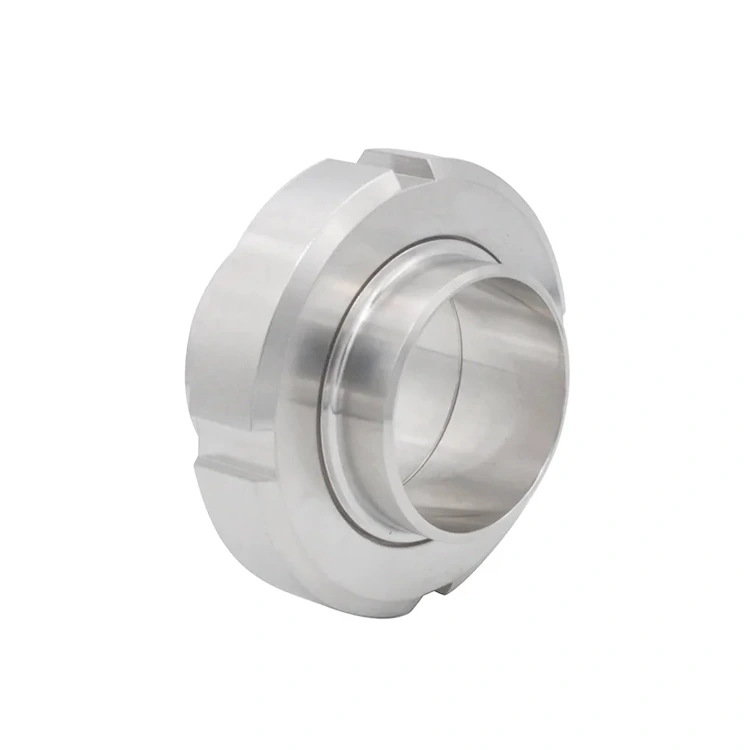
How a Sanitary DIN Union Works
A Sanitary DIN Union works through a three-part compression concept: a threaded male stud welded to one pipe end, a matching female nut on the other, and a profiled sealing ring compressed between the two mating faces. When the nut is tightened, the gasket deforms into the groove profile, creating a void-free seal that is flush with the bore. Because the seal is metal-to-gasket rather than metal-to-metal, the joint tolerates minor misalignment while remaining fully cleanable.
VTY produces these unions with controlled thread geometry and surface finishes (Ra ≤ 0.8 µm on product-contact surfaces) so that the sealing compression is consistent from assembly to assembly.
Key Design Features
-
DIN 11851 thread profile — the standard metric thread that defines interchangeability across Europe and global OEM equipment
-
Flush bore design — eliminates dead legs and product holdup
-
Available gasket materials — EPDM, NBR, FKM, and PTFE for different temperature and chemical duties
-
Stainless steel grades — 304 and 316L, with 316L preferred for aggressive or high-chloride service
-
Sizes from DN10 to DN100 — covering small utility lines through main process headers
Sanitary DIN Union vs. Common Connection Types
| Connection Type | Standard | Seal Method | Typical Best Use |
|---|---|---|---|
| Sanitary DIN Union | DIN 11851 | Profiled gasket compressed by threaded nut | Dairy, brewery, pharma, high-cycle CIP lines |
| Tri-Clamp (TC) | ASME BPE / ISO 2852 | Clamp compresses gasket between ferrules | Fast teardown, sanitary skids |
| SMS Union | SMS 1145 | Threaded nut with flat gasket | European food and beverage lines |
| IDF Union | IDF / BS 4825 | Threaded nut with gasket | Dairy processing |
| Welded joint | ASME BPE | Fusion weld, no gasket | Permanent, highest-purity loops |
The Sanitary DIN Union advantage is its combination of a wide, stable sealing face and a threaded body that resists vibration loosening — which is why it remains dominant in dairies and breweries where lines are assembled and reopened frequently.
Selection and Installation Checklist
| Parameter | Recommended Practice |
|---|---|
| Material | 316L for product contact; 304 acceptable for utility water |
| Surface finish | Ra ≤ 0.8 µm for product contact; Ra ≤ 0.4 µm for aseptic duty |
| Gasket | EPDM for steam/CIP up to ~140 °C; FKM for fatty products and higher temperatures |
| Torque | Tighten to manufacturer specification; over-torque deforms the gasket and shortens seal life |
| Alignment | Support pipe runs so the union is not load-bearing |
| Inspection | Replace gaskets at scheduled intervals; inspect thread and sealing face for galling |
Frequently Asked Questions
What pressure and temperature can a Sanitary DIN Union handle? A Sanitary DIN Union typically operates up to 10–16 bar depending on size and gasket material, with EPDM gaskets rated to roughly 140 °C and FKM grades suitable for higher-temperature duties; always confirm against the specific VTY datasheet for the size ordered.
How do I choose between EPDM, FKM, and PTFE gaskets for a Sanitary DIN Union? EPDM is the default for steam and CIP duty, FKM suits fatty products and broader chemical resistance, and PTFE is selected where the widest chemical compatibility or the lowest extractables are required, so the choice should follow the product, cleaning chemistry, and temperature profile.
Can a Sanitary DIN Union be used in aseptic or pharmaceutical service? Yes, provided the union is supplied with an appropriate surface finish (Ra ≤ 0.4 µm), a validated gasket material, and documented material traceability, which is why VTY offers certification packages for pharma and aseptic installations.
Why does my Sanitary DIN Union leak after reassembly? The most common causes are a worn or mis-seated gasket, over-torquing that deforms the seal, damaged threads from cross-threading, or insufficient pipe support allowing the joint to flex under load.
Are Sanitary DIN Unions interchangeable between manufacturers? Dimensional interchangeability is defined by DIN 11851, so a compliant Sanitary DIN Union from VTY will mate with other standard-compliant components, but gasket profile and finish quality still vary and should be verified before mixing brands in a critical line.
Contact Us
Ready to specify the right Sanitary DIN Union for your process line? Contact VTY today for dimensional drawings, material certificates, gasket selection guidance, and competitive pricing on DIN 11851 unions from DN10 to DN100 — our technical team will help you match the correct Sanitary DIN Union to your pressure, temperature, and hygiene requirements.
