

What Is the Difference Between PTFE Packing and PTFE Gasket Materials?
2026-11-02
A maintenance technician at a chemical plant draws two items from the storeroom for a valve overhaul. The first is a coil of PTFE Packing for the valve stem. The second is a sheet of PTFE gasket material for the bonnet flange. Both are white, both are PTFE, and both are marked with the same temperature and pressure rating. The technician asks whether one can be used in place of the other if the storeroom runs out. The answer is no, and the reason is not the polymer. It is the physical form and the sealing motion. The packing seals a moving stem; the gasket seals a static flange. The two products are made from the same polymer but designed for completely different functions. This guide explains the difference.
1. Why Do Two Products Made From the Same Polymer Serve Completely Different Sealing Functions?
PTFE is a remarkable polymer. It is chemically inert, it has a very low friction coefficient, and it operates over a wide temperature range. These properties make it suitable for both dynamic and static sealing. But the sealing mechanism is different in each case. A dynamic seal must accommodate the movement of the shaft or the stem while maintaining contact with the surface. A static seal must fill the microscopic gaps between two flange faces and remain compressed for years. The physical form of the product is designed around the sealing mechanism. The PTFE Packing is a braided rope that is compressed into a stuffing box. The gasket is a flat sheet or a cut ring that is compressed between two flanges. In our factory, we manufacture both products from the same PTFE resin but with different fillers and different constructions. Ningbo Kaxite Sealing Materials Co., Ltd has been manufacturing sealing materials for over 15 years.
The confusion arises because both products carry similar temperature and pressure ratings. The ratings describe the material capability, not the product capability. A PTFE gasket sheet rated for 100 bar in a static flange is not rated for 100 bar in a stuffing box. The packing is rated for the same pressure only when it is installed with the correct number of rings and the correct gland load.
2. How Does the Physical Form of Each Product Match Its Sealing Motion?
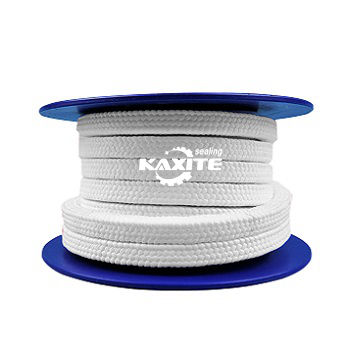
The PTFE Packing is a braided rope. It is cut into rings and stacked in the stuffing box around the stem. The gland compresses the rings axially, and the rings expand radially against the stem and the box wall. The radial force creates the seal. The braided construction allows the packing to conform to the stem surface and to recover slightly as the stem moves. The PTFE gasket is a flat sheet or a cut ring. It is placed between the flange faces and compressed by the bolts. The compression reduces the thickness of the gasket and forces the material into the surface irregularities of the flange. The seal is static because the flanges do not move relative to each other. The table below compares the two products.
| Parameter | PTFE Packing | PTFE gasket |
| Physical form | Braided rope, cut into rings | Flat sheet or cut ring |
| Sealing motion | Dynamic (stem or shaft movement) | Static (flange faces) |
| Force direction | Axial gland load, radial seal | Bolt load, face compression |
| Typical compression | 15 – 25% of ring height | 20 – 40% of gasket thickness |
| Friction | Low but present (stem contact) | Not applicable (no movement) |
| Typical application | Valve stems, pumps, agitators | Pipe flanges, heat exchangers, vessel covers |
The compression values in the table are the key to reliable sealing. A packing that is compressed too little will leak. A packing that is compressed too much will generate excessive friction and heat, and it will wear the stem. A gasket that is compressed too little will leak. A gasket that is compressed too much will cold-flow and extrude out of the flange gap. In our factory, we provide the recommended compression value and the gland load for each packing size, and the recommended bolt torque for each gasket size. Kaxite provides the installation data with each shipment.
3. Which PTFE Grade and Filler System Suits Each Product?
Pure PTFE is soft and prone to cold flow. For both packing and gaskets, fillers are added to improve the mechanical properties. The filler system is different for each product because the requirements are different. For PTFE Packing, the filler must improve the wear resistance, the thermal conductivity, and the creep resistance. The common fillers are graphite, carbon fiber, glass fiber, and molybdenum disulfide. For PTFE gaskets, the filler must improve the compression set and the creep resistance while maintaining the chemical resistance. The common fillers are glass microspheres, barium sulfate, and graphite. The table below shows the filler systems and their suitability.
| Filler system | PTFE Packing suitability | PTFE gasket suitability | Typical benefit |
| Pure PTFE | Low (cold flow, wear) | Low (cold flow) | Maximum chemical resistance |
| Graphite | High | Moderate | Low friction, good thermal conductivity |
| Carbon fiber | High | Low | High strength, wear resistance |
| Glass fiber | Moderate | Moderate | Good dimensional stability |
| Barium sulfate | Low | High | Improved compression set, chemical resistance |
Sealing engineer's note: The filler must be compatible with the process medium. A glass-filled PTFE packing is not suitable for hydrofluoric acid or hot concentrated alkali, because the glass is attacked. A graphite-filled packing is not suitable for strong oxidizing media. In our factory, we check the filler compatibility with the medium before recommending a product. Ningbo Kaxite Sealing Materials Co., Ltd provides a chemical compatibility chart for each product family.
4. Why Do Installation and Compression Control Decide Whether Either Product Seals Reliably?
The installation procedure is different for the two products. For PTFE Packing, the rings are cut at a 45 degree angle, and the cuts are staggered by 90 degrees between successive rings. Each ring is seated individually, and the gland is tightened to the recommended load. The packing is then run in for a few hours, and the gland is retightened to compensate for the initial compression set. For the PTFE gasket, the bolts are tightened in a star pattern in three stages, and the final torque is applied after the gasket has been compressed. The flange faces must be parallel and clean. In our factory, we provide a installation guide with each product that shows the ring cut angle, the staggering pattern, the gland load, the bolt torque, and the tightening sequence.
The most common installation error for the PTFE Packing is over-tightening the gland. The over-tightening generates excessive friction and heat, and the packing wears out in a few weeks. The most common installation error for the PTFE gasket is under-tightening the bolts. The under-tightening leaves the gasket uncompressed, and the joint leaks at the first pressure cycle.
5. How Should Engineers Specify and Verify the Right PTFE Sealing Product?
The specification should include six items. The first is the sealing location, dynamic or static. The second is the medium, the temperature, and the pressure. The third is the PTFE grade and the filler system. The fourth is the size, including the stem diameter and the stuffing box dimensions for the packing, or the flange dimensions for the gasket. The fifth is the installation torque or gland load. The sixth is the acceptance test. The verification should include four checks. The first is the dimensional inspection. The second is the density and compression test. The third is the medium immersion test. The fourth is the leak test after installation. In our factory, we perform these checks on every batch and provide the test report with the shipment. Ningbo Kaxite Sealing Materials Co., Ltd also offers on-site installation support for critical applications.
We recommend that the engineer specify the product by function, not by material alone. A specification that says "PTFE sealing material" is ambiguous. A specification that says "PTFE packing, graphite filled, 10 mm square, for 25 mm stem, gland load 15 Nm" is unambiguous and can be verified at receipt.
Frequently Asked Questions About PTFE Packing and PTFE Gasket Materials
Summary for Sealing Engineers and Maintenance Teams
PTFE Packing and PTFE gasket materials are made from the same polymer but serve different sealing functions. The packing is a braided rope for dynamic sealing in a stuffing box. The gasket is a flat sheet for static sealing between flanges. The filler system and the installation procedure are different for each product. The compression control is the key to reliable sealing in both cases. The specification should include the sealing location, the medium, the PTFE grade, the filler system, the size, and the installation torque. The verification should include dimensional inspection, compression testing, medium immersion testing, and leak testing. Ningbo Kaxite Sealing Materials Co., Ltd has been manufacturing sealing materials for over 15 years and provides full selection and installation support for our customers.
