

What Is the Difference Between RO and EDI in Industrial Water Treatment?
2026-10-14
A water treatment supervisor at a pharmaceutical plant compares two quotations for a Pure Water System. The first quote is for a two-pass RO system with a capacity of 10 m³/hour. The second quote is for a single-pass RO followed by EDI. The first system costs $80,000 and produces water with a conductivity of 2 µS/cm. The second system costs $120,000 and produces water with a conductivity of 0.1 µS/cm. The supervisor must decide which system is appropriate. The decision depends on the required water quality, the operating cost, and the maintenance requirements. This guide explains the difference between RO and EDI and how to choose between them.
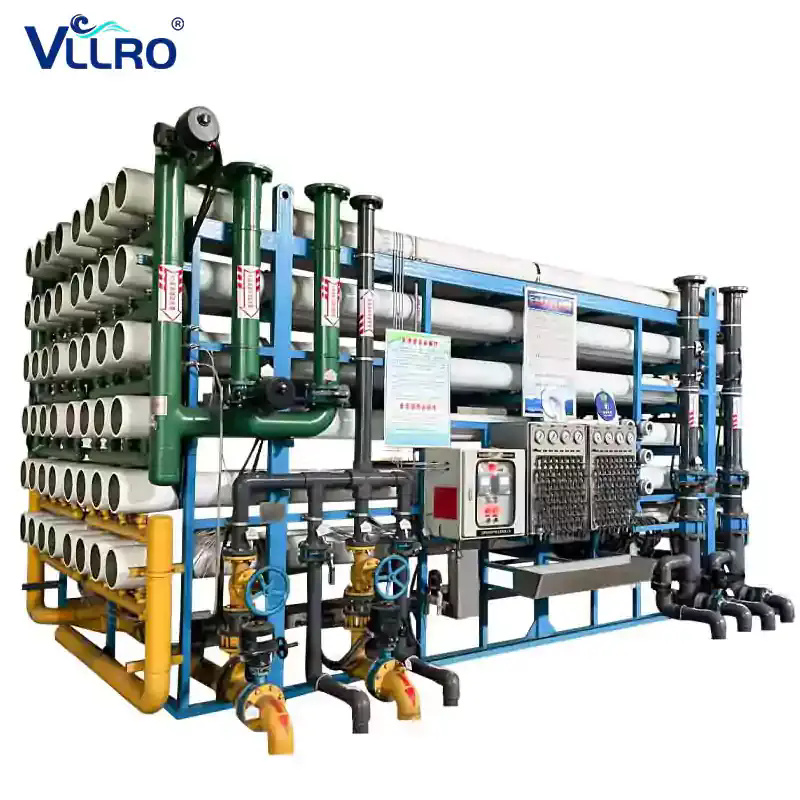
1. What Does RO Remove and What Does It Leave Behind?
Reverse osmosis (RO) uses a semi-permeable membrane and pressure to separate dissolved ions from water. The membrane rejects 95 to 99 percent of dissolved salts, depending on the feed water and the membrane type. RO also removes bacteria, viruses, and organic molecules with a molecular weight above 200 Daltons. However, RO does not remove dissolved gases such as carbon dioxide, ammonia, or silica. These gases pass through the membrane and remain in the product water. In a Pure Water System, the presence of carbon dioxide is particularly problematic because it forms carbonic acid, which increases the conductivity and reduces the resistivity. The table below shows the removal efficiency of RO for different contaminants.
| Contaminant | RO removal efficiency | Residual in product water | Impact on Pure Water System |
| Dissolved salts (NaCl) | 98 – 99% | 10 – 50 ppm | Conductivity 2 – 10 µS/cm |
| Silica (SiO₂) | 85 – 95% | 0.1 – 0.5 ppm | Scaling risk on EDI |
| Carbon dioxide (CO₂) | 0 – 20% | 5 – 30 ppm | Conductivity increase |
| Boron | 40 – 70% | 0.5 – 2 ppm | Not suitable for high-purity |
| Bacteria | 99.9% | < 1 CFU/ml | Requires final filtration |
| TOC | 90 – 95% | 0.1 – 0.5 ppm | Requires UV or final polish |
In our factory, we design Pure Water System units with RO as the primary demineralization step. We recommend a two-pass RO for applications that require a conductivity below 1 µS/cm. For applications that require a conductivity below 0.1 µS/cm, we recommend RO followed by EDI. Jianyun Zhishui (Qingdao) Industrial Technology Co., Ltd. has been designing and manufacturing industrial water treatment systems for over 12 years.
2. How Does EDI Remove Residual Ions and Gases?
Electrodeionization (EDI) is a continuous, chemical-free process that removes residual ions from RO permeate. EDI uses a combination of ion exchange membranes and ion exchange resin. The resin adsorbs the ions, and the electric field drives them through the membranes into the concentrate stream. The resin is continuously regenerated by the electric field, so there is no need for acid or caustic regeneration. EDI removes residual salts, carbon dioxide, and silica. It does not remove boron, which is a weak acid and is not well ionized at neutral pH. The table below compares the removal performance of RO and EDI.
| Parameter | RO (single pass) | RO (two pass) | RO + EDI |
| Conductivity (µS/cm) | 2 – 10 | 0.5 – 2 | 0.05 – 0.1 |
| Resistivity (MΩ·cm) | 0.1 – 0.5 | 0.5 – 2 | 10 – 18 |
| Silica removal | 85 – 95% | 90 – 98% | 99.9% |
| CO₂ removal | 0 – 20% | 10 – 40% | > 99% |
| Chemical regeneration | None | None | None |
| Waste stream | Concentrate (25 – 50%) | Concentrate (25 – 50%) | Concentrate (5 – 10%) |
EDI produces water with a resistivity of 10 to 18 MΩ·cm, which meets the requirements for pharmaceutical, semiconductor, and power plant applications. The EDI concentrate stream is only 5 to 10 percent of the feed, which reduces the wastewater volume compared to RO alone. In our factory, we integrate EDI modules from qualified suppliers into our Pure Water System units. We also provide the power supply and the control system for the EDI stack.
3. What Are the Capital and Operating Cost Differences?
The capital cost of an RO+EDI system is 30 to 50 percent higher than a two-pass RO system. However, the operating cost of the RO+EDI system is lower because it does not require chemical regeneration and it produces less wastewater. The table below compares the capital and operating costs for a 10 m³/hour Pure Water System.
| Cost component | Two-pass RO | RO + EDI |
| Capital cost | $80,000 | $120,000 |
| Power consumption (kWh/m³) | 0.8 | 1.2 |
| Chemical cost per year | $2,000 (membrane cleaning) | $500 (membrane cleaning) |
| Wastewater discharge (m³/day) | 60 | 30 |
| Annual operating cost | $18,000 | $14,000 |
| Payback period for EDI premium | N/A | 10 years |
Economic note: The payback period for the EDI premium depends on the cost of chemicals, the cost of wastewater discharge, and the required water quality. If the plant requires a resistivity above 10 MΩ·cm, the two-pass RO system cannot meet the specification, and the EDI system is the only option. If the plant requires a resistivity of 1 to 2 MΩ·cm, the two-pass RO system is sufficient and more economical. In our factory, we provide a cost-benefit analysis for each customer based on their specific water quality requirements and utility costs.
4. What Are the Maintenance and Operational Requirements?
RO and EDI have different maintenance requirements. RO membranes require periodic cleaning and replacement every 3 to 5 years. EDI modules require periodic inspection and replacement every 5 to 7 years. The EDI stack also requires a DC power supply and a control system to monitor the voltage and current. The table below shows the maintenance requirements for each technology.
| Maintenance item | RO | EDI |
| Cleaning frequency | Every 3 – 6 months | Not required |
| Replacement interval | 3 – 5 years (membranes) | 5 – 7 years (modules) |
| Chemical handling | Cleaning chemicals | None |
| Power supply | High-pressure pump | DC power supply |
| Control requirements | Pressure, flow, conductivity | Voltage, current, resistivity |
| Operator skill | Moderate | Moderate to high |
In our factory, we provide training for the operators of our Pure Water System units. The training covers the maintenance procedures for both RO and EDI. We also provide a maintenance manual and a spare parts list. VLLRO offers a remote monitoring service that allows our engineers to monitor the performance of the system and to alert the operator if maintenance is required.
Frequently Asked Questions About RO and EDI in Industrial Water Treatment
Summary for Plant Engineers and Water Treatment Supervisors
RO and EDI are complementary technologies in a Pure Water System. RO removes the bulk of dissolved salts, bacteria, and organics. EDI removes the residual ions, carbon dioxide, and silica to produce ultrapure water with a resistivity of 10 to 18 MΩ·cm. The choice between a two-pass RO system and an RO+EDI system depends on the required water quality and the operating cost. For resistivity above 10 MΩ·cm, RO+EDI is required. For resistivity of 1 to 2 MΩ·cm, two-pass RO is sufficient. Jianyun Zhishui (Qingdao) Industrial Technology Co., Ltd. has been designing and manufacturing Pure Water System units for over 12 years and provides full engineering support for our customers.
Jianyun Zhishui (Qingdao) Industrial Technology Co., Ltd. designs and manufactures Pure Water System units with single-pass RO, two-pass RO, and RO+EDI configurations. We provide water analysis, system design, installation, and operator training.
