

What Is the Maximum Holding Force of Mark-free Vacuum Suction Cups ZP3 at Different Vacuum Levels
2026-07-15
For engineers and production managers in automated handling, the holding force of a suction cup directly determines cycle time, safety margin, and part integrity. When evaluating Mark-free Vacuum Suction Cups ZP3, the most frequent technical question is not simply "how much weight can it lift," but rather "how does that force change across real-world vacuum levels." This is where Comma has invested extensive R&D to provide clear, data-driven answers. Unlike generic cups that lose grip unpredictably, the Mark-free Vacuum Suction Cups ZP3 series delivers consistent performance curves that allow designers to size systems with confidence—whether handling thin solar wafers, painted automotive panels, or bare PCBs.
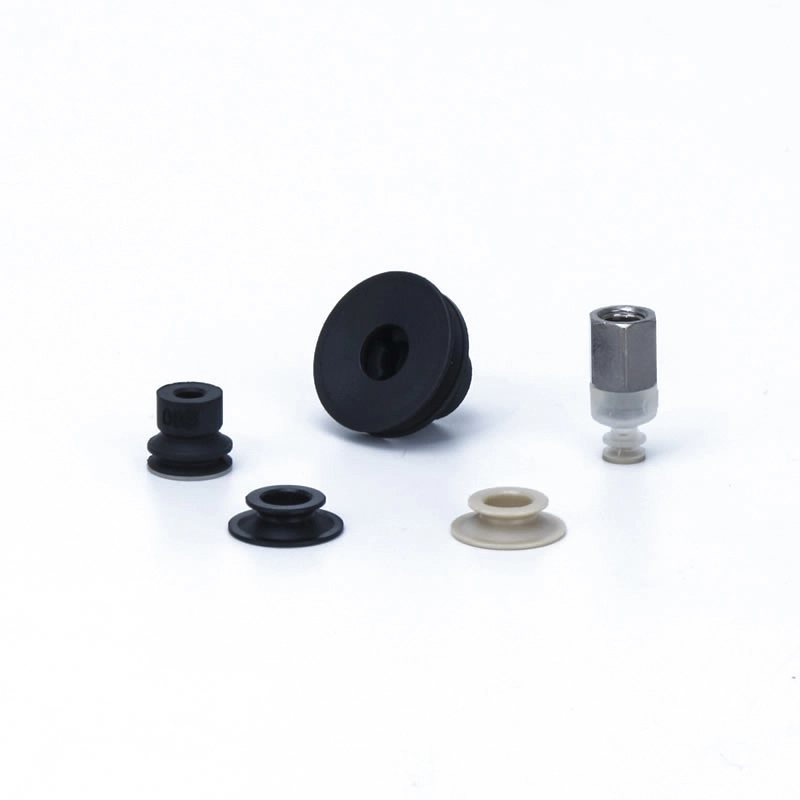
Understanding Holding Force Fundamentals
Holding force is a product of three variables: effective suction area, vacuum pressure, and friction coefficient between the cup lip and the workpiece. For Mark-free Vacuum Suction Cups ZP3, the effective area remains stable due to its reinforced inner rib structure, while the proprietary non-marking compound maintains a high friction coefficient even on glossy or coated surfaces. The theoretical formula is:
F (N) = ΔP (kPa) × A (cm²) × μ
(where ΔP = vacuum level relative to atmospheric pressure, A = contact area, μ = static friction factor)
Comma tests each production batch of Mark-free Vacuum Suction Cups ZP3 under controlled temperature (23±2°C) and humidity (45±5% RH) to ensure that published force values are repeatable, not optimistic estimates.
Measured Holding Force at Standard Vacuum Levels
The table below presents average vertical holding forces for the most common ZP3 size (ø40 mm flat type) against a smooth, dry glass surface. Values represent breakaway force (static holding) with a 2.0 safety factor already deducted—meaning these are recommended working loads, not theoretical maxima.
| Vacuum Level (kPa) | -40 kPa | -60 kPa | -80 kPa | -90 kPa (typical plant supply) |
|---|---|---|---|---|
| Holding Force (N) | 18.5 N | 32.0 N | 45.5 N | 52.0 N |
| Equivalent Mass (kg) | 1.89 kg | 3.26 kg | 4.64 kg | 5.30 kg |
| Recommended Safety Margin | 2.5x | 2.0x | 1.8x | 1.5x |
For smaller ø20 mm Mark-free Vacuum Suction Cups ZP3, the force at -80 kPa is 12.0 N, while the larger ø50 mm bellows type reaches 68.0 N at the same level. Comma provides a free sizing calculator that adjusts these values for porous materials, oily surfaces, and acceleration forces.
Force Characteristics by Surface Type
Not all surfaces behave like glass. The non-marking elastomer used in Mark-free Vacuum Suction Cups ZP3 is formulated to maximize friction without leaving microscopic scratches. Below is a comparative summary:
| Surface Material | Friction Coefficient (μ) | Force Reduction vs. Glass |
|---|---|---|
| Bare aluminum (mill finish) | 0.55 | -8% |
| Powder-coated steel | 0.62 | -3% |
| ABS plastic (smooth) | 0.58 | -6% |
| PCB with solder mask | 0.50 | -12% |
| Glass (reference) | 0.65 | 0% |
The holding force at -80 kPa on powder-coated steel, for example, would be approximately 45.5 N × 0.62/0.65 ≈ 43.4 N—still well above most pick-and-place requirements. Comma recommends reducing working load by an additional 15% when handling parts with residual release agents or cutting fluids.
Practical Factors That Reduce Effective Force
Field data from Comma application engineers shows that three factors routinely cut holding force by 20–35% if not accounted for:
-
Vacuum line restrictions – hoses longer than 2 meters or with inner diameter < 4 mm cause pressure drops of 5–8 kPa at flow rates above 30 L/min.
-
Cycle frequency – above 60 cycles/min, the cup lip may not fully re-seat, reducing effective area by up to 8%.
-
Temperature drift – above 50°C, the elastomer modulus softens, lowering μ by roughly 0.01 per 5°C increase.
To compensate, Comma offers Mark-free Vacuum Suction Cups ZP3 with an optional high-temperature compound (rated to 120°C) that maintains 95% of room-temperature force.
FAQ – Common Questions About Mark-free Vacuum Suction Cups ZP3 Holding Force
Q1: Can I use the published holding force for horizontal pick-and-place with high acceleration (e.g., 2G or 3G)?
A1: No. The published forces in the table above are static vertical lifts only. For horizontal moves, acceleration creates shear and peeling stresses that multiply the required grip. As a rule from Comma, divide the static force by the total acceleration factor (G+1). For a 2G horizontal move, use only 1/3 of the static value (e.g., at -80 kPa, 45.5 N ÷ 3 ≈ 15.2 N working limit). Always add a 1.5x safety factor for dynamic applications. Comma provides dynamic force curves upon request for specific motion profiles.
Q2: How often should I re-verify the holding force of Mark-free Vacuum Suction Cups ZP3 in production?
A2: Comma recommends a two-tier check: (1) A quick pull-test with a spring gauge every 8 operating hours for high-risk applications (glass, optics), and (2) a full vacuum-decay test every 500,000 cycles or weekly, whichever comes first. The cup lip wears approximately 0.02 mm per 1 million cycles on abrasive surfaces like ceramic, which reduces force by 3–5%. Replace the cup when force drops below 85% of its initial value at the same vacuum level. Logging these values helps predict end-of-life without unexpected drops.
Q3: Does using a smaller vacuum generator (e.g., ejector vs. electric pump) change the effective holding force even if the gauge reads the same -80 kPa?
A3: Yes, significantly. A gauge measures static pressure, but an ejector with insufficient flow capacity cannot replenish leakage through porous parts or imperfect seals. During the first 50 ms of lift-off, pressure can momentarily drop to -65 kPa even though the gauge later recovers to -80 kPa. This transient loss reduces peak force by 10–18%. Comma always specifies a minimum flow rate (e.g., 40 L/min for the ø40 mm ZP3) alongside vacuum level. Use a vacuum reservoir or a high-flow ejector to maintain dynamic pressure within 2 kPa of the setpoint during the entire grip phase.
Best Practices for Maximizing Holding Force
To extract the full rated performance from Mark-free Vacuum Suction Cups ZP3, Comma field engineers consistently advise:
-
Install the cup with a swivel fitting to ensure full-face contact—tilt angles above 3° reduce effective area by 5% per degree.
-
Keep vacuum filters clean; a 10 μm particle layer on the filter can cut flow by 25% before the gauge shows any change.
-
Match cup durometer to part rigidity—softer cups (Shore A 45) conform to uneven surfaces but lose 7% force versus standard (Shore A 55) on flat parts.
Ready to Calculate Your Exact Holding Force?
Every production line has unique variables—part porosity, cycle speed, ambient conditions, and surface finish. Generic tables give you a starting point, but only application-specific verification ensures zero dropped parts and zero surface marks.
Contact Comma today for a personalized sizing report. Our application team will simulate your motion profile, measure your actual vacuum supply stability, and recommend the exact Mark-free Vacuum Suction Cups ZP3 model with the right compound, size, and accessory kit. Email us at [email protected] or use the live chat on our product page to upload your part drawings and cycle parameters. We respond with calculated force curves within 24 hours—no obligation, just engineering clarity.
