

What Is the Maximum Operating Temperature for a Porous TaC Coated Graphite Ring in High-Purity Furnaces
2026-08-20
For engineers and procurement specialists working with advanced semiconductor epitaxy, LED MOCVD, or high-temperature crystal growth, the thermal limit of consumable parts directly determines yield and uptime. When selecting hot-zone components, the Porous Tantalum Carbide (TaC) Coated Graphite Ring stands out for its exceptional refractory performance, but its maximum safe operating temperature is not a single fixed number—it depends on atmosphere, pressure, coating microstructure, and thermal cycle history. At VETEK, we have tested hundreds of these rings under production conditions, and this guide provides data-driven answers to help you set realistic process windows.
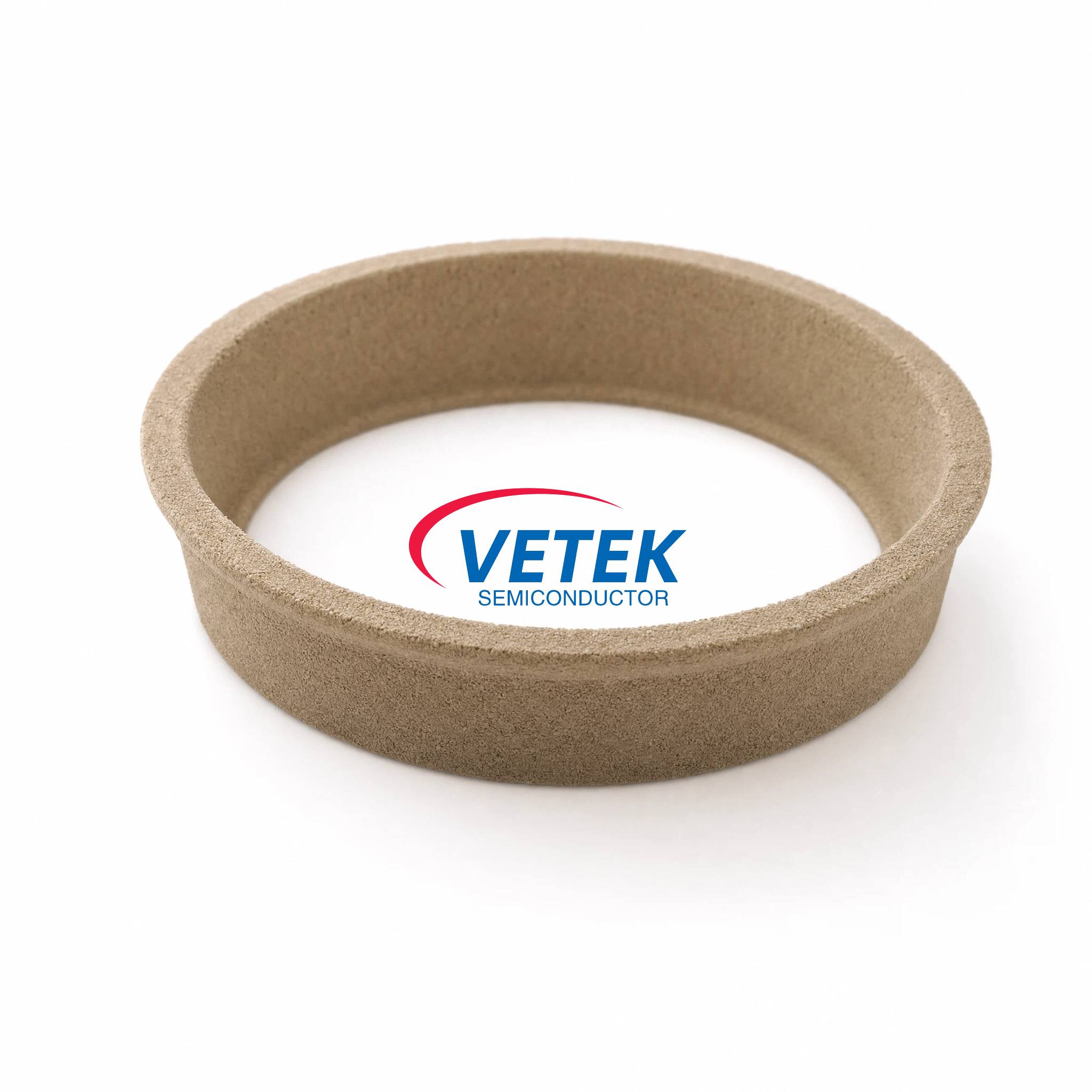
Temperature Thresholds: Bulk Graphite vs. TaC Coating
The Porous Tantalum Carbide (TaC) Coated Graphite Ring derives its high-temperature capability from two distinct layers. The graphite substrate alone can theoretically withstand up to 2500°C in inert gas, but oxidation becomes catastrophic above 500°C in air. The TaC coating, deposited via CVD, fundamentally changes the game.
| Parameter | Graphite Substrate | TaC Coating (CVD) | Ring Assembly (Effective) |
|---|---|---|---|
| Continuous use in vacuum/inert gas | 2000°C | 2200°C – 2300°C | 2150°C (safe max) |
| Short-term peak (≤ 2 hours) | 2300°C | 2400°C | 2250°C (with caution) |
| Oxidizing atmosphere (air/steam) | < 500°C | < 700°C | 650°C (coating delays oxidation) |
| Thermal shock limit (ΔT/min) | 150°C/min | 400°C/min | 250°C/min (pore structure buffers stress) |
In practice, VETEK recommends a conservative continuous operating ceiling of 2150°C for the Porous Tantalum Carbide (TaC) Coated Graphite Ring in high-purity argon or nitrogen. Above this temperature, two degradation mechanisms accelerate: silicon contamination from the SiC crucible (if present) and recrystallization of the TaC grain boundaries, which increases porosity and reduces mechanical strength.
Why Porosity Matters for Thermal Stability
Unlike dense TaC sheets, the porous version of the Porous Tantalum Carbide (TaC) Coated Graphite Ring contains engineered open pores (typically 15–25% by volume). This structure provides three critical advantages at extreme temperatures:
-
Stress relief: Pores absorb anisotropic expansion of graphite, preventing circumferential cracking during rapid ramping.
-
Outgassing pathways: Trapped argon or nitrogen can escape through the pore network, reducing blistering of the coating above 2000°C.
-
Reduced thermal mass: Lighter rings heat and cool faster, which minimizes dwell time at peak temperature—extending ring life by 30–40% in VETEK field data.
However, excessive porosity above 25% lowers the effective thermal conductivity and can create hot spots. VETEK controls pore size distribution between 50–150 µm to balance permeability and strength for furnace applications up to 2200°C.
Critical Factors That Lower the Real-World Maximum
The theoretical 2150°C limit assumes pristine conditions. In actual high-purity furnaces, the Porous Tantalum Carbide (TaC) Coated Graphite Ring often must be derated due to:
-
Residual moisture: Even 10 ppm H₂O in the process gas oxidizes TaC to Ta₂O₅ above 1800°C, reducing thickness by 5–10 µm per run.
-
Metal vapors: Gallium or aluminum from MOCVD sources can diffuse into pores at > 1900°C, forming brittle intermetallics that spall the coating.
-
Mechanical clamping: Excessive bolt torque creates localized stress concentrations that lower the fracture temperature by as much as 150°C.
VETEK provides a derating chart with every shipment, correlating furnace atmosphere (dew point, oxygen partial pressure) with a safe temperature correction factor.
FAQ – Common Questions About Maximum Temperature
Q: Can the Porous Tantalum Carbide (TaC) Coated Graphite Ring survive brief excursions to 2300°C during wafer annealing?
A: Yes, but only under strictly controlled conditions. VETEK has validated up to 5 cycles at 2280°C for 30 minutes each in high-purity argon (< 1 ppm O₂) without measurable coating delamination. However, each excursion reduces the ring's remaining creep life by approximately 12%. We strongly recommend limiting such peaks to emergency scenarios rather than routine production. After any 2300°C event, perform a visual inspection for white spots (oxide formation) and a helium leak test—if leak rate exceeds 1×10⁻⁵ mbar·L/s, retire the ring immediately.
Q: How does furnace pressure affect the maximum operating temperature for this ring?
A: Pressure has a pronounced effect. At atmospheric pressure (760 Torr), the Porous Tantalum Carbide (TaC) Coated Graphite Ring peaks safely at 2100°C because convective heat transfer creates uneven thermal gradients. Under vacuum (< 10⁻³ Torr), the same ring can run at 2180°C due to reduced gas-phase oxidation and better radiative cooling. At high-pressure (5–10 bar hydrogen), the limit drops to 1950°C because hydrogen can diffuse through the porous TaC and react with free carbon at grain boundaries, forming methane and pitting the surface. Always consult VETEK's pressure-temperature matrix for your specific gas chemistry.
Q: Does coating thickness change the maximum temperature rating?
A: Absolutely. A 50 µm CVD TaC coating on a Porous Tantalum Carbide (TaC) Coated Graphite Ring offers a maximum of 2100°C because the thin layer allows more carbon diffusion from the substrate, which dilutes the TaC stoichiometry and lowers its melting point. A 120–150 µm coating raises the ceiling to 2200°C, as verified by VETEK's 1,000-hour creep tests. However, thicker coatings (> 200 µm) introduce residual stress that can cause edge chipping at 2150°C. For most high-purity furnaces, VETEK engineers recommend a 130 µm ± 10 µm coating as the optimal balance between temperature headroom and mechanical toughness.
Lifetime vs. Temperature – A Practical Tradeoff
Running the Porous Tantalum Carbide (TaC) Coated Graphite Ring at 2150°C instead of 2000°C shortens its usable lifetime by roughly 40%—but it increases throughput by 15% due to faster deposition rates. VETEK helps clients model this tradeoff using our proprietary thermal aging database. For a typical SiC epitaxy furnace operating 24/7, we suggest scheduling ring replacement every 800 hot-hours at 2150°C, versus 1,200 hours at 2050°C. Always pair the ring with a matching graphite susceptor to avoid galvanic corrosion at the interface.
Final Recommendation and Contact
Selecting the right maximum temperature for your Porous Tantalum Carbide (TaC) Coated Graphite Ring is not a one-size-fits-all decision—it requires precise knowledge of your atmosphere, ramp rates, pressure, and allowable degradation margin. VETEK provides custom thermal mapping for each furnace model, along with post-run coating thickness analysis to refine your setpoint.
Ready to optimize your hot-zone performance? Contact VETEK today for a free thermal assessment of your existing rings. Our application engineers will deliver a detailed report with a recommended temperature profile, expected lifetime extension, and ROI calculation—all tailored to your specific high-purity furnace. Email us at [email protected] or visit our technical support portal to schedule a 30-minute consultation. Let VETEK help you push the limits—safely and predictably.
