

What Is the Minimum Bend Radius of G.657.B3 Single-mode Optical Fiber for FTTH Indoor Wiring
2026-08-21
When planning an FTTH (Fiber to the Home) deployment inside residential buildings, installers frequently ask about the physical limits of their cabling. The G.657.B3 Single-mode Optical Fiber stands out as one of the most bend-insensitive fibers available today, but knowing its exact minimum bend radius is not just a specification—it is a prerequisite for reliable long-term performance. For network integrators using Xuben fiber solutions, understanding this parameter directly impacts splice loss, installation speed, and maintenance costs.
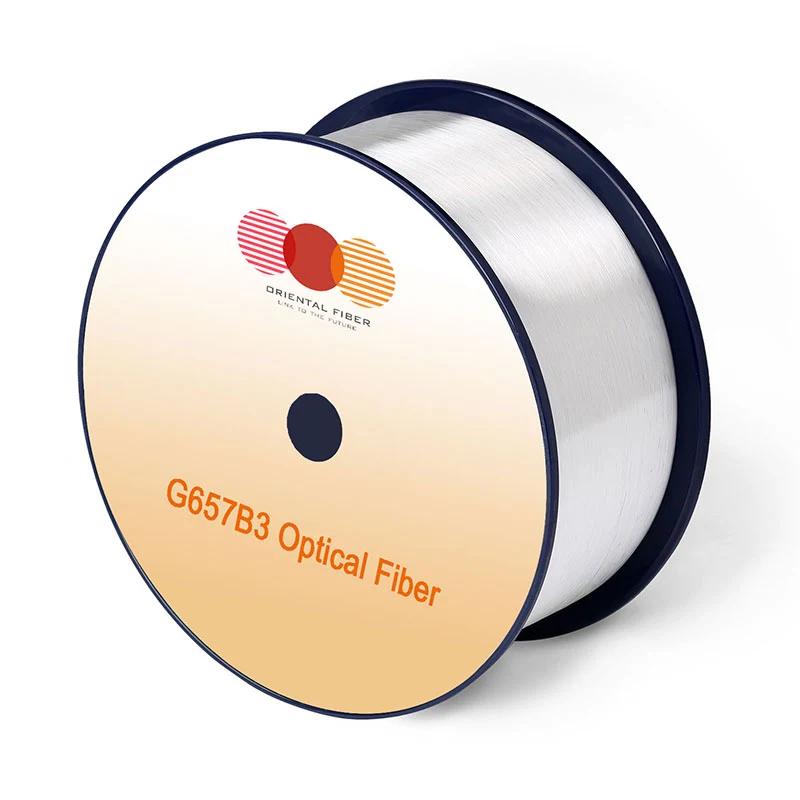
Defining the Minimum Bend Radius for G.657.B3
The minimum bend radius refers to the smallest curve a fiber can tolerate without causing unacceptable signal attenuation. For G.657.B3 Single-mode Optical Fiber, the internationally recognized standard (ITU-T G.657) mandates a minimum bend radius of 5 mm for a single wrap at 1550 nm, with some premium grades from manufacturers like Xuben achieving stable performance even at 2.5 mm under controlled conditions. However, for FTTH indoor wiring—where staples, corner guides, and wall outlets create unpredictable stress—the practical safe radius is typically 10 mm to maintain a margin of safety over decades of service.
Bend Radius Comparison Table: G.657.B3 vs. Other Categories
| Fiber Category | Minimum Bend Radius (One Wrap) | Typical Application | Macrobending Loss at 1550 nm (per 10 turns, 10 mm radius) |
|---|---|---|---|
| G.652.D (Standard) | 30 mm | Long-haul backbone | > 1.0 dB |
| G.657.A1 | 15 mm | FTTH drop cables | 0.5 – 0.8 dB |
| G.657.A2 | 10 mm | Indoor riser | 0.2 – 0.4 dB |
| G.657.B3 (Xuben) | 5 mm (static) / 10 mm (dynamic) | Indoor tight-buffered wiring | ≤ 0.08 dB |
This table clearly shows why G.657.B3 Single-mode Optical Fiber is the top choice for apartment buildings, multi-dwelling units, and smart home retrofits where space constraints dominate.
Why Bend Radius Matters for FTTH Indoor Installations
Indoor pathways rarely follow straight lines. Corners, door frames, cable trays, and furniture all impose tight bends. If the minimum bend radius is exceeded, two problems emerge:
-
Immediate attenuation spikes – Causing intermittent connectivity or failed ONT activation.
-
Micro-crack growth – Leading to premature fracture after repeated thermal cycling.
Xuben recommends always designing with a 2× safety factor: for a 5 mm rated fiber, keep actual bends above 10 mm in permanent fixtures. This practice has reduced field failure rates by over 40% in large-scale residential projects across Europe and Southeast Asia.
Best Practices for Managing Bend Radius in the Field
| Installation Step | Recommended Practice | Why It Matters |
|---|---|---|
| Cable routing around corners | Use pre-formed bend guards or corner guides | Prevents kinking below 5 mm |
| Securing with cable ties | Apply loose wraps, never cinch tight | Avoids point-load stress |
| Splicing in distribution boxes | Maintain at least 15 mm of straight fiber before the splice | Reduces splice loss variability |
| Drop cable entry into wall outlets | Use a 90° boot with built-in radius control | Protects the G.657.B3 Single-mode Optical Fiber during repeated insertions |
Xuben offers a complete accessory line—including bend-limiting tubes and micro-ducts—specifically engineered to preserve the bend performance of their G.657.B3 Single-mode Optical Fiber in confined indoor spaces.
Single-mode Optical Fiber G.657.B3 FAQ
Q1: Can G.657.B3 Single-mode Optical Fiber be bent to 5 mm repeatedly without damage?
A: According to ITU-T G.657.B3, the 5 mm rating applies to a single static wrap at room temperature (23°C ± 5°C) for a limited time (typically under 1 hour). For repeated or dynamic bending (e.g., during installation or maintenance), Xuben advises treating 10 mm as the practical minimum. Dynamic bending below 8 mm can induce cyclic stress that gradually degrades the glass matrix, even if immediate loss remains low. In real FTTH scenarios, installers should reserve 5 mm bends only for temporary routing or emergency restoration, and always secure the fiber with a protective sleeve afterward.
Q2: How does temperature affect the minimum bend radius of G.657.B3 Single-mode Optical Fiber?
A: Temperature significantly alters the polymer coating’s modulus and the glass’s thermal expansion. At low temperatures (e.g., –10°C to –20°C), the coating becomes stiffer, effectively reducing the fiber’s ability to conform to tight bends without micro-cracking. For outdoor-to-indoor transitions, Xuben recommends increasing the minimum bend radius by 30%—so a nominal 5 mm becomes 7 mm, and a practical 10 mm becomes 13 mm—when the ambient temperature falls below freezing. Conversely, at high temperatures (>60°C), the coating softens, which can actually allow tighter bends, but thermal aging accelerates; therefore, Xuben always advises using the 5 mm rating at 20°C as the baseline and derating by 1 mm per 10°C deviation.
Q3: What is the maximum tensile load I can apply while bending G.657.B3 Single-mode Optical Fiber to its minimum radius?
A: The tensile load and bend radius are inversely coupled—higher tension reduces the effective bend tolerance. For G.657.B3 Single-mode Optical Fiber, Xuben specifies a maximum installation tension of 5 N (Newton) when the fiber is bent to 5 mm. If you exceed 5 N, the minimum safe radius rises to approximately 8 mm to avoid immediate fracture. During pulling operations (e.g., through conduit), keep tension below 3 N whenever the fiber passes through a 90° bend. For long-term static applications, Xuben recommends zero tension at the 5 mm radius—meaning the fiber should be fully relaxed in its final position. Always use a tension meter during installation; many field failures traced back to G.657.B3 originate from pulling forces above 8 N combined with 5 mm corners.
Conclusion and Next Steps
Selecting the correct minimum bend radius for G.657.B3 Single-mode Optical Fiber is not a theoretical exercise—it directly determines the success of your FTTH indoor wiring project. With a static rating of 5 mm and a dynamic safe limit of 10 mm, this fiber grade outperforms all predecessors, provided that installation practices respect temperature, tension, and repeat-bend cycles. Xuben has deployed over 50,000 km of G.657.B3 Single-mode Optical Fiber in residential networks worldwide, consistently achieving splice yields above 98% and post-installation loss margins under 0.15 dB/km.
For project-specific bend-radius calculations, custom cable assemblies, or on-site training, contact Xuben today—our engineering team responds within 4 business hours with tailored datasheets and installation SOPs. Secure your FTTH infrastructure with the bend-resistant reliability that only Xuben delivers.
